
President Donald Trump and Boeing said Friday that China had agreed to order 200 of the company’s planes, potentially lifting the fortunes of the American jet manufacturer in one of the world’s largest aviation markets. But Chinese officials were noncommittal.
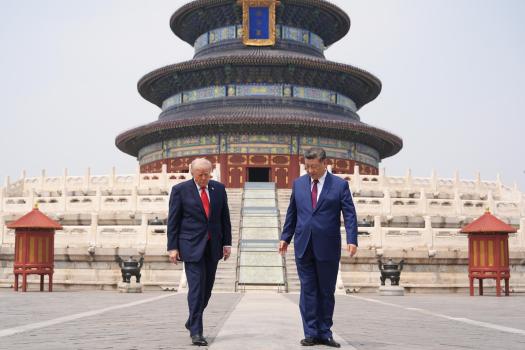
Aboard Air Force One on his way home from Beijing following two days of talks with Xi Jinping, China’s top leader, Trump said a large order would be placed for Boeing planes and General Electric jet engines, and an even larger aircraft order might follow.
“It’s approximately 400, 450 engines, 200 planes and a promise of up to 750 if they do a good job,” Trump told reporters on the plane.
Many hours later, on Friday afternoon, Boeing confirmed the order in a short statement.
“We had a very successful trip to China and accomplished our major goal of reopening the China market to orders for Boeing aircraft,” the company said. “This included an initial commitment for 200 aircraft and we expect further commitments will follow after this initial tranche.”
The order is the largest single sale of Boeing aircraft to customers in China in nearly a decade. But the company declined to provide details about the order, including which models it was selling and which Chinese airlines would purchase the aircraft.
The Chinese side has not made any announcements regarding whether it has agreed to purchase the aircraft or engines. When asked specifically after Trump had left Beijing whether there was any agreement for aircraft purchases, Guo Jiakun, a spokesperson for China’s Ministry of Foreign Affairs, responded that Sino-American trade ties were mutually beneficial.
“Both sides should jointly implement the important consensus reached by the two heads of state and inject more stability into China-U.S. economic and trade cooperation as well as the world economy,” he said.
Xi made a similar point when he said at an appearance with Trump before he left that they had “achieved a wide range of cooperative outcomes.”
Numerous predictions of a very large Boeing deal have preceded recent summits between the two countries’ leaders, but none have materialized. However, Trump’s comments represented the closest in nearly a decade that any American leader has come to saying a large deal was in place after a summit. In September 2024, the aircraft-leasing arm of state-owned China Development Bank did order 50 Boeing 737 MAX 8s, but separately from a summit.
Kelly Ortberg, Boeing’s CEO, was part of the delegation of American business leaders who traveled to Beijing with Trump.
Beijing has strategically pursued industrial self-reliance and worked to reduce its dependencies on the West. But in a handful of sectors, American and European companies still lead. One is commercial aviation, with Boeing and Europe’s Airbus competing for China’s enormous market.
Nearly 1 in 7 planes in use today flies in China, according to an analysis of figures from Cirium, an aviation data firm. Boeing projects that China’s jet fleet will double over the next 20 years to almost 10,000 planes.
Deliveries of Boeing planes to Chinese customers slowed significantly after two fatal crashes involving Boeing 737 MAX jets in 2018 and 2019. In Trump’s first term, the two countries struck an agreement in January 2020 that called for a sharp increase in Chinese purchases of American-manufactured goods, a target that could only be met through major purchases of Boeing jets.
Weeks later, China declared it could not comply with the agreement because of the COVID-19 pandemic, and, in April 2020, it canceled the purchase of 29 undelivered 737 MAX jets.
Although the 2020 agreement called for purchases from the United States to continue rising through 2025, China did not return to it, and discussions of aircraft purchases have proceeded slowly ever since.
Deliveries to China resumed in earnest in 2024, but stalled again last year when Chinese airlines, apparently on government instructions, warned of further delays in response to Trump’s tariffs. Shipments eventually restarted as trade tensions eased.
Boeing’s troubles in China have been a boon for Airbus, its European rival. Chinese customers have outstanding orders for nearly 500 Airbus jets, compared with fewer than 200 from Boeing, according to Cirium.
Unlike Boeing, Airbus yielded to Chinese pressure and has assembled its A320 single-aisle jet in Tianjin since 2008. The move has helped it gain market share but at the cost of helping China to begin developing the expertise to build its own jetliners. The Chinese government has bankrolled Comac, a state-owned company in Shanghai that makes a jet, the C919, that is described by aviation analysts as almost identical to the A320.
However, the C919 still uses many components from foreign companies, notably the engines and avionics.
For now, China’s rapidly growing aviation market is still dependent on Airbus and Boeing and the country will probably want planes from both manufacturers to avoid becoming too reliant on any one company, experts said.