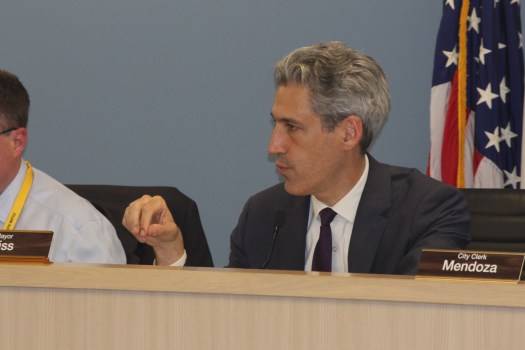

Following an exhaustive May 11 discussion that bled into the early hours of May 12, Evanston City Council voted to adopt the Housing4All plan, ending months of delays on implementing Evanston’s first milestone housing initiative intended to guide policy for the next 10 years.
Aldermen approved the 134-page housing plan in a 7-2 vote a little past midnight on Tuesday, with Ald. Clare Kelly, 1st, and Ald. Parielle Davis, 7th, dissenting.
While officials have stressed that the expansive plan itself is not a catch-all, it is designed to be a roadmap for future housing decisions, with three primary objectives: protecting residents from displacement, preserving up to 1,000 existing affordable housing units and creating up to 4,000 additional housing units in the city.
As outlined in the plan, rising housing costs have contributed to increased economic and racial segregation in Evanston, with its population of Black residents reportedly declining over the past 10-15 years.
With income disparities by race becoming more evident, equal housing access and stability remain at risk, according to the document. In 2025, 35% of all households in Evanston were estimated to be “cost-burdened,” spending more than 30% of their income on housing, with renters suffering the brunt of the burden.
Housing4All points toward several approaches the city can pursue to address these concerns, officials argue, including, but not limited to, strengthening renter protections, supporting transit-oriented development, increasing accessory dwelling units (ADUs) and updating existing zoning code for new housing.
Much of the discussion at the May 11 Council meeting centered around the 64 amendment proposals introduced since the plan was last up for a vote in April. At that time, it was tabled to give Council members additional time to draft more changes.
Amendments were only submitted by three of the nine Council members: Ald. Thomas Suffredin, 6th, Davis and Kelly, the latter of whom was responsible for the majority of additions, many of which concerned language around protecting residents against displacement and expanding the share of affordable housing to middle and low-income residents.
The Housing4All plan was unanimously recommended to City Council by the Housing and Community Development Committee (HCDC) back in February, but early versions of the document date back to the end of 2023.
In the hopes of streamlining what was anticipated to be a lengthy policy debate, City of Evanston Planning Manager Elizabeth “Liz” Williams proposed at the start of the discussion that Council members vote on a group of 10 amendments first.
That list, Williams told Council members on Monday, reflects the amendments “staff believe are consistent with other plans, such as the Comprehensive Plan (which passed in January) and the Housing and Community Development Committee’s review process that was undertaken.”
Those 10 amendments advanced rather quickly, with little resistance from Council members.
“Congratulations,” Williams teased. “You’re one sixth of the way there.”
But the efficiency would prove short lived, as debate over the remaining 54 amendments continued on for several hours.
Williams suggested Council vote on the remaining amendments in two groups: voting against a group of 33 the Community Development Department believed to be “potentially in conflict” with previously adopted city policies and a further discussion of the remaining 21 amendments to be voted on independently.
Aldermen, however, proceeded to pull out amendments one-by-one for discussion, a move that proved to create further division among Council members.
Kelly, who proposed a majority of the amendments, urged Council members to go back to the drawing board to have more “robust discussions” about the various objectives in the document.

“A little bit like Envision Evanston, this is really, really clumsy and a disservice to our residents,” Kelly voiced to Council members Monday.
“I think we should be having study sessions where we’re all together… .We should be talking about homeownership, about our Black population’s homeownership, gentrification… All we’re doing now is trying to clumsily go through some awkward language and we’re not having the kind of intellectual, critical discussion that we should be having.”
Ald. Juan Geracaris, 9th, countered Kelly’s argument, “I’ll reiterate, we had, it spent six months in HCDC, we’ve had these discussions.”
“I’m going to vote ‘no’ on all the extra amendments that we haven’t discussed,” Geracaris said. “We’re just muddying the waters at this point.”
Geracaris added that his decision to vote against the amendments was made in part because a “majority” of them looked to “weaken any talk of upzoning,” the process of updating local zoning codes to allow for increased building density in a specific area or neighborhood.
Geracaris, along with Ald. Jonathan Nieuwsma, 4th, Ald. Krissie Harris, 2nd, Ald. Shawn Iles, 3rd, and Ald. Bobby Burns, 5th, previously voiced support for greater housing density proposals.
The Council proceeded to review the amendments piece by piece.“I don’t think I should have to do this… I would have much rather been doing something else, but I care deeply about this community and about displacement first and foremost and that is not adequately addressed in this document,” Kelly said in defense of her effort to add the new amendments.
“I ask that we please look into long-term homeownership, the impacts of gentrification like other cities have…this is what I fear most, the fact that we can’t even name gentrification and talk about it? It’s not passé,” she said.
Kelly then added that she’d like to see increased specificity around the document’s discussion of the areas in the city from which residents are most threatened to be displaced.
“If we’re not going to talk about it, how are we going to hold ourselves accountable?”
But only a fraction of Kelly’s amendments — 16 and a half of one amendment — ultimately prevailed, with several never coming to a full vote because Kelly herself decided to skip them or they failed to receive a second motion from other Council members.
Conversations extended into Tuesday morning, with City Council eventually approving the amended housing plan a little before 1 a.m.“This is actually a really exciting and big moment and a chance for us to move on to the next steps in the monumentally important work of expanding affordable housing throughout Evanston,” said Mayor Daniel Biss following the vote.
City Council will now move to update Evanston’s zoning code to reflect the new changes introduced in the Housing4All plan. A preliminary date for that has not yet been set.