
Leadership from BP and United Steelworkers Local 7-1 will return to the bargaining table at 9 a.m. Friday to continue contract negotiations.
“The parties discussed reviewing each other’s proposals, identifying the remaining issues, and getting back to the table,” a union statement said after Monday’s negotiations. “USW Local 7-1 remains committed to bargaining for a fair agreement.”
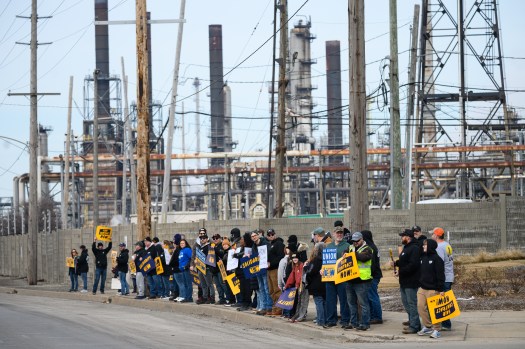
BP announced that bargaining would resume in a Wednesday statement. The two parties met Monday morning, but bargaining stalled after USW leadership asked BP to end the lockout of more than 800 union workers without requiring acceptance of its March 17 contract proposal.
“We hope to have meaningful dialogue to reach an agreement for a sustainable future for our employees, the refinery and the community,” said a Wednesday statement from BP.
USW International President Roxanne Brown expressed her distaste for the lockout in a phone call with the Post-Tribune Wednesday morning.
“The refinery is not running in a way that is safe for the community because our members are the one with the knowledge and skills to run it most safely and efficiently,” Brown said. “The lockout that our members are experiencing at BP is just horrendous and is solidly based in corporate greed, and is a blatant disregard for our members who work at the refinery. … It’s a blatant disregard for the community as well.”
The company alleged Monday that the union “chose to leave the bargaining table without meaningfully engaging on the issues that remain unresolved,” and they were “unwilling to resume meaningful discussions on items critical” to the Whiting refinery’s future.
According to Post-Tribune archives, USW alleged that the company wouldn’t provide a “direct yes-or-no answer” to its question about the lockout’s end, and company leadership repeated they were “here to bargain.”
“The company is trying to use mortgage payments, grocery bills, health care worries, and family pressure as bargaining leverage. British Petroleum is trying to win at the kitchen table what it could not win at the bargaining table,” USW Local 7-1 President Eric Schultz said in a statement. “We are ready to bargain, but British Petroleum should stop using this lockout to pressure workers and their families into accepting concessions.”
With its March 17 proposal, BP claims that it would offer modernized job structures, enhanced training and upskilling, a six-year agreement, a $2,500 lump sum bonus after ratification, additional lump sum payments between $5,000 and $7,500 for “certain classifications,” wage increases, annual cash bonus opportunity, simplified local work rules and an 150-day notice requirement for intents to strike or lockout.
The union claims BP’s proposal would eliminate more than 100 local jobs, reduce pay, include sweeping management rights language and seniority issues. According to Post-Tribune archives, the company also proposed eliminating maintenance and environmental jobs.
BP and USW started negotiations for a new collective bargaining agreement on Jan. 5, and its former one expired Jan. 31. The union operated under a three-year agreement, according to Post-Tribune archives.
According to BP, the company and union have had more than 60 face-to-face discussions. Monday’s meeting was the parties’ first since March 17.
Brown said she appreciates the Northwest Indiana community members who have supported USW 7-1 during the lockout, and she’s hopeful that BP and the union come to an agreement.
“There is a deep solidarity in Northwest Indiana,” Brown said. “We’re hopeful every time we go back to the table that they’re coming back in an earnest way, to come together and arrive at an agreement that is fair and respectful.”