

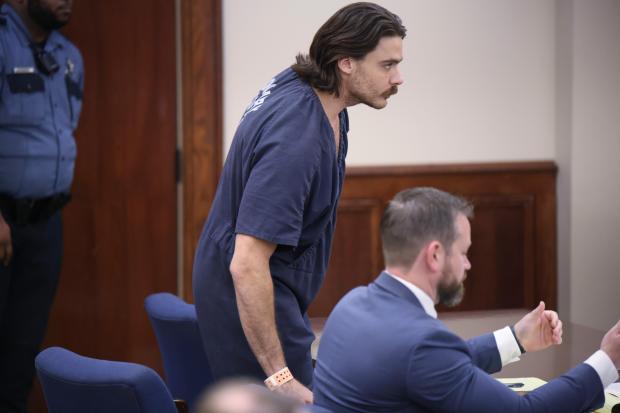
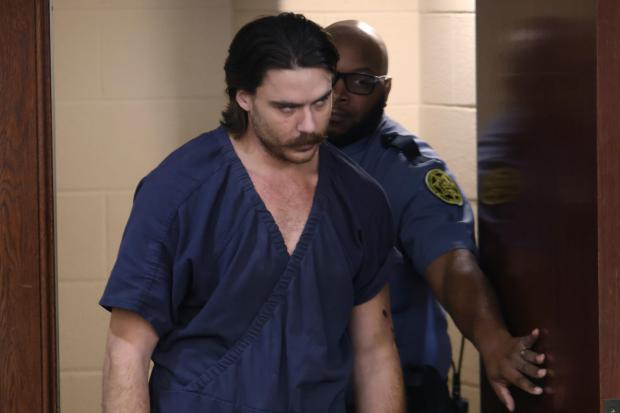
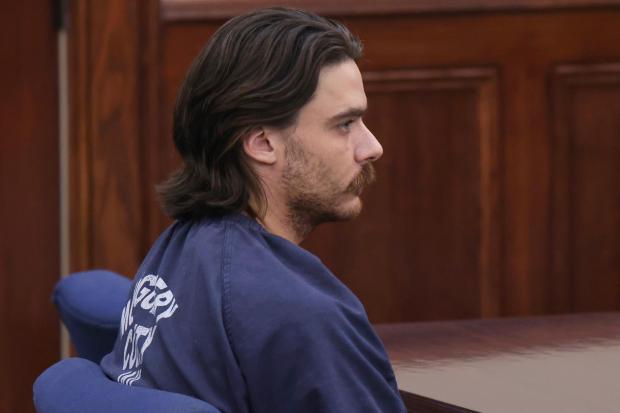

CLARKSVILLE, Tenn. — A judge on Thursday set a $1 million bond for a white livestreamer charged with attempted murder for allegedly shooting and wounding a Black man, in a case that has stoked debate over the extents of free speech and the rights of content creators who profit from hate-filled interactions.
Dalton Eatherly, who livestreams as “Chud the Builder,” is charged in the May 13 shooting of Joshua Fox outside of the Montgomery County Courthouse in Clarksville, a Tennessee city of about 165,000 people not far from Kentucky.
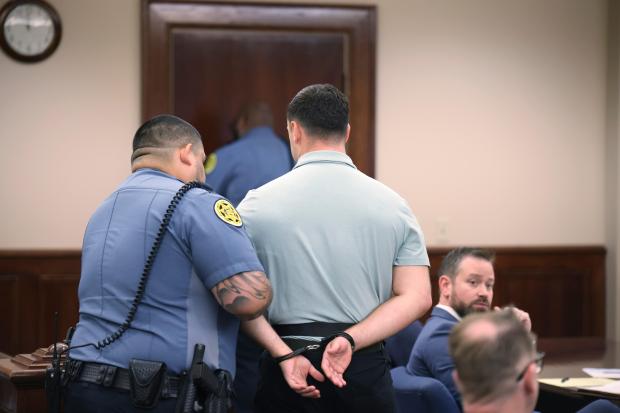
Judge H. Reid Poland III forbade attendees at the hearing from using electronic devices and interfering in any way with the proceedings, and he ordered several people from the courtroom, including conservative activist Jake Lang, who was led out in handcuffs.
Eatherly’s attorney, Jacob Fendley, declined to comment on the charges when reached two days after the livestreamer’s arrest. But he asked people to stop harassing him and his staff, saying even though he’s defending Eatherly, he finds his online content objectionable.
The case has drawn interest, with Eatherly raising more than $100,000 for his legal defense in a single day on a fundraising site. It is reminiscent of an incident from a year ago in which a white Minnesota woman was captured on cellphone video admitting to calling a child a racist slur. She amassed over $800,000 on a crowdfunding site and also pointed to her First Amendment rights.
A blurring of the lines
As more livestreamers find that being performative with bigoted language can draw big audiences — and big bucks — the line is blurring between freedom of expression and people’s right to feel safe. Even within livestreaming communities, some assert they have a right to say whatever they want to and to make money, while others support having boundaries.
Racial justice advocates worry that allowing people to profit from such videos only encourages and normalizes racist and otherwise shocking antics. As for regulation, social media can sometimes feel lawless, as it’s generally left to platforms to self-regulate and hold users accountable for obscene and abusive words. But at some point, laws for offline behavior can trump online freedoms, experts say.
According to the criminal complaint, Eatherly, 28, and Fox initially were involved in a verbal altercation. Eatherly reached for a gun inside his right jacket pocket and the two men started to fight. Fox was shot multiple times and later underwent emergency surgery at a hospital.
In an audio stream apparently Eatherly recorded just after the shooting and later posted online, he said he fired in self-defense.
Freedom of speech or hate speech?
Eatherly has defended his videos on the crowdsourcing site as “mild jokes, unfiltered thoughts.” While he has sometimes defended using a racial slur as “edgy, harmless humor,” Eatherly wrote, “I know it’s controversial, but it’s my right to speak freely.”
But legal experts say not all speech is protected.
Speaking generally about Eatherly’s social media offerings, David Raybin, a criminal defense attorney and former prosecutor, said although Eatherly repeatedly references free speech in the posts, his actions in them may actually be crimes under Tennessee law. Because Eatherly was known to openly carry a pistol while berating people, the combination could constitute assault, he said.
“You don’t have to touch someone,” Raybin said. Assault can be charged if you “create fear of imminent harm.”
Brandon Tucker, senior director of government affairs for civil rights organization Color of Change, said “race-baiting” content creates immediate risk for Black bystanders. There’s a “power imbalance” with a livestreamer who is attracting an audience.
“The same free speech that this individual wants to advocate for doesn’t recognize the chilling of my response to know that I cannot react in any reasonable way because my face, my safety, my family’s safety is in jeopardy and being broadcast to an audience that most likely aligns with this person’s views,” Tucker said.
These streaming platforms cannot claim neutrality if they’re essentially financially rewarding users for using racist language to agitate, he said.
Even some other livestreamers say Eatherly crosses the line.
“When you get to terrorizing and doing all this hate speech, that’s when the line gets drawn, especially when nobody is bothering you,” said James Champion, a 41-year-old Los Angeles-based livestreamer and content creator who goes by the preferred online moniker SendaRoni Sloscru. “Whatever platform is allowing him to get away with that is basically race-baiting, and I just think in this day and time you got people who are going to laugh at it or people who will beat you to death about it.”
Platform regulation can feel like the ‘Wild West’
Eatherly was streaming on Pump.fun, a platform where users create and trade cryptocurrency tokens. Token creators have used the livestream feature to gain notice in some outrageous ways, such as by performing dangerous stunts and threatening violence. In November 2024, Pump.fun paused the feature because people were violating its terms of service by uploading abusive, obscene or dishonest messages.
“It’s not clear what was done to improve that situation before it was reinstated,” said Kate Ruane, director of the free expression program at the Center for Democracy and Technology. “If you’re relying on users to report and none of the users that are viewing these livestreams disagree or have a problem with what they’re seeing, you might not be getting the user reports that you should.”
Representatives for Pump.fun didn’t respond to a Wednesday email seeking comment.
Brandon Golob, a criminology, law and society professor at University of California, Irvine, said the number of livestreaming platforms has grown, but self-regulation can still feel like ‘the Wild West.’
The First Amendment, however, is not a blanket shield from real-world laws against harassment, hate crimes and provocation.
“The reality is that when it involves two private individuals, state law is going to govern,” Golob said. “We just want to make sure that we’re not conflating government responsibility or government censorship with private accountability.”
SendaRoni said he’s been livestreaming for a few years and has “tens of thousands” of followers across a number of social media platforms.
“I usually talk about social issues. I speak on trending events, news,” he said, adding that a number of livestreamers addressed Eatherly’s antics following the shooting in Clarksville.
“I think he tried to find people he’d get a reaction out of,” SendaRoni said. “When you do things such as that the end results are not going to be exciting. You’re acting like no one has a reason not to be disgusted and you made a mockery of yourself.”
Leading livestream platforms such as YouTube and Twitch do have an infrastructure for content moderation — and community guidelines barring hate speech and slurs. They utilize automated detection and user reports.
Both Golob and Ruane advise people to know their rights on how to handle livestreamers who are making them uncomfortable. Ruane says it’s OK “to film them right back.”
“Make sure that you’re sharing a different version of the story because whatever First Amendment rights they might be exercising, you have them too,” Ruane said. “Make sure that is being published at the same time and that can serve as a form of pushback in and of itself.”
Tang reported from Phoenix and Williams from Detroit. Associated Press reporter Travis Loller in Nashville contributed to this story.


