Longtime Hyde Park resident Bennie Currie has for years pictured his neighborhood as a destination for young people. But he has hot dogs and stoop-sitting on his mind, not tactical officers and blue lights.
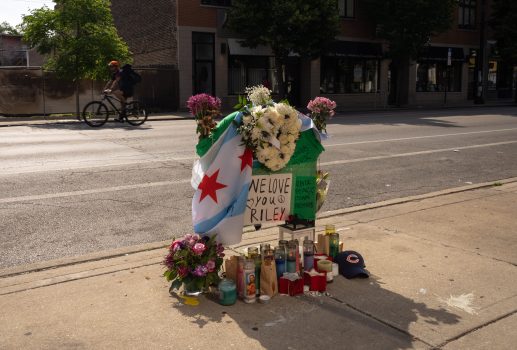
After word spread that a so-called teen trend — a massive and sometimes violent meetup advertised online — was planned for Hyde Park in April, Currie took part in a counter-gathering to meet potential chaos in the neighborhood, which he believes helped prevent the kind of large gathering that ended the life of a “vibrant” 14-year-old late last year.
Though the group Currie helped marshal was dubbed a “parent takeover,” the Hyde Parker objected to that moniker: “We’re not taking over anything. We live here,” he said. “What I do want for us is to create a visible, positive, deterrent presence the next time we hear one of these takeovers is supposed to happen.”
He is one of many Chicagoans, from Mayor Brandon Johnson and police Superintendent Larry Snelling on down, who are pondering the best way to respond to the “trends,” which have become increasingly common since the COVID-19 pandemic and often take place in some of the city’s wealthiest, most visible neighborhoods.
Though the congregating teens are the marquee issue as another summer arrives in Chicago, they’re only the tip of the iceberg as the city looks to sustain steep drops in crime through familiar, proactive offerings like summer job programs and organized recreational activities and shifting focus onto newly prominent types of criminal activity, like a spike in motor vehicle thefts.
This summer coincides with personnel shakeups on Johnson’s public safety team and within the Chicago Police Department: Chief of Patrol Jon Hein, effectively the department’s second-in-command who manages the department’s backbone of patrol officers, is set to retire Monday, June 1. And Johnson has a new deputy mayor for community safety, Emmanuel Andre, hired in April following the abrupt ouster of Garien Gatewood.
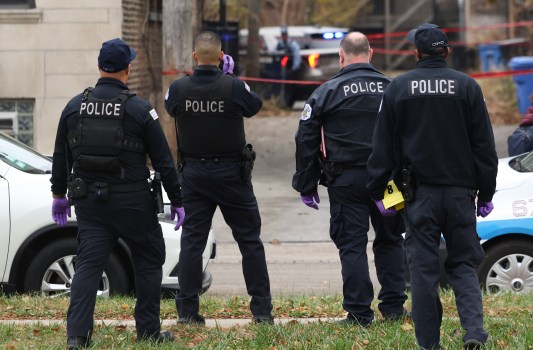
Work to head off violence began kicked into a higher gear over the holiday weekend, which marked the unofficial start of summer.3 wounded during large gathering of teens Memorial Day in Hyde Park
Between Friday evening and Monday afternoon, the city saw 26 people shot, including two shootings that police were treating as death investigations. One mass gathering left five police officers hospitalized after a car plowed into a crowd they were trying to clear on the Near West Side.
Andre, speaking in the Back of the Yards neighborhood last week just before city officials discussed a battery of summer safety precautions and opportunities meant to help prevent shootings and other kinds of violence that unfolded early Sunday morning, said he saw that “the city is desperate for creative responses (to trends) and we’ll continue to look at and review creative responses.”
But, he cautioned, “We’re not going to arrest our way out of (them).”
Creating chaos
Snelling, speaking to the City Club of Chicago on Wednesday, said droves of young people come to enjoy the city’s downtown and other high-traffic areas every day with no incident. The “trends,” he said, are something else altogether.
“These are young people who are coming together to create chaos,” he said. “That is the actual goal. People need to understand that.”
“The failure here,” he said, was that “we don’t put accountability on teenagers, because teenagers need it more than anybody.”
He called for greater consequences for the teenagers who take part in the gatherings, both from their parents and in the public conversation that they tend to set off.
“I think it’s an insult to young people, especially young, inner-city kids — I was one — to say that they shouldn’t be held accountable for this,” he said. “Because what we’re actually saying is, they don’t have the intellect to be able to determine right from wrong.”

Johnson, in keeping with his administration’s focus on funneling resources to address factors behind violent crime before they start, said he thought “the greatest incentive” the city could offer families whose children might make their way to trends was “making sure that parents know that we are investing in their young people and there’s somewhere for them to go in a constructive, safe, fun space.”
Some of those opportunities will be available through Chicago Youth Works, which pays Chicagoans between the ages of 14 and 24 to work for local entities like the Lincoln Park Zoo and the Forest Preserves of Cook County, along with larger private companies such as JPMorgan Chase. Department of Family and Support Services Commissioner Angela Green said there would be 29,000 such opportunities open for the summer.
The city will also continue its “My Chi. My Future. Safe Spaces for Youth” program, which Green said would host 80 youth-led “kickback” events this year. These events can be found on the initiative’s mobile app, which also promotes programs led by other community organizations, such as My Block, My Hood, My City’s July 11 “Downtown Day.” Kids who attend this event will be given a $50 prepaid debit card to enjoy cultural and recreational activities downtown, according to the organization’s website.
Snelling kept the focus on preparation for major summer events like the opening of the Obama Presidential Center, canceled days off for Memorial Day weekend and brought additional manpower to the city’s highest-traffic recreational sites like beaches. He left it to Johnson to make the point he’d argued before the City Club a day earlier.
“At some point, adults have to work hard to help raise their children,” Johnson said. “If anyone believes this effort is solely the responsibility of the government, they’re mistaken.”
Resisting the takeovers
Currie, the Hyde Parker, warned that if the city hopes to see a decline in teen trends this summer, having as many adults outside acting as “goodwill greeters” is critical.
It’s a philosophy he has put to work over the last seven years as the founder of CollaBOOration, a community-led violence prevention network. And on April 14, when credible reports of a teen trend brewing in Hyde Park dissolved into nothing, he saw his longtime strategy succeed.

A few days prior, as flyers circulated on social media encouraging teens to bring their own beer and weed for a “Hyde Park takeover,” the neighborhood began to brace for another chaotic evening. Discussions of the impending trend and how to prevent it extended beyond the city and into suburban circles, where some parents noted that kids planned to travel to join in.
Responding to online posts advertising a “parent takeover,” droves of parents and other adult community members gathered at a 53rd Street coffee shop. From there, they walked down nearby sidewalks and by the lakefront, following teens closely at times in what event organizers said were attempts to engage them in conversation.
Though he did not plan the event, and preferred to call it a “convergence” rather than a “parent takeover,” Currie marshaled his usual crew of volunteers to join in.
He said he watched as teens opted to patronize local businesses rather than engage in dangerous behavior. Others scattered at the sight of their principals and teachers, many of whom came from nearby Kenwood Academy High School.
After another “trend” in Hyde Park led to aggravated battery charges against a 14-year-old girl, Currie has accelerated his efforts is working to better organize parents for the summer months ahead. Maintaining the energy around violence prevention is a must, he said.
He plans to hold a large meeting at his Lutheran church next week to inform his neighbors on how to effectively engage teens, rather than treating them antagonistically. He hopes to highlight the need to create safe spaces for kids to hang out, especially considering some local restaurants restrict them from visiting without a parent, he said.
Whenever someone tells Currie they want to participate in the cause, he immediately takes down their contact information, adds them to a GroupMe and sends them a document outlining guidelines for “what this is about and what it’s not about,” with an emphasis on preventing police involvement whenever possible.
“Not everything is a 911 situation,” he said.
For Julie Less, who has lived in Hyde Park since the 1970s and worked closely with youths for many years, the path to preventing violence proves impossible without ensuring kids are entertained. She pointed to the decline of third spaces like malls and recreational activities as the primary reason teen gatherings grow out of hand, adding that increased police presence can incubate disruptive behavior.
Less serves as a board member for The Blue Gargoyle, a youth service center aimed at cultivating community and employability skills as a means of violence prevention.
In the past, she and Currie have helped bring makeup artists, drum circles and supervised parties to Hyde Park so teens have somewhere to go. During the summer, when most parents are at work and many youth programs are geared toward younger children, the need for free organized activities becomes even greater, she said.
“They’re coming whether you like it or not,” Less said. “Why can’t we give them something positive to do?”
The work continues
Data updated through May 17 shows that while the city has seen eight more murders year-to-date than took place last year, overall violent crime levels have remained largely flat compared with the same period in 2025 and dramatically lower than totals coming out of the pandemic.

But new hurdles have also emerged. COVID-era funding that helped pay for a surge in community violence intervention programs has largely expired, while the Trump administration has clawed back millions in funds that were earmarked for violence prevention organizations, forcing some to lay off employees.
At the state level, budgeting woes led to deep cuts for organizations that support the survivors of homicide victims — considered one of the most important ways to prevent violence from metastasizing — and sparking fears that the city and its suburbs would backslide on the reduction in shootings and murders.
While the takeovers in the city’s highest-visibility areas are dominating the conversation about summer safety, the reality is that most of the season’s violence will occur far from places like North Avenue Beach or the Loop.

For the second year running, a tiny piece of the city’s West Side miles from downtown — Beat 1114, in the city’s Harrison (11th) police district — has experienced the highest frequency of shootings anywhere in Chicago, with 24.1 shootings for every 10,000 people this year, city data shows. That’s a drop from the same time frame last year, when there were almost 29 shootings per 10,000 people.
South Shore residents who attended a Wednesday beat meeting told their community policing officers that they were worried about teen trends, but not just the ones in Hyde Park or the Loop — there had been talk of planned gatherings at 77th and Jeffery and another at 78th and Ridgeland, neither of which materialized.
And in the meantime, while she was concerned about the “trends,” one woman wanted to know if CPD could have enough bandwidth to respond to her and her neighbors’ calls about a broad-daylight package thief within an hour of them calling 911.
Andre, questioned Thursday about how city leaders could strike the balance between high-profile issues like the takeovers and more day-by-day, quality-of-life public safety issues, said some of the solution lay in “a collective approach, so we can focus the appropriate resources and appropriate responses.”
There was also the matter of making sure people called nonemergency services for the correct concerns so that first responders were free to respond to urgent calls for help, he continued. But he said his message to that woman and those who shared her concerns was “you are not forgotten.”
And as Andre, Johnson, Snelling and other officials gathered in Back of the Yards on Thursday, a 13-year-old boy was shot in the the head in the South Chicago neighborhood. Just a few blocks from Sherman Park, where the news conference took place, a spate of shootings and a fatal hit-and-run rattled a stretch of West 50th Street weeks earlier.
For the organizations tasked with helping prevent violence in the city’s neighborhoods, summer is a test and a continuation of the work they do year-round. Samuel Castro, whose organization Institute for Nonviolence helped respond to the rash of shootings along 50th Street earlier this month, said he and his colleagues were looking to keep up their momentum from last year’s drop in shootings.
“We’re not done,” Castro said. “We are not on autopilot.”
In response to increased violence in Area 1, which covers Back of the Yards, Castro said his organization had added an extra day to the schedule for “peacekeepers” — people with strong ties to street violence paid to prevent and deescalate conflicts — and extended hours and days for the group’s professional outreach workers.
The Rev. David Kelly, the executive director of Precious Blood Ministry of Reconciliation, which responded to the 50th Street shootings alongside the Institute for Nonviolence, said his organization would continue to offer open, drop-in spaces for kids and families in the neighborhood to spend time, put on local events and push for more structured activities and programming in the neighborhood for young people in particular.
Regular Chicagoans, he said, could help by “coming out and just being engaged with our young people.”
“Too many people are afraid of these kids,” he said. But getting to know them, Kelly continued, is often the thing that makes the most difference: “It’s hard for a kid to act out when the community is out there with him or her.”
This story has been updated to clarify that the summer youth initiative called “Downtown Day” is led by My Block, My Hood, My City.