
Townhomes that could cost as much as $1.45 million have been proposed for the northwest corner of Spring Avenue and Mill Street just off downtown Naperville.
The “Ostara” townhomes would be built on a site that was once home to a 30,000-square-foot warehouse and three single-family homes, some of which were being used for office space, according to plans to be reviewed June 17 by the city’s Planning and Zoning Commission.
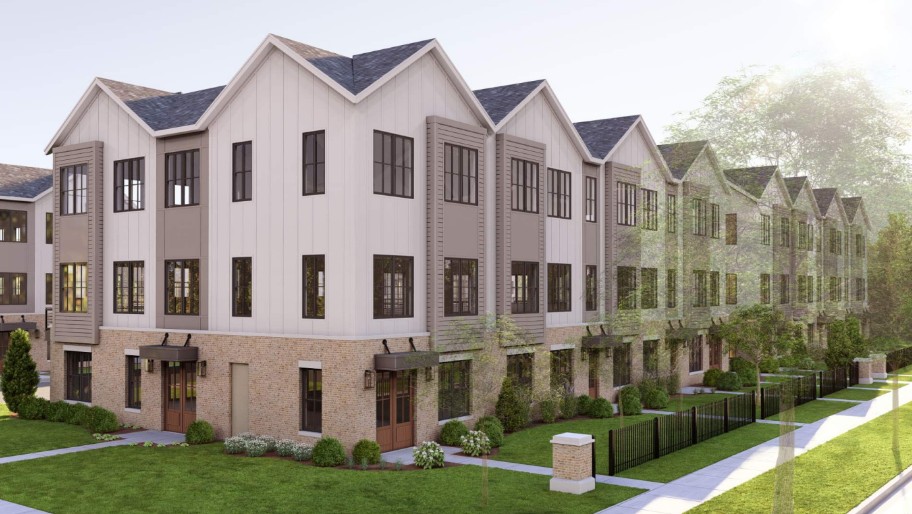
Each of the 25 three-story townhouse would range in size from 2,900 square feet to 3,400 square feet and include three bedrooms, four bathrooms, a two-car garage and a second-floor balcony.
Prices would range from $1.37 million to $1.45 million. A homeowner’s association would be responsible for all exterior maintenance, landscaping and snow removal.
The development, which sits on 2.3 acres of land, would serve as a buffer between the neighborhood and the Metra BNSF railroad tracks north of the property.
Duplex homes and a residential neighborhood surround the southern part of the site. An auto repair shop is located to the east and a concrete manufacturing facility to the west.
“The Spring Avenue corridor possesses a unique location within the city that is highly favorable for residential development,” the proposal said. “The corridor has great potential to act as a model pedestrian environment due to its proximity to a variety of destination uses that cater to foot traffic.”
Developer Richard Kramer of Kramer Homes is no stranger to the area.

He lives close to the site and used to operate out of the warehouse before it was torn down last year, according to Jimmy Calvo, attorney for the project. He has built hundreds of homes in Naperville, including in the White Eagle community, the proposal said.
“He was very familiar with the parcel, he buys it and the city is telling him, ‘Hey, you can’t keep operating this warehouse here, we’ll give you a couple extensions, but you eventually need to stop operating this warehouse. We want this to be converted to residential,” Calvo said.
The area was rezoned in 2008 from industrial to residential use, prior to Kramer moving his office into the building. Part of the reason the area was rezoned was to address resident concerns about truck traffic, noise, pedestrian safety, poor street conditions and property maintenance, officials said.
The city’s land use master plan calls for low- and medium-density residential development in the corridor, making the warehouse inconsistent.
With the buildings now torn down, Kramer thought building townhomes there made sense, Calvo said.
Initially, Kramer’s proposal required a density variance from the city to allow 26 townhomes to be built. That plan was scrapped after residents expressed concerns about it in January.
“He went back to the drawing board and worked carefully through the feedback point by point,” Calvo said. “The result was a substantial reworking of the project.”
Kramer redrew the site plan so the townhomes face the streets, replaced flat roofs with gabled roofs, and added decorative fencing and interior sidewalks, he said.
The result is a townhome community that feels more walkable and in line with the current residential community, Calvo said.
“This neighborhood is a fantastic neighborhood and they are very passionate about what goes in there,” he said.
Kramer needs one variance from the city — a change in the rear yard setback for some of the lots in the northern section of the property. If approved, the rear yard setbacks would be 12 feet, 14 feet and 22 feet.
“The lots in the northern-most part of the property, closest to the train tracks, encroach what is normally a 25-foot setback,” Calvo said. “We’re asking … to be able to encroach on that 25 feet a little bit because it’s up against the tracks and it’s not going to impact any of the neighbors.”
Kramer also needs city approval for a conditional use to allow for single-family attached dwellings, according to the proposal.
cstein@chicagotribune.com