


There’s something addictive about it. Sitting in bed late at night watching one 30-second clip after another. Bright, blue light illuminating the room.
Whipping out a camera the moment a restaurant server brings a meal or a favorite performer appears onstage. Succumbing to the urge to scroll Instagram the second conversation grows quiet or social awkwardness creeps in.
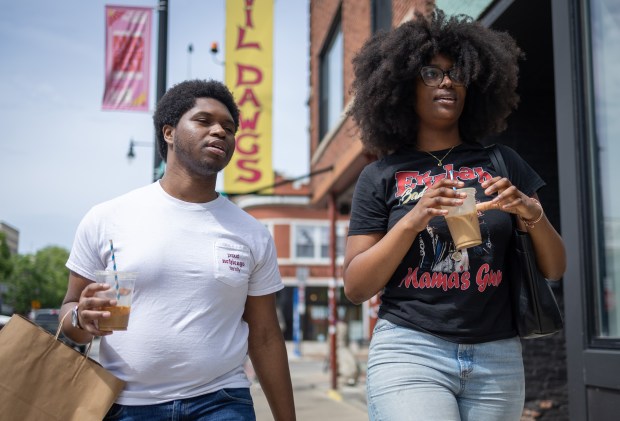
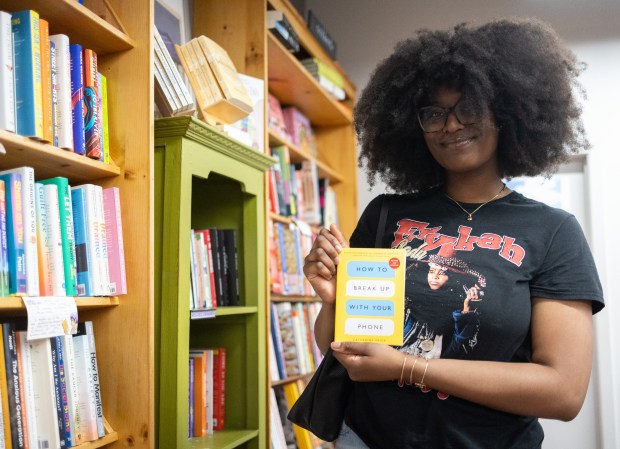
The alarm bells began to ring in recent Loyola University graduate Kamryn McPhaul’s head when she realized a third of her waking life was spent on her cellphone.
She, like so many others, craved the “cheap hits of dopamine,” the sense of mindless joy she received from watching a short video only to forget it moments later.
Earlier this year, she decided enough was enough.
Goodbye to Instagram and Snapchat; hello to sightseeing adventures, solo trips to the movies and hours spent at the Art Institute. The moment McPhaul installed a “permanent black-and-white filter” on her screen and deleted all her social media apps, she felt something shift. She doesn’t plan on going back.
While McPhaul’s mission to curb her screen time has been an individual endeavor, others are increasingly seeking out social spaces to join like-minded people hoping to unplug. The number of phone-free experiences grew by 567% globally in 2024 and 2025, according to Eventbrite, a platform where organizers can advertise events.
In Chicago, this trend has taken various forms: everything from creative spaces relegating devices to cotton bags and locked boxes to phone-free raves moshing into the morning’s wee hours.
Some of these events are planned and attended by young adults, most of whom hardly remember a world before instantaneous digital communication. In many cases, phone-free parties emerge in the form of novelty pop-ups, advertised as a chance to escape the pressures of an ever-demanding online universe.
“Some people want to let loose and be free and they don’t want to be filmed while they’re doing that,” said 29-year-old Samantha Boehlen, an event producer who helped plan multiple phone-free dance parties around the city.
‘How all of our parents hung out’
After acquiring her first iPhone at 13, Olivia Gork spent most of her young life wondering what a party free of digital disruption would look like.
She dreamed of dance floors packed with crowds who let music move through them. Bars where people entered as strangers and left as friends. But the more she went out, the more she realized phones inherently stood in the way of the experience she longed to have.
“I was ending the night just being like: Where were we?” Gork said. “Were we just capturing the moments or were we living them?”
Unbeknownst to her, Gork’s vision was one she shared with event producer Chinaecherem Nwaubani, whom she met at North Coast Music Festival in 2024. Now business partners, the pair founded an agency, Saturnalia, to plan “otherworldly phone free(dom) gatherings.”
Back in December, they hosted their first and only party to date at Fulton Street Collective, a West Town art gallery and event space. The event, with bright colorful fabrics draped from the ceiling, drew a crowd of more than 100 people, Nwaubani said.
Some came with friends and others came alone, but all followed the night’s one rule: Phones must be kept in a locked box by the entrance.
“We debated putting them in little pouches, but something for me is that I just hate being encumbered and I was just like, what is a way that everyone can be as unencumbered as possible?” Gork, now 23, said. “I think the phone just needs to be completely locked up.”
The zero-tolerance phone policy brought people together in ways even Gork and Nwaubani couldn’t have predicted. They were particularly struck by a moment when a group gathered to play chess with a security guard, and the fact that one attendee got so caught up in being screen-free, she forgot her phone at the venue when she departed for the night.
“This is how all of our parents hung out,” Nwaubani said. “There was a time not that long ago where this was just normal.”
Boehlen, the 29-year-old event producer whose work ranges from creative collage clubs to nightlife, said she wishes she had been “more stringent” about phone usage when she helped plan a January dance party in Wicker Park.
Over the years, she has advertised many of her events as being “phone-free,” but unlike the owners of Saturnalia, she never enforced the rule as anything more than a friendly suggestion.
Recently, she said, she attended a few events that weren’t marketed as screen-free, but ended up operating that way once she arrived. She recalled a concert’s policy of storing phones in automatically sealed bags as something that could be a good idea for her future functions.
“I think people can use their phone as a crutch,” Boehlen said. “It’s very easy to look down at your phone and just scroll or answer a text message, rather than sitting in that uncomfortability.”
Phone-free creative spaces
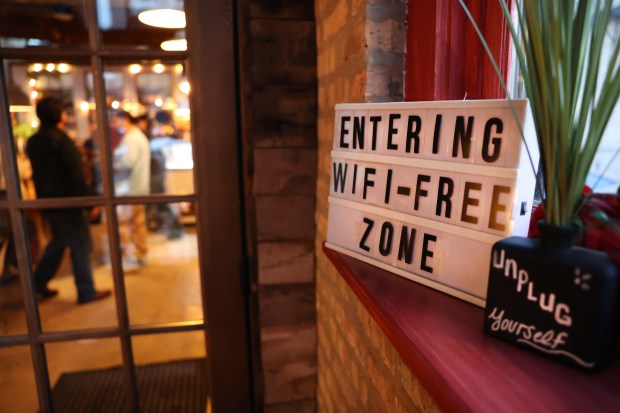
For some, the notion of unplugging isn’t a new idea. With its eclectic collection of vinyl records and board games, Kibbitznest, a WiFi-free book bar in Lincoln Park, has been capturing the fancies of those seeking a digital detox for nearly a decade.
While phones are technically permitted inside, those visiting find themselves hard-pressed to spot anyone choosing to use them. Instead, groups gather on comfortable furniture and chat while sipping cocktails and dealing playing cards. The dark interior features walls covered with books of every genre, encouraging those who enter to keep their laptop tucked away for the sake of the written word.
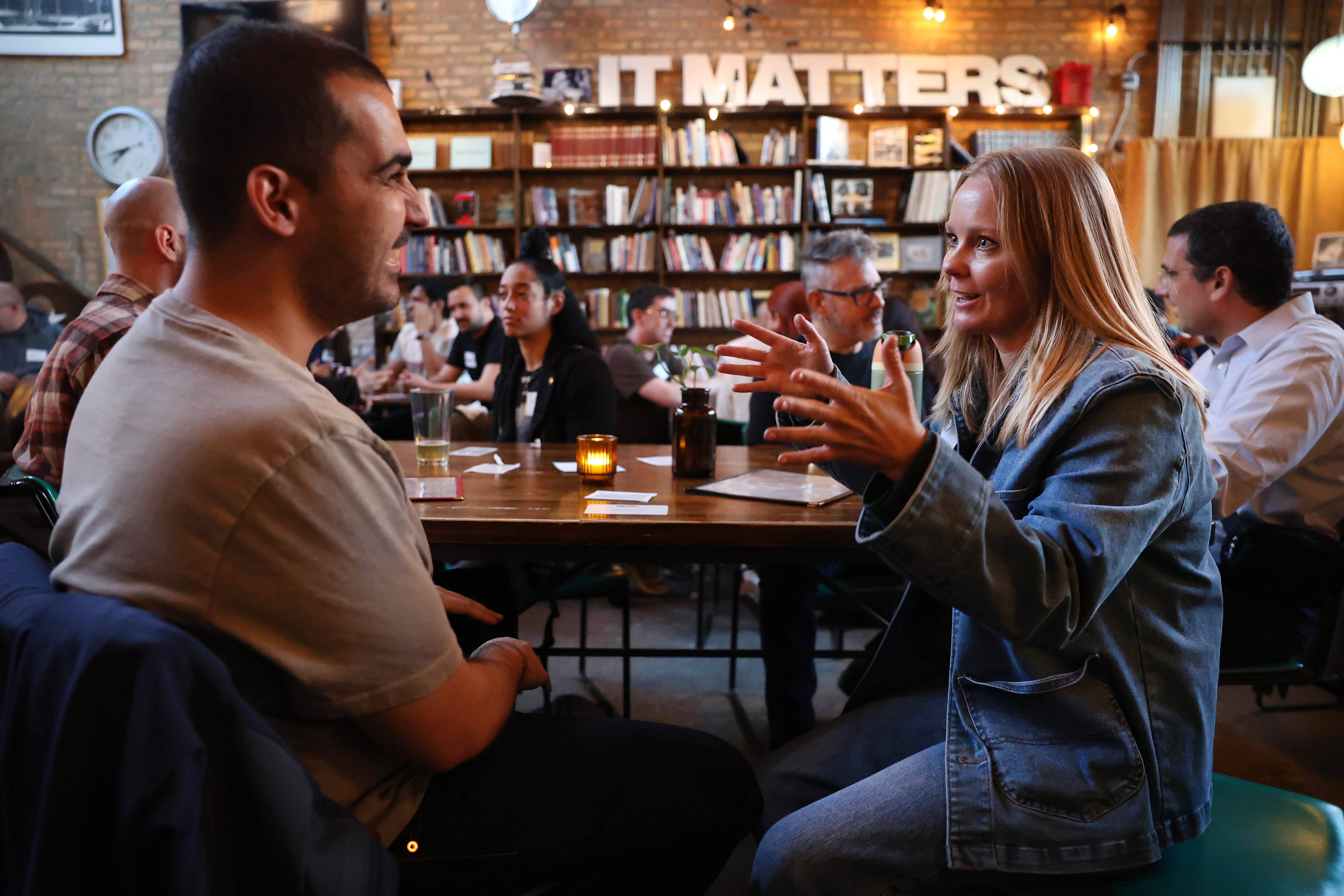
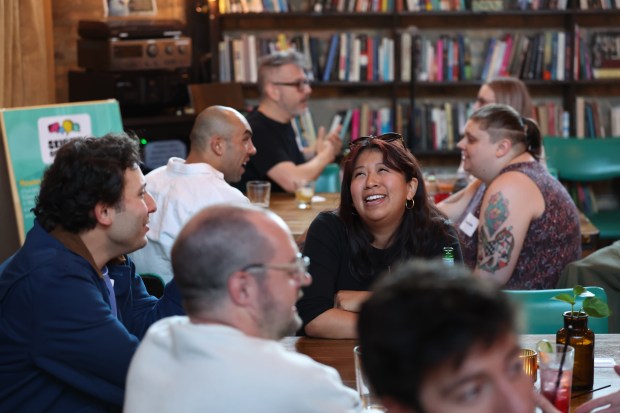
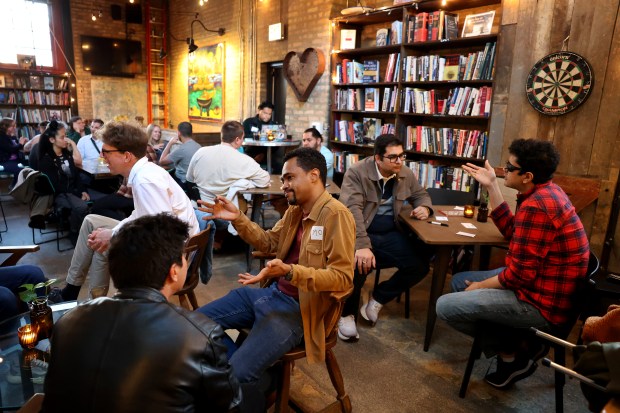
One weeknight in May, around 30 people gathered for an event called “Skip the Small Talk” in Kibbitznest’s back room. As the name suggests, the night was centered around facilitating deep conversations between strangers, a task much easier when phone usage is kept to a minimum, event organizers said.
“Wouldn’t it be nice if people just talked to people?” Viviana Barajas, the 33-year-old emcee, asked the crowd at the top of the event.
Over two hours, attendees shuffled from partner to partner, engaging in 10-minute conversations centered around card-prompted topics like “What are some of your biggest hopes for your personal future?” and “What are some things you loved about yourself as a child?”
Though attendee Lindsey Lucenta doesn’t consider herself addicted to her phone, she said she believes “our relationship with phones as a society has oriented people away from engaging genuinely.” She appreciated the opportunity to step into a space like the small talk event because it allowed those around her to be more “authentically themselves.”
Jessa Fuller, an event curator and co-founder of experiential marketing agency Little Council, sought to cultivate a similar sense of belonging when her team hosted a phone-free pop-up event on a Saturday morning in River North last month.
The event, called Fulfillment Center, was geared toward people of all ages who were encouraged to come, put their phone in a cotton bag and engage with one of the many activities centered around reading, writing, making and playing at a long, communal table.
“Right now, when you think of a fulfillment center, you think of a large, giant, warehouse-y building built to get us things we order online super fast,” Fuller said. “So we said: ‘What would it look like if … we took up space with one that was more focused on personal fulfillment?’”
Fuller’s team hosted the pop-up over two days. For her, the most striking part of the weekend was seeing people come to the Fulfillment Center alone and leave with plans to reconnect with the people they met at her event.
Students, teachers adapt in a digital world
For some, the conversation around limiting screen time has extended beyond social circles and into professional or academic ones.
This spring, Olivia Stewart Lester, a Loyola professor who typically teaches classes on the New Testament and early Christianity, proposed and taught a new class that investigated the intersection of religion and technology.
Eighteen students joined her for her semester-long passion project, together exploring topics such as artificial intelligence and online religious communities, as well as participating in a monthlong digital fast coinciding with the start of Lent and Ramadan.
“They were surprisingly enthusiastic,” Stewart Lester said, adding she was unsure of how students would respond to a professor mandating a behavioral change.
In assigned reflection papers, students described how the fast gave them the chance to take up new hobbies, she said. Given the choice of how to implement the assignment in their lives, some students opted to eliminate certain apps like TikTok, while others chose not to use their devices on public transportation in order to be more aware of their surroundings.
“(They found) once they got through the kind of rocky adjustment period of getting used to detaching from those devices, that their mental health improved,” she said. “That they were sleeping better and forming more connections with other people that felt more authentic to them.”
At the University of Illinois Chicago, 20-year-old engineering student Nawar Masood sometimes employs the help of an app called FocusFlight, which allows her to lock her phone for the typical duration of any flight. Sometimes she chooses to turn off her phone for the two-hour flight path from Chicago to Atlanta, or if she really needs to focus, she’ll opt for a longer hypothetical flight, such as one to San Francisco.
Even though she tries to limit her phone usage, Masood said her screen time can spike as high as 11 hours per day during the school year.
“A friend sent me a statistic that said we look at our phones over 200 times per day,” Masood said. “I don’t know if that’s an exaggeration or not, but I just got super overwhelmed by that.”
Now, she said, she and her friends place their phones in the center of the table when they’re hanging out. Just before going to bed each night, she reserves an hour for reading or drawing to help her wind down without her phone nearby.
Back at Loyola, Stewart Lester said she has witnessed many students struggle to keep their screen time down in a world where both academics and social spheres increasingly demand an online presence. In her own classes, she restricts technology use to lecture-based notetaking, instructing her students to put everything away for activities and discussion.
McPhaul, the recent Loyola graduate who did not take Stewart Lester’s class but has been working independently to cut her screen time, said the past few months have been a blessing as she’s learned to “hang out with herself” and engage meaningfully with her friends in a way she hasn’t been able to before.
At 22, she recognizes that leaving social media behind all together probably isn’t feasible for a young person hoping to maintain a social life in this day and age. And so, while McPhaul much prefers catching up with friends face-to-face, she said she reluctantly checks social media on her computer sometimes to ensure she doesn’t miss anything too important.
She equates this strategy to what she called “AOL era,” meaning she tries to limit her internet use to when she’s at home, just as her mother would have done in the ‘90s.
“Our phones are programmed to be like a slot machine in our pockets,” she said. “Before I had never thought about that, but it’s just so true.”



