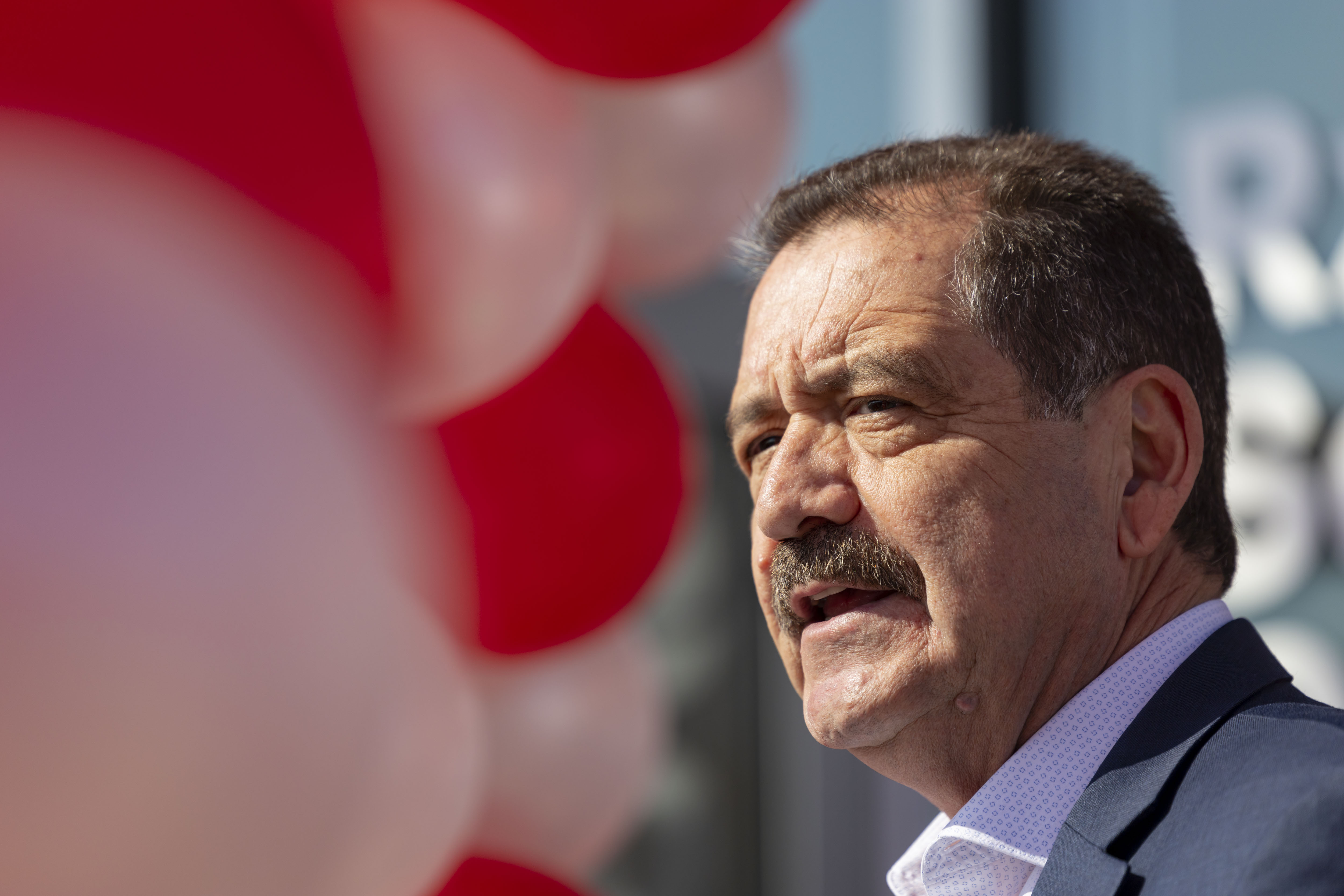

As Manny Diaz testified in a fluorescent-lit basement hearing room, he returned time and again to a single response: “I do not recall.”
Pushing to kick a progressive independent Latina off this autumn’s 4th Congressional District election ballot late last month, he said he couldn’t recall if he had ever before challenged a candidate’s signatures. He said he didn’t know if he had ever worked outside regular business hours in his busy job as a political staffer.
Most strikingly, Diaz paused when asked whom he worked for, responding only when the attorney representing him in the hearing gave him the go-ahead.
The answer — and the man now intimately tied to the strong-arm effort to clear the opposition to his preferred candidate off the ballot — was U.S. Rep. Jesús “Chuy” García.
The exchange highlighted the charge by García opponents that the outgoing congressman from the Southwest Side is incinerating his long progressive track record by resorting to the kinds of obstructionist Chicago Democratic machine election tactics his outsider movement has railed against for decades.
In his relentless attempts to clear the way for his chosen successor — his former chief of staff, Patty García — to coast to an easy win this November, García is no better, they say, than the political insiders who have long leveraged their deep pockets and control of the election rules to keep themselves in power in the face of challenges from grassroots political organizations in and around Chicago.
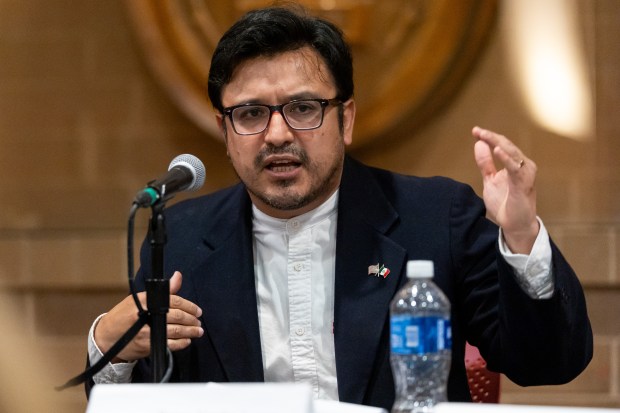
“This will certainly taint his legacy as someone who leaves out the back door, suppressing the voice of the people, anointing a successor,” said one of the two progressive Latino independent candidates García’s organization is trying to boot from the ballot, firebrand Southwest Side Ald. Byron Sigcho-Lopez, 25th. “You don’t fight authoritarianism with these kinds of authoritarian or unilateral decisions.”
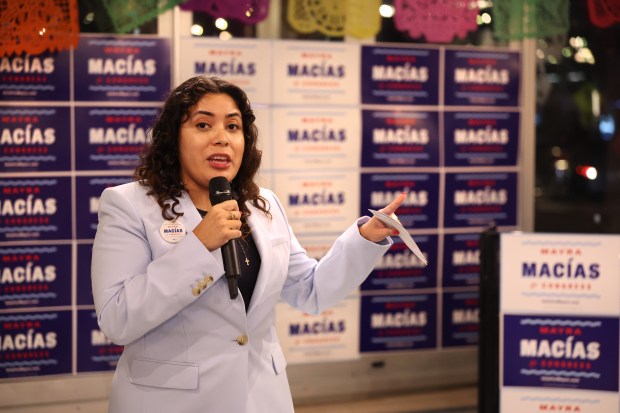
Late last month, Diaz, a senior staffer for the four-term congressman, zeroed in on ending the candidacy of independent Mayra Macías. He testified under oath at the Illinois State Board of Elections hearing as a notary who gathered evidence, on behalf of several objectors, that could invalidate hundreds signatures for Macías.
At least two of the people who objected to Macías’ and Sigcho-Lopez’s signatures also gathered petition signatures for Patty Garcia, yet another sign of apparent coordination by the candidate and the congressman.
Macías and Sigcho-Lopez face a flood of challenges against the signatures they collected to be listed on the ballot. Both submitted the maximum amount, over 17,000 names, but the Board of Elections could rule this month against them and effectively end their uphill-battle campaigns.

To get on the general election ballot as an independent, a candidate must secure 10,816 valid signatures from registered voters. The García-linked objectors are seeking to push Macías and Sigcho-Lopez below that threshold by asserting thousands of their signatures are no good for one reason or another.
The signature challenge is a time-honored way for well-heeled Chicago campaigns to try to remove opponents who might not have the organizational depth to get enough names or the money to mount a time-consuming defense against the claims.
As his political organization again moves to knock out candidates, the man who was a top mayoral candidate in 2015 and 2023 appears to be doubling down. In doing so, Garcia is trouncing his long-held progressive ideals, Macías and Sigcho-Lopez say.
“If we are saying that we want people to engage in the democratic process, we want democracy to thrive, why are we not trusting our voters?” said Macías, a former Planned Parenthood Action Fund member.
Macías filed a complaint July 3 with the House Ethics Committee and the Office of Congressional Conduct alleging the congressman, Patty García, Diaz and other staffers violated ethics rules by working on Patty García’s campaign during taxpayer-funded work hours.
Rebuffing the criticism, allies of Rep. García and Patty García say they are proven progressives.
“But they’re progressives in Chicago,” said state Rep. Edgar Gonzalez, who worked under Patty García in Rep. García’s office. “And Chicago’s a very different ballgame than anywhere else in the country. We play with the rules that are set.”

Gonzalez praised Patty García as “extremely organized,” “extremely intelligent” and deserving of the seat. Chicago politics is a “hardball sport” where candidates do what they can to win, he argued.
“Complaining and whining about the rules is kind of dumb,” he said. “Don’t hate the player, hate the game. … Everybody knew what they were signing up for.”
The general election ballot fight is only the latest chapter in a monthslong controversy that began when the congressman cleared the way for his chief of staff to secure the Democratic nomination by announcing in November he would not seek a fifth term just hours before a deadline for candidates to run in the primary election.
Only Patty García, of no relation, had the heads-up that the incumbent — her boss — would bow out, and only she submitted the hundreds of signatures needed to enter the race.
The move drew criticism for taking choice away from voters. The progressive congressman representing the heavily Latino Southwest Side district was even censured by his U.S. House of Representatives colleagues in a 236-183 vote led by Republicans.
David Orr, the former Cook County clerk and aldermen whose ties to García stretch back to their shared support for Mayor Harold Washington in the 1980s, said he was disappointed by the way the congressman exited office.
“That really could or should have been better,” he said of García’s decision to only alert his chief of staff that he would not run again.
But Orr was unbothered by the petition signature challenges.
“I see that as a different situation. It’s the law, and you have a right to challenge,” he said. “I just don’t know how far you get ignoring the law.”
Orr said he believes the law should be changed. But García has nonetheless proved himself as a key part of Chicago’s progressive movement, he added.
“Most of the major issues that we consider progressive, he’s been there,” he said. “And not just on a vote, but working behind the scenes on many things, working with some of his colleagues, working to build coalitions where you need to.”
In the eyes of Juan Rangel, CEO of the Urban Center and long a political enemy of García’s, the congressman’s tactics looked familiar.
Petition challenging is a “classic move employed mostly by machine politicians,” Rangel said.
He would know. Rangel’s own organization has played a key role in broadly challenging the validity of signatures collected to allow Chicago Teachers Union-affiliated candidates onto the ballot in recent weeks, he said.
That signatures were challenged is not surprising, he said. The surprising thing is who the challenges seemed to come from, Rangel said: “A self-pronounced reformer, anti-machine (who) always saw himself as the outsider fighting the good fight.”
“There’s nothing illegal in terms of the maneuver,” he said. “But I’ve never grandstanded and stood on a moral high ground above everybody else as Chuy likes to do.”
It’s a late effort to hold onto power for “the old guard of the progressive left,” Rangel said. “The politics of the progressive movement kind of left Chuy. … He’s just not progressive enough.”
In the days after he announced he wouldn’t run again, García told reporters he made the last-second decision because of health and family pressures.
His cardiologist advised him to find less stressful work. His wife, Evelyn, faced complications from multiple sclerosis and told him she needed him in Chicago. And he was just completing the adoption of a grandchild after his daughter, Rosa, passed away in 2023.
“Congressman García made a deeply personal decision based on his health, his wife’s worsening condition and his responsibility to the grandchildren he is raising after the death of his daughter,” García congressional spokesperson Fabiola Rodriguez-Ciampoli said in a statement shortly after García dropped out of the race in November.
“He followed every rule and every filing requirement laid out by the State of Illinois,” Rodriguez-Ciampoli said. “At a moment like this, he hopes his colleagues, especially those who speak about family values, can show the same compassion and respect that any family would want during a health crisis.”
García has not publicly defended his connections to the signature challenging effort. He and his office did not respond to repeated requests for an interview. Neither did Patty García or her campaign.
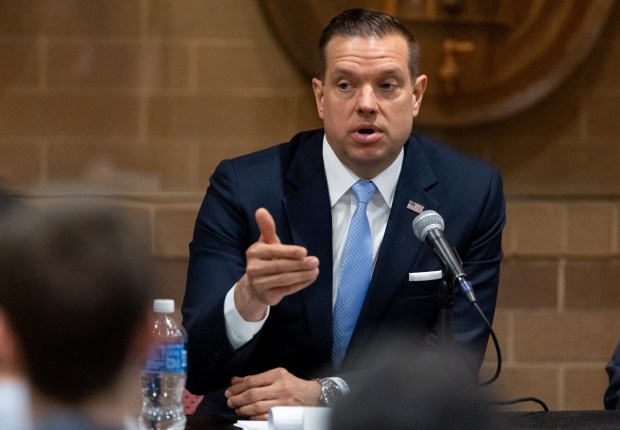
A third independent congressional candidate vying for a ballot spot, Lyons Mayor Chris Getty, has not faced any challenges to his petition signatures.
Asked after the late June hearing why he was trying to bounce Macías from the ballot, Diaz told a Tribune reporter he didn’t need to answer. Diaz then turned his back, rolled his eyes and walked out of the underground elections office.
Macías maintained after the hearing that her team will be able to secure enough legal evidence to prove she qualified for the ballot if given only a few more days to collect affidavits.
During another hearing Monday, Sigcho-Lopez, a democratic socialist, took a different approach. His attorney, Andrew Finko, did not attempt to prove he had enough signatures. Instead, he took aim at the “very sad” system.
It would be “a travesty of democracy” if the support from 18,000 petition signers were negated because there was too little time months later to gather evidence supporting each signature, he said. “I need to keep raising it, keep bringing it up, because at some point, someone will start listening.”