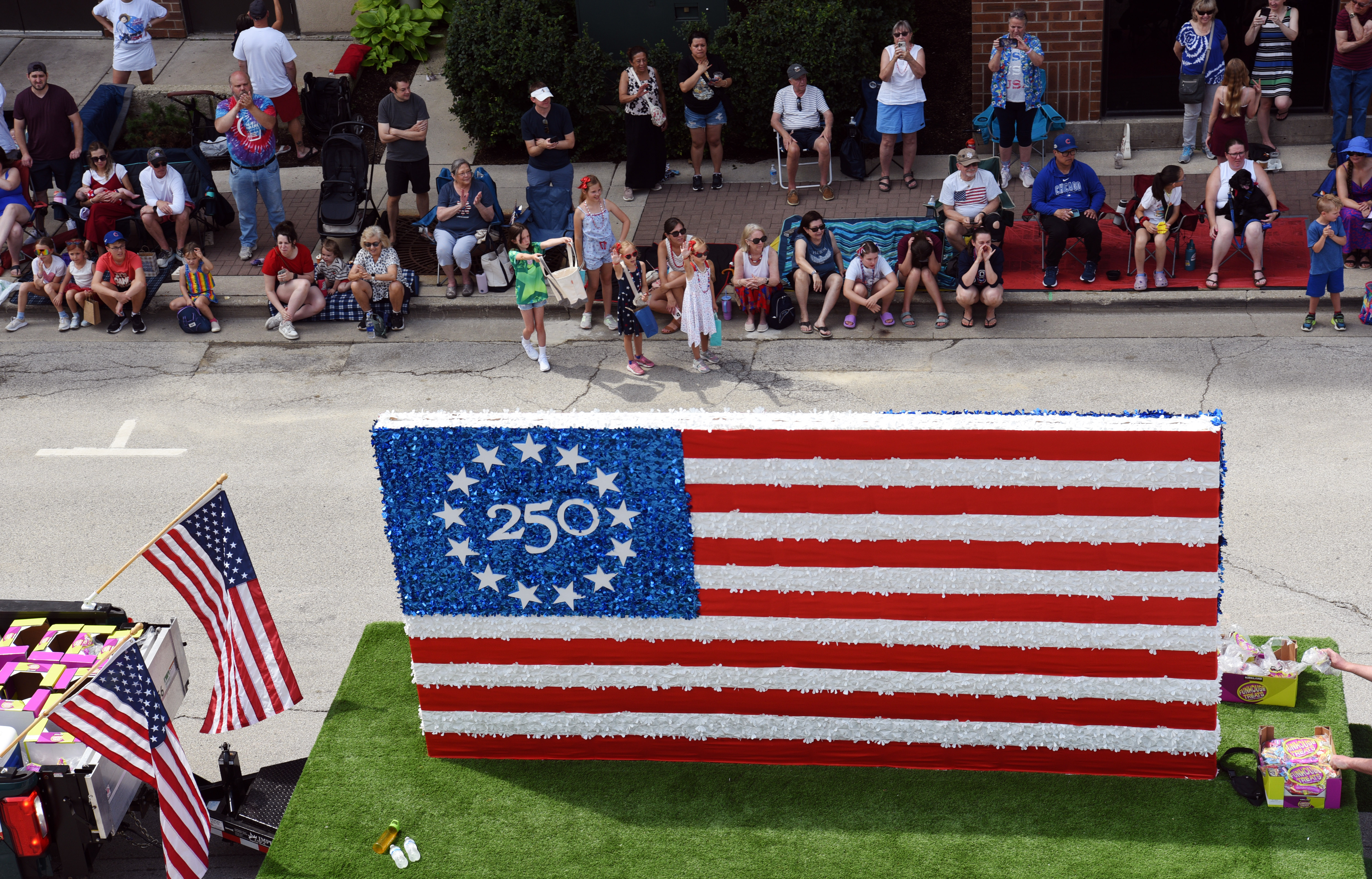

By almost any measure — but especially compared with President Donald Trump’s campaign-style National Mall speech and Washington’s massive fireworks show over the Independence Day holiday — Illinois’ celebrations to commemorate the United States’ 250th birthday this year have been decidedly low-key.
Gov. JB Pritzker’s office listed about $376,000 in costs for semiquincentennial-specific state programming, a relatively low price tag amid federal funding cuts and a striking contrast to the all-out, politically charged events in the nation’s capital.
Illinois residents and visitors may see a lasting impression from the celebrations, however, as the bulk of those state dollars, about $300,000 from existing funding, went to grants for 22 public art projects throughout the state, including a mural of singer-songwriter and Maywood native John Prine going up on the exterior of Chicago’s Old Town School of Folk Music. The other biggest line item: the printing of Illinois “passports” encouraging visitors and residents to see historic and civic sites, for a cost of about $76,000 “from existing operating resources,” according to the governor’s office. The state’s overall spending plan for day-to-day operations during the budget year that began July 1 totals nearly $56 billion.
Illinois 250: What the state has uniquely contributed to the nation — and the world
Other state agencies are incorporating contributions into existing staff time, contracts and other resources, Pritzker spokesperson Andres Correa said.
Through Labor Day, for example, the state archives and state library, which fall under the purview of Secretary of State Alexi Giannoulias, are putting on a special archival exhibit at the Capitol called “America 250: Land of Lincoln.”
The bulk of the hundreds of events publicized by the Illinois 250 commission were put on by nonprofits and other outside organizations, not the state itself, said Gabrielle Lyon, chair of the Illinois America 250 Commission.
The celebrations faced federal budget cuts heading into this year, and the state’s budget also is tight, she said. The nonprofit Illinois Humanities, which Lyon chairs, lost about $2 million as part of cuts last year from the Elon Musk-led Department of Government Efficiency, a good portion of which would have been used for the anniversary this year, she said.
Even the billionaire governor, asked about the costs at a news conference unveiling the plans back in December, replied, “I honestly wish we were able to spend more because I want the celebration to be as big as possible.”

In fact, federal funding cuts forced communities across the country to scale back plans for the semiquincentennial, The Associated Press reported last year.
“People in Illinois care about their history and their heritage, and they know it’s connected to the American story. The dollars haven’t been in place that we probably — certainly — could have used,” Lyon said, adding, “It’s not lost on me, the irony that the dollars are staying, for the most part, all in Washington, but the people who are really making the meaning of the moment in Illinois, they’re in the townships, they’re in the cities, they’re at the county level.”
The commemorations both in Washington and across the country over the recent holiday weekend came as Trump continued seeking to make his mark on the country’s understanding of its own history.

The Trump administration this month slammed leadership at the Smithsonian Institution museums, particularly the National Museum of American History, as activists that “cannot be trusted to tell America’s story honestly and in a way that is inspiring, unifying, and worthy of our great republic.” He previously targeted programs that promoted “divisive narratives” there and has generally signaled the institution has become too liberal.
Trump also created the public-private partnership “Freedom 250” to run his administration’s events for the anniversary, including the “Great American State Fair” on the National Mall, a move that created tension with the America250 commission Congress established a decade ago.
The state of Illinois opted out of state-funded participation in the Great American State Fair earlier this year, leaving the Peoria Riverfront Museum to send a showcase instead. Pritzker also chose not to send Illinois National Guard troops to Washington for the celebrations this month, breaking with some other Democratic governors, including Minnesota’s Tim Walz and Michigan’s Gretchen Whitmer, and earning praise in a letter signed by a group of 19 former defense and military leaders.
In Illinois, museums, historical societies and other organizations including Illinois Humanities know “how important public imagination is to what we invest in for the future,” Lyon said Thursday.
“We have really stepped up into this moment to say, ‘We are going to find a way,’” she said. For the commission overall, “it was never a set of goals around parties or big fireworks shows,” she said.
Indeed, there was no central, state-funded event commemorating the anniversary.
In Chicago, Navy Pier planned an extended fireworks show on Independence Day — an event that ended up so blotted out by clouds that the pier issued a disappointed statement on social media. But as Navy Pier is operated by an independent nonprofit organization, that display was self-funded through normal operating revenues as well as philanthropic and corporate sponsorships, not by the state, said Marilynn Gardner, president and CEO of the popular tourist destination.

Lyon said she’s seen enthusiasm for the civic-minded, diverse celebrations that the commission has promoted. About 100,000 passport brochures were distributed statewide, encouraging people to visit historic landmarks, museums and other civic sites, and about 2,000 individuals requested them in the mail, she said.
Barbara Engelskirchen, chief development officer at the National Museum of Mexican Art in Chicago’s Pilsen neighborhood, said the museum chose to participate because initiatives that are good for the state and community are good for the museum, too.
“We want people, whoever they are, wherever they come from, to engage with the art we have here,” she said.
At least four of the public art projects funded through the Illinois 250 grants have already been unveiled, according to the Illinois Arts Council. The projects were intended to reflect Illinois’ history and diverse stories across communities, Executive Director Joshua Davis-Ruperto wrote in an email.
“Public art is accessible, it’s free to experience, and oftentimes becomes a permanent part of a community’s landscape,” Davis-Ruperto wrote. “This small investment offered an opportunity for the state to support local artists, strengthen cultural organizations, and create opportunities for residents to connect through their shared history in meaningful ways. Honestly what better way to celebrate our state and the nation?”

For Lyons, two highlights of the celebrations so far have been viewing a public reading of the Declaration of Independence in Peoria on Wednesday — the 250th anniversary of the founding document’s first public reading — and witnessing people at the Little Village branch of the Chicago Public Library record conversations for Illinois Voices 250, a privately funded initiative to preserve the stories of Illinoisans in the Library of Congress.
The Little Village library event was especially meaningful “given all that community has had to contend with,” in recent months she said, including militarized immigration enforcement during the Trump administration’s Operation Midway Blitz and what she described as exclusion of many groups, including immigrant communities, from the anniversary celebrations at the national level.
“Then to see these grandmothers, people in their 30s and parents and children, just have a conversation about this moment and what’s important to them was unbelievably powerful,” she said.
The Associated Press contributed.