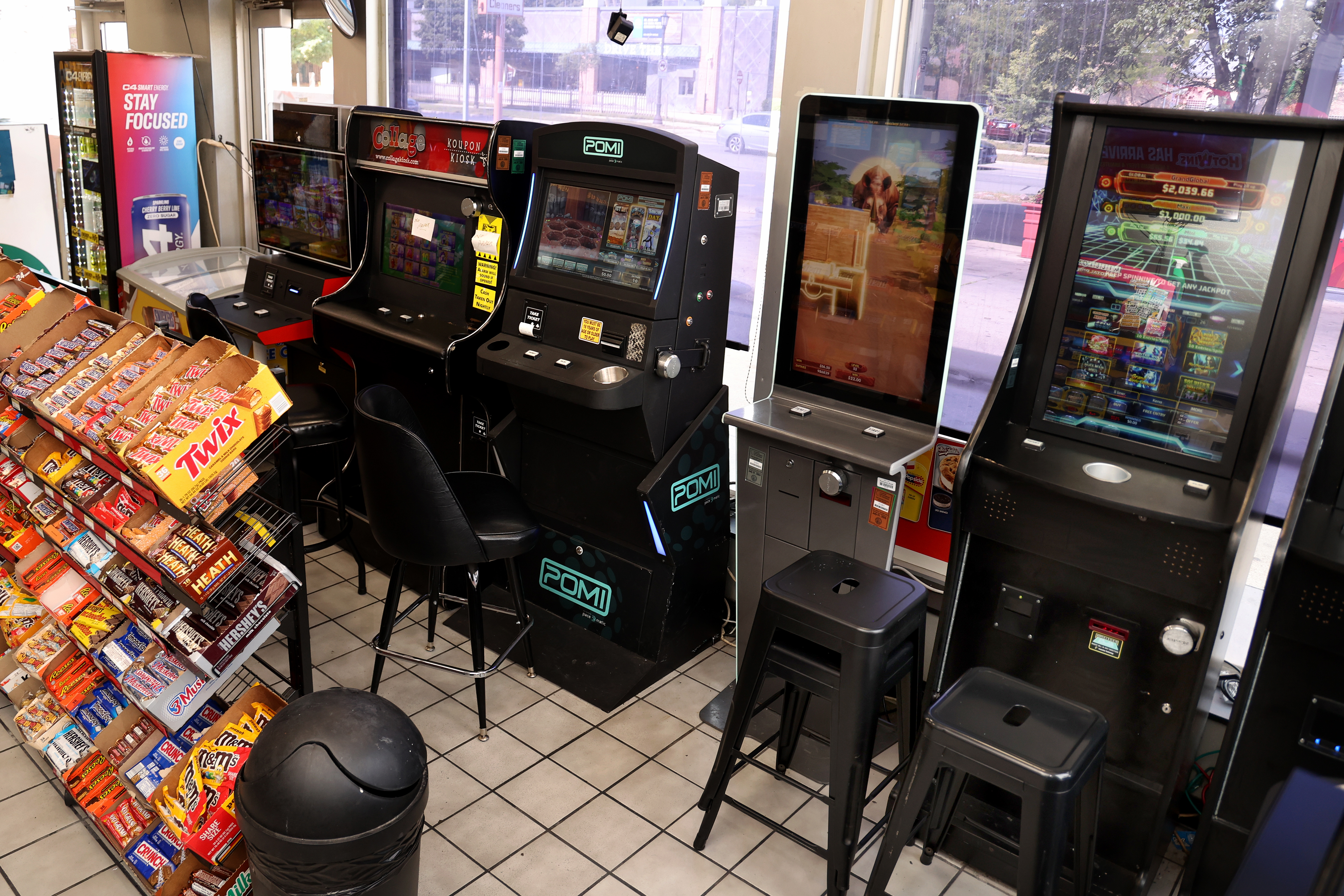

The fate of Evanston’s “sweepstakes” machines remains on pause after City Council once again punted a decision on whether to regulate, or ban entirely, the gaming kiosks that operate under a legal gray area of Illinois gambling laws.
Video gambling machines have been banned from use within the city’s limits since 2009, according to officials, but sweepstakes machines, which resemble the look and feel of slot machines, have been allowed to remain in operation because they exist under a legal loophole that falls outside of state laws.
This is because the machines claim to be “promotional” games rather than gambling ones, in which players convert their winnings into gift cards or credits they can use as entries to play various games.
The Illinois Prizes and Gifts Act allows for the operation of sweepstakes machines so long as there is no purchase required to enter, but the machines often require a payment to play, “which mimics gambling and violates the law,” per a city memo sent by Evanston Health & Human Services Director Ike Ogbo.
Because the gift certificates or coupons are what is being used to play with, rather than cash game entries, the machines circumvent state regulations by the Illinois Gaming Board, per Ogbo’s memo, along with licensing regulations and taxation governed by the Illinois Video Gaming Act.
Municipalities across Illinois, including Chicago, have passed ordinances banning these types of gaming machines, viewing them as exploiting the system by operating outside of the state’s regulated gambling framework.

Evanston officials identified two Illinois municipalities that allow for the operation of sweepstakes machines, Elmwood Park and Dolton, both of which also license video gaming machines, according to Ogbo’s memo.
Elmwood Park, however, does not appear to have any active kiosks or “issue licenses for sweepstakes machines,” he wrote.
But the legal ambiguity of sweepstakes machines makes prohibiting their installation in local gas stations and convenience stores challenging, compelling Evanston City Council members to move forward with a decision about what exactly to do about them.
Many local business owners who operate these machines oppose an outright ban on them because they bring in further business and the profit the gaming machines make is split between the sweepstakes machine company that leases the machines and the business owner who “hosts” them, per previous reports.
At their July 13 meeting, Council members voted 4-2 to regulate rather than outright ban sweepstakes machines under an ordinance proposed by Ald. Bobby Burns, 5th.
The new regulations would impose an annual licensing fee of $500 for business owners to operate the kiosks and limit the number of machines in operation in Evanston to 20 at a given time, with no more than two per establishment.
“[This regulation] ensures that these machines, if this is approved, would not be gambling by another name,” Burns voiced from the dais on Monday.
“One of the things that’s added in here is that there has to be a free entry in the same way that it’s free to do a sweepstakes for a vehicle in a mall, there’d be a free option in these machines as well.”
Burns added that he would “encourage people to read through [the ordinance] to understand that, and that’s why I’m happy to support it.”
But with three aldermen absent from the meeting, a 4-2 vote in favor of regulating the machines was not enough for the required five majority vote to adopt the ordinance.
Consequently, a final decision on the sweepstakes machines will be postponed until the next City Council meeting.
Ald. Matt Rodgers, 8th, heavily favored sweepstakes regulation over a total ban, citing that his Ward represents multiple small business owners who operate these types of machines.
“We often see these businesses struggle when we make rules on our convenience stores, our gas stations…people have the option of going elsewhere for things, and that’s what we’re seeing happen here,” Rodgers said.
“There is a fallacy out there that gas prices are high, and so [gas station owners] are making a lot of money in this economy. They are not. Gas prices are high, but their wholesale prices are just as high…I think we can regulate, and I think we can do it in a sensible way, where the city knows where these [machines] are operating, that we’re keeping some general oversight on them.”
Rodgers added that he hoped there wouldn’t be so much regulation that business owners are “unable to continue with this type of operation.”
As one of two aldermen who supported a total ban on the machines, Ald. Shawn Iles, 3rd, voiced to Council members that while he appreciated the “challenges in running small businesses,” a “heavy social cost” is involved in keeping sweepstakes kiosks running.
“This mimics gambling,” he said. “Most other communities similar to ours have banned it. There’s only two that expressly allow it, so I’m going to [support] a ban version of the ordinance.”
Ald. Clare Kelly, 1st, agreed with Iles; “I also don’t want to undermine or harm any of our small businesses, but I’m not excited about the idea of proliferation of this in our city,” she said.
Earlier in the meeting, Adriana Vital, who manages a CITGO gas station located at 443 Asbury Avenue in Evanston, spoke on behalf of several business owners in attendance at the July 13 meeting to urge Council members to oppose banning the machines outright.
Vital said that a ban would hurt local businesses and add further strain following Evanston’s decision to ban flavored tobacco products, which went into effect in April 2024.
Managers like Vital installed these machines in part to make up for lost revenue from the flavored tobacco ban, and prohibiting sweepstakes machines could cause additional business revenue loss, she said.
“The last time, we didn’t do anything about it,” Vital said.
“This time we want to say that we are against this ban that you guys want to implement.”
The sweepstakes machine ordinance will come back to City Council for a vote at its next scheduled meeting on July 27.