
This story originally ran in the Chicago Tribune on April 25, 1901.
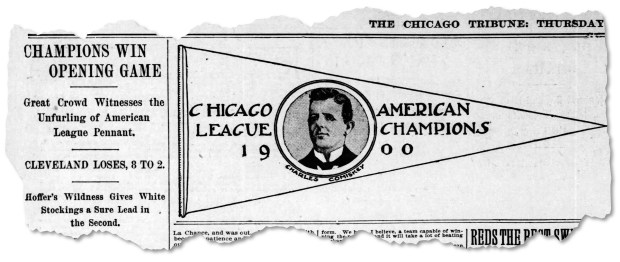
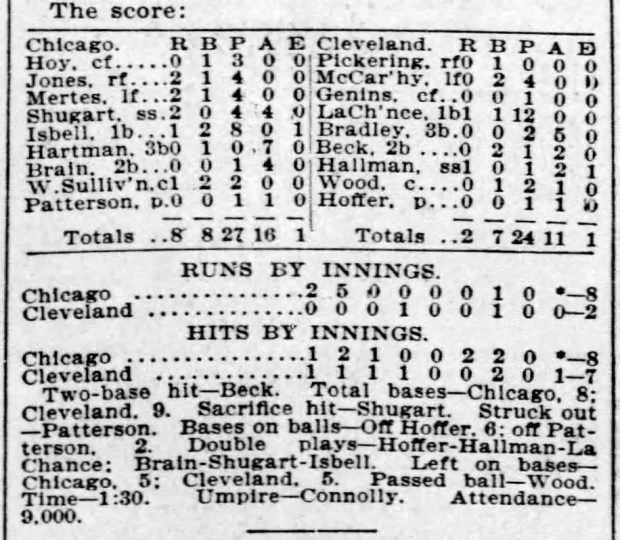
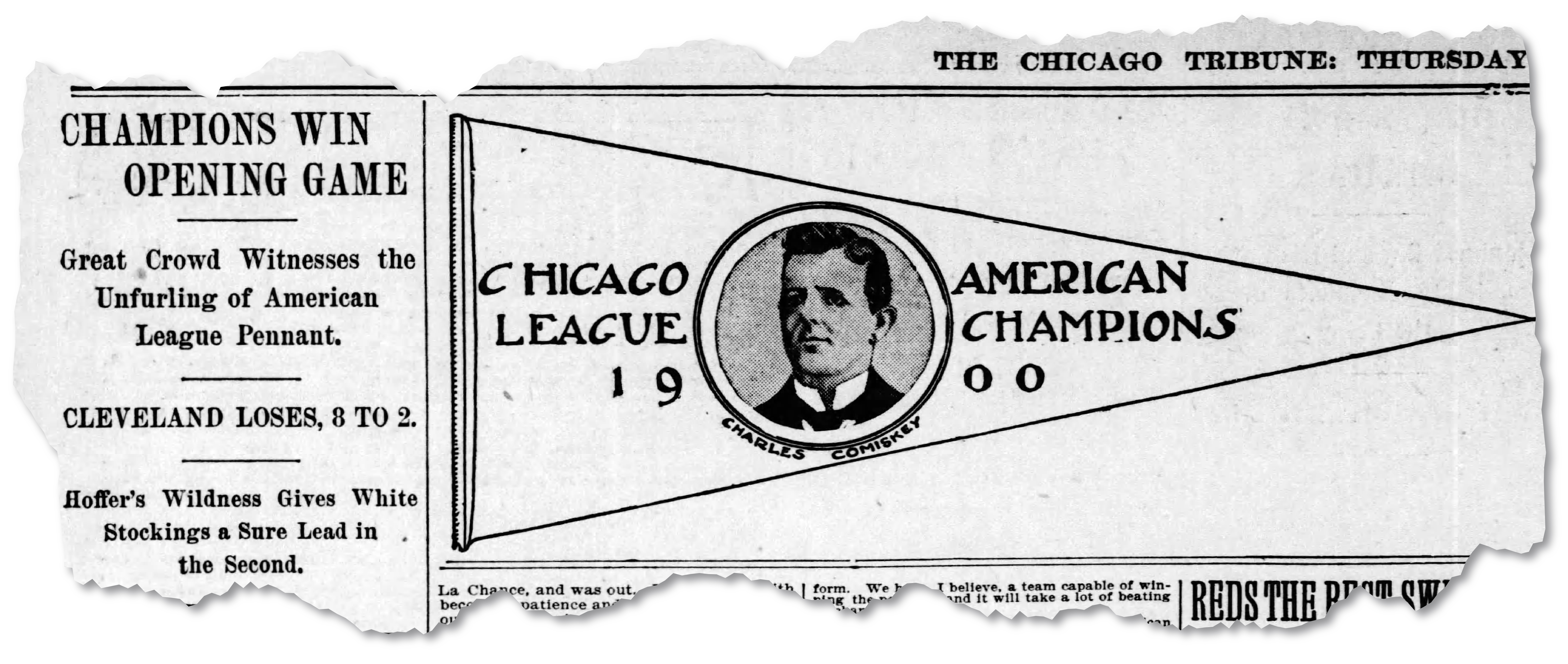
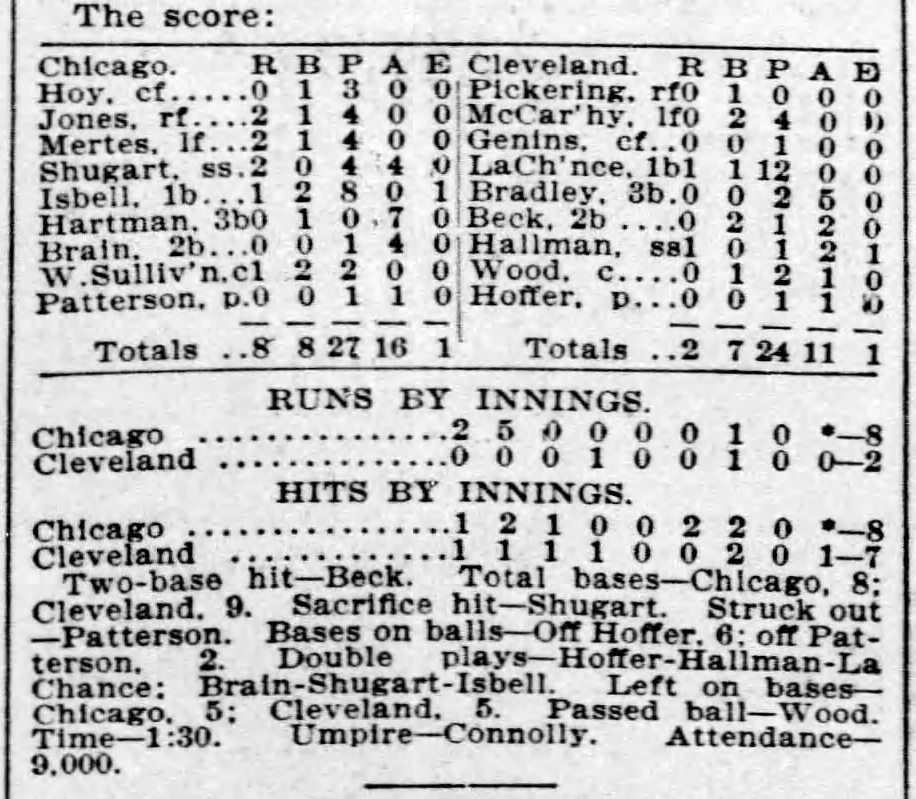
Under the fairest skies the weather clerk could select from his varied stock of April goods; with a championship pennant floating high above them from the proudest pine of all Michigan’s forests; with 9,000 fans to cheer them from a pent-up enthusiasm that burst forth at every possible opportunity, the White Stockings opened the American league baseball season on the South Side grounds yesterday with a clean-cut victory over the aggregation from Cleveland. The score was 8 runs to 2.
It was the most auspicious beginning imaginable, without a thing to mar the occasion. The only thing the fans could have asked for, to add to their delight, was a little more warmth in the atmosphere, and even that was supplied by the spectators when the real rooting began. It was a splendid crowd, both in its proportions and in the elements of which it was composed, and it was a magnificent welcome it gave the players who fought for, won, and hoisted that pennant and the new men who have joined the champions to help them retain that emblem.
There were cheers for everybody, from (William) Hoy, who couldn’t hear them, to (Roy) Patterson, the hero of many a hard-earned victory last year. There was so much enthusiasm on tap that the visitors came in for a generous share of it, especially (Bill) Bradley and (Jack) McCarthy, the two ex-Orphans, who, by the way, cut the greatest figure in the game for the losers, and (Bob) Wood, who helped the champions so much last season. There were flowers for (David) Brain, the youngest of the White Soxs, and a cane and umbrella for McCarthy from the friends he made at the West Side grounds. And at the end there was so much surplus exuberance that the bleacherites indulged in a merry cushion fight all through the concluding inning by way of celebration.
Hoffer’s costly bases on balls
It would have been most discourteous for Cleveland to have won in the face of all that good-natured enthusiasm. It would have been cruelty to have put the slightest damper upon it. But the visitors tried hard enough to be discourteous, and if Bill Hoffer had been able to locate the plate at all in the first two innings it would have been an uncomfortably close rub at the best. It was fast, clean baseball. Nine innings were played in an hour and a half, and each team made a single error, on difficult chances in both cases. Dashing base-running gave the White Stockings so wide a margain of scores in comparison to the slight difference in the batting figures, and it was that base-running that made Hoffer’s bases on balls so costly to his team in the main.
The crowd began to gather long before 3 o’clock, and the early arrivals were amused by a concert by the First Regiment Rough Riders’ band. The visiting team was the first to make its appearance and went through its preliminary practice amid the good-natured guying of the blearcherites, while the champions kept modestly out of sight down by the clubhouse. Fifteen minutes later the White Stockings marched out and across the field in a long line of dazzling white, and the spectators arose as if one man to cheer. There was one preliminary burst and then a hush until the advancing line reached the edge of the diamond, then there was another cheer which might have been heard in South Chicago if the wind had been stronger.
Not since 1886 have Chicago fans had such an opportunity as that, not in fifteen years a chance to applaud and feel proud of a team of champions. In that time a new generation of fans has sprung up, and those who can recall Chicago’s last previous pennant are in the veteran class of rooters. But old and young seemed bound to make the most of their opportunities on this occasion — and they did.
Greeting the champions
There was a cheer when the White Stockings took their positions for practice, another when Manager (Clark) Griffith went out to drive hot liners and grounders to the infield, still another for big Jack Katoll when he began to push long fungoes to the outfielders, and more cheers for each individual player as he handled the ball; for (Fielder) Jones and Hoy and (Sam) Mertes when they came in under short pop flies; for (Fred) Hartman, (Frank) Shugart, and Brain as they scooped up fast bounders with almost mid-season accuracy and shot them over to first; for (Frank) Isbell when he pulled in the wide throws, and for Billy Sullivan, who stood at the plate and snapped the ball around the different bases with an arm which he says is lame but which showed no signs of it in practice or play.
Then the rival teams congregated at the plate and with the band to lead them marched in two long lines down to the tall flagpole in deepest center field. There was the briefest of delays and then the members of last season’s team, to whom belonged the honor of hoisting the pennant, grasped the rope, and, tugging lustily, slowly raised it aloft. The big crowd arose and let out a cheer as the silken banner left the ground, the band played, “The Star-Spangled Banner,” and everybody hoped the “long may it wave” would come true.
Pennant is unfurled
Not until the pennant reached the top of the staff did the breeze seem strong enough to straighten it out, but then, as the long silken folds were slowly and lazily unfurled, disclosing the words so unfamiliar to the eyes of local fans, “Chicago, Champions American League, 1900,” cheer followed cheer, and while the teams marched back across the park to the strains of “There’ll Be a Hot Time” the spectators settled back into their seats ready for the struggle of 1901 to commence. There was a little delay while the Captains and Umpire Connolly fixed the ground rules made necessary by the crowd on the field and the game was on. And if the “hot time” predicted didn’t eventuate it wasn’t the band’s fault. It was all Hoffer’s.
Then it was discovered that Roy Patterson, no longer a “boy” in fast company, but still a “wonder,” was to pitch the game for the champions, and the crowd once more expressed its delight. (Ollie) Pickering was the first to face him and the first ball of the season was a “ball,” but it was closely followed by a “strike” — an American league strike, and not the National league brand once known as a foul. Then Pickering raised a high fly which gave Hoy the first putout of the season in pretty nearly the same spot that he made the last putout of the last season. (Jack) McCarthy was next, and after he had blushed his acknowledgments of the present made him, the West-Sider cracked a sharp hit to Hartman. It bounded off the Dutchman’s hands and caromed over to Shugart, who grabbed it and shot it to first just a thousandth of a second too late to catch his man and McCarthy had made the first base hit of the season. (Frank) Genins flied out to the silent man and (Candy) LaChance sent an easy one to Brain, forcing McCarthy at second.
Hoy led off for Chicago with a grounder to LaChance, and was out. Jones waited with becoming patience and earned his base without even swinging his bat. Mertes shot one at his old teammate, (Bill) Bradley, who fumbled just an instant and missed a possible double play, then retired Sandow at first. Here Hoffer lost his bearings badly and permitted Shugart and Isbell to walk, filling the bases. Hartman was next, and, after making a half dozen National league “strikes,” most of which hit the grand stand, the Duchman caught a straight squarely and lined it sharply over Hallman’s head, scoring the first two runs of the season. Brain flied out to McCarthy, and the score was “two — love, Chicago wins.”
Bradley hit to his third-base rival and was out in the second inning, but (Erve) Beck hit safely. Little Sullivan went back close to the visitors’ bench and made a brilliant catch of Hallman’s foul, and Wood hit to Shugart, forcing Beck for the third out.
“Sully’s” catch of the foul made his welcome at bat one of the warmest of all, and he responded with a liner straight over second bag. Patterson struck out trying to sacrifice, and Hoy sliced a ball to Bradley, trying to “hit and run” with Sullivan, and was thrown out, but it advanced the runner. Jones once more gave a correct imitation of Job, and was rewarded with another walk. Mertes profited by the example and, after watching four wide balls go by, the bases were filled. Shugart made it three walks in succession, and thereby forced in a run.
Isbell started out to repeat, but changed his mind when he saw one of his favorites coming over the base, and smashed it fast to center field, starting one of the weirdest mixups ever seen at South Side Park, from which the White Stockings emerged with their traditional good luck of last year — without a scar.
Chicago’s good base running
Two runs scored on the hit, of course, and when (Frank) Genins threw the ball to Hoffer Shugart, thinking it was going to the plate, kept on running for third. Hoffer nailed the throw and relayed it over to Bradley, heading off Shugart, who turned back. Isbell had broken for second on the play and the Clevelanders had two runner trapped, with only one base between them. But those two runners kept pretty nearly the whole Cleveland team busy for a minute, and both of them slipped through the visitors’ fingers at that. Shugart dodged, doubled, and twisted until he slid into second safely, but that left Isbell at their mercy, and the ball went to LaChance, who ran “Liz” down close to second. Shugart had meanwhile set sail for third again, and LaChance turned his attention that way, chasing Shugart down the line. Just before they reached third LaChance tossed the ball toward where he supposed Bradley was, but Bradley wasn’t there. Shugart had squirmed past him on the line, and the only man at third was Manager Griffith, the coacher. So everybody was safe, and it cost two runs.
Once more in that inning the White Stockings got away with their traditionally reckless base running. Hartman hit a sharp one at Hallman, who fumbled, then picked the ball up and threw wide of first. LaChance stretched his lanky frame to its utmost and nearly saved the error, but the ball bounded out of his mitt and a few feet away, letting in two runs, for Isbell scored from second on the play and had such a start that LaChance made no attempt to catch him at the plate. Brain was the third out by way of Bradley.
Visitors’ first score
The third inning was notable only for a brilliant stop by Shugart off Hoffer’s hit and for a fast double play by the visitors, retiring both Sullivan and Patterson on a sharp grounder to Hoffer. The visitors accumulated their first tally in the fourth inning, and it was by virtue of a momentary fumble by Brain. LaChance led off with a clean drive to center. Bradley popped a cinch to Shugart, and then Roy Patterson went to the wrong side of the street for a couple of blocks. He gave both Beck and Hallman bases on balls, filling the circuit as full at it would hold without running over. By this time the crowd was willing to see Cleveland do something to make it interesting, and rooted for Wood to hit it out. The ex-champion hit sharply to Brain, who had an easy double play in front of him, but was in such a hurry to start it that he had to make two grabs for the ball, and that instant was just enough to let Wood beat the relay to first by a step. LaChance scored from third, and then Mertes smothered Hoffer’s fly.
In the sixth the White Stockings gave an exhibition of the opposite of team work at bat just by way of contrast to their previous work, evidently. With two out Hoy pushed out a safe hit. Jones pulled the first ball pitched into right field between LaChance and Beck, but Hoy was not expecting it and failed to get the start that would carry him to third. Then, as if to make amends, the silent man started to steal third on the first ball pitched to Mertes, and neither Jones nor Mertes was expecting it. But Wood made a bad throw, which Bradley stopped only by a miracle, and Hoy landed in safety, slid away over the bag, and was touched out.
White Stockings’ only error
In the next inning the White Stockings made their only error. It was Isbell’s muff of a poor throw by Hartman, and it started the inning with a life for Hallman. Wood singled him to second with a jab to left. A faultless double play by Brain, Shugart, and Isbell killed Wood and Hoffer on the latter’s sharp hit and it looked like another blank, but Pickering bumped one between third and short which Shugart blocked but couldn’t stop, and it let in Hallman with Cleveland’s last run.
The champions got it back in their half easily enough. It was just a little hit by Mertes into Pickering’s preserves, just a little bunt by Shugart toward LaChance, and just a little push by Isbell which sent the ball scurrying past Beck, and Mertes scampered past Bradley to the plate.
Beck opened the ninth with a double — the only one of the day — but he expired on Hallman’s grounder to Shugart, who tossed it to third instead of to first, and stopped a promising run in its early infancy. A grounder to Hartman and a fly to Mertes did the rest, and the big crowd slowly filed out and faded away with a parting glance over its shoulder at the silken tribute to the prowess of Chicago’s White Stockings as it furled itself softly against its support.
Sign up to receive the Vintage Chicago Tribune newsletter for more photos and stories from the city’s past and the Tribune’s archives.