The old Chicago main post office was built in 1921 by Graham, Anderson, Probst & White. A major expansion in 1932 added nine floors and more than 60 acres of floorspace. When it was expanded, a hole was reserved at its base for the planned Congress Parkway extension to run through it. The post office vacated the building in 1996. The building is listed on the National Register of Historic Places. This photo shows the view looking south from Van Buren and Canal streets. Undated photo.
The old Chicago main post office was built in 1921 by Graham, Anderson, Probst & White. A major expansion in 1932 added nine floors and more than 60 acres of floorspace. When it was expanded, a hole was reserved at its base for the planned Congress Parkway extension to run through it. The post office vacated the building in 1996. The building is listed on the National Register of Historic Places. This photo shows the view looking south from Van Buren and Canal streets. Undated photo.
An exterior view of Chicago’s new $21,000,000 post office, biggest in U.S., nearing completion in 1932. This photo shows the new structure extending from Van Buren to Harrison streets along the east side of Canal Street and was taken on Oct. 6, 1932 as workmen rushed to complete the exterior. The face of the building is of Bedford stone When in use the new post office will house nearly 12,000 federal employes.
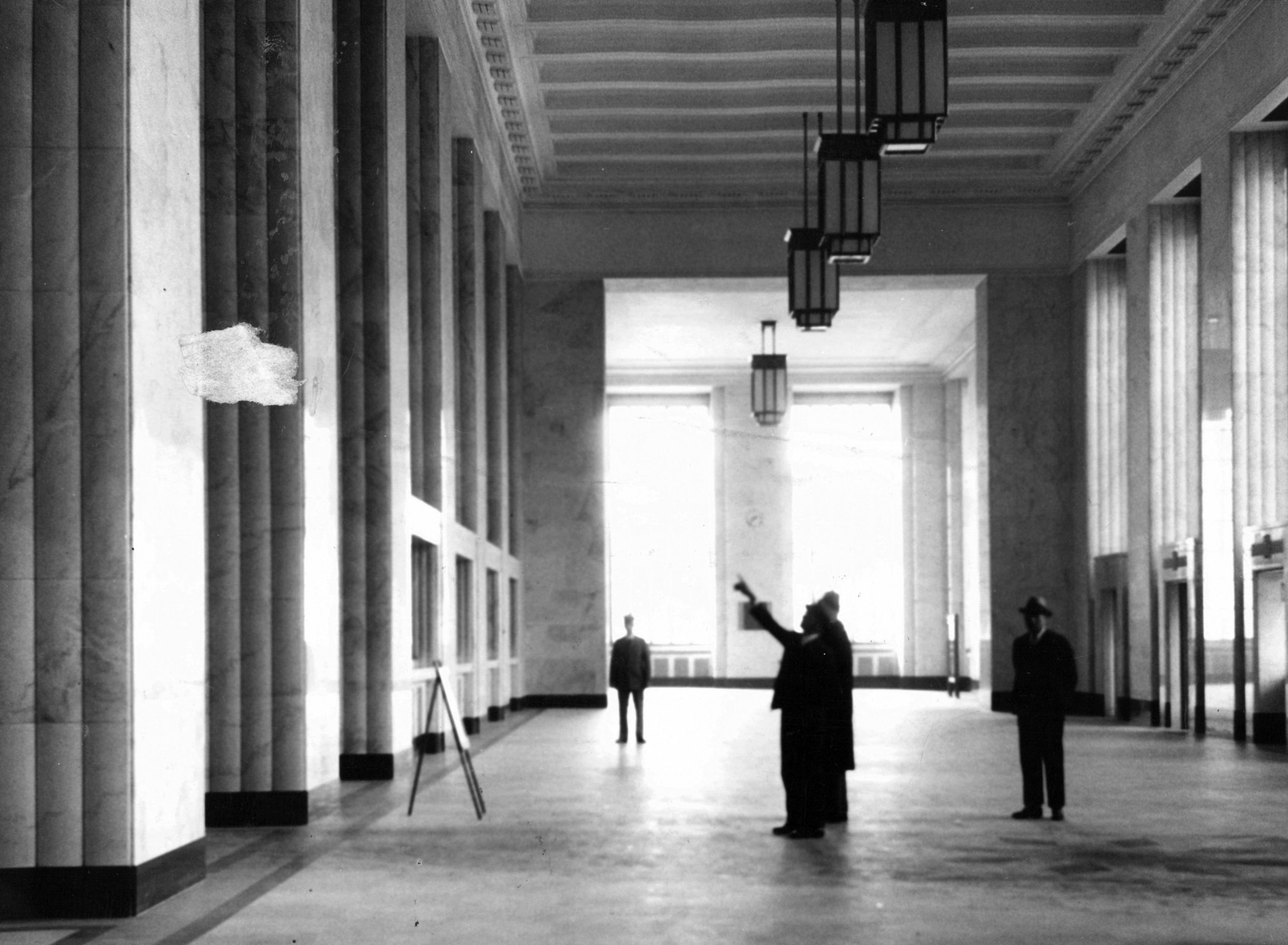
The main lobby of the new federal post office on the Van Buren street side in 1933, prior to the building’s dedication.
The new main post office building at Canal and Van Buren streets in Chicago. The building opened to the public in 1932.
Chicago’s new post office was dedicated in a ceremony on Feb. 15, 1933. “Some 2,000 persons attended the ceremonies, which included speeches, singing, and music by the post office band, in the spacious marble and gold mosaic lobby at the Van Buren street entrance,” reported the Tribune.
“Figure of the Republic”, created by sculptor Oskar J.W. Hansen, will decorate the main Chicago post office in 1934. The figure was created for the Public Works Art Projects administration to decorate the main concourse of the building. The Tribune reported the design as, “Two huge wings extend upward from the figure, which, Mr. Hansen announced, epitomizes the physical daring and spiritual alertness of the true type of American manhood.”
Walter F. Brown, postmaster general, speaks at the dedication of the new post office building at Van Buren and Canal streets on Feb. 15, 1933. A cluster of American flags are draped behind him.
Here are three of Uncle Sam’s hard-tired mail trucks, photographed on July 8, 1933, at the United States main post office building in Chicago. Illinois law required pneumatic tires on vehicles driven faster than 10 mph. The truck to the left was checked at speeds between 15 and 20 mph in a run with mail to the North Western railroad station. The law, passed in 1931, was intended to protect pavements from destruction by uncushioned wheels.
Light beacons were turned on at the main Chicago post office to mark the taking off at San Francisco of the China Clipper with the first Pacific air mail in 1935.
Mail carriers leave the Canal Street side of the new post office with the last delivery of Christmas mail for the Loop on Dec. 24, 1936.
Chicago’s main post office is the tall building in the background, with Union Station in the foreground in 1938.
An aerial photo shows the main Chicago post office in 1939.
Forty-three postmasters and their assistants from Illinois and Indiana wait on the roof of the main post office to watch a helicopter land during an exhibition for them on Sept. 29, 1940. They learned how the mail will be picked up and delivered to them from the main post office at Harrison and Canal streets in Chicago.
A view of Chicago’s main post office building from the air in 1938 shows the 50 by 50 foot spot on the roof where pilot John M. Miller was to land his autogiro to launch air mail week. This photo was taken from a TWA plane.
Postmaster Ernest J. Kruetgen, left, and Harry McGann, foreman of foreign parcel post, examine packages to be sent to service men for Christmas gifts on Oct. 12, 1943.
The entrance to the post office on Canal Street is seen in 1941. It was to become part of the Congress Parkway.
Mailmen are jubilant over their raise in pay at the post office in 1945.
Jeannette Lee, 22, is the first and only female mail carrier for the city of Chicago in 1944. Lee is posing on Dec. 15, 1944, in the truck she drove to pick up mail. The Tribune reported, “Meet Chicago’s first woman mail truck driver. She is Mrs. Jeannette Lea, 22, of 6210 Harper Ave., who is attached to the South Shore post office, 2207 E. 75th Street. She started Thursday and yesterday made the collection trip alone. ‘I’d like to have more drivers like her,’ Supt. Michael C. McCarthy said. ‘She keeps to her schedule and can handle a truck like a veteran. I’m certainly satisfied.’ The woman driver is a widow with a 3 year old daughter.”
A service was held in the lobby of the main post office to dedicate a plaque for the war dead on Nov. 27, 1946.
Postmaster Ernest J. Kruetgen, right, waves a greeting to mail carriers as they set out from the main post office with holiday packages for delivery on Dec. 19, 1946.
Employees in Chicago’s main post office sort and distribute a mountain of packages on Dec. 17, 1952. Outgoing sacks of parcel post totaled 2,853,810 in the first 16 days of December.
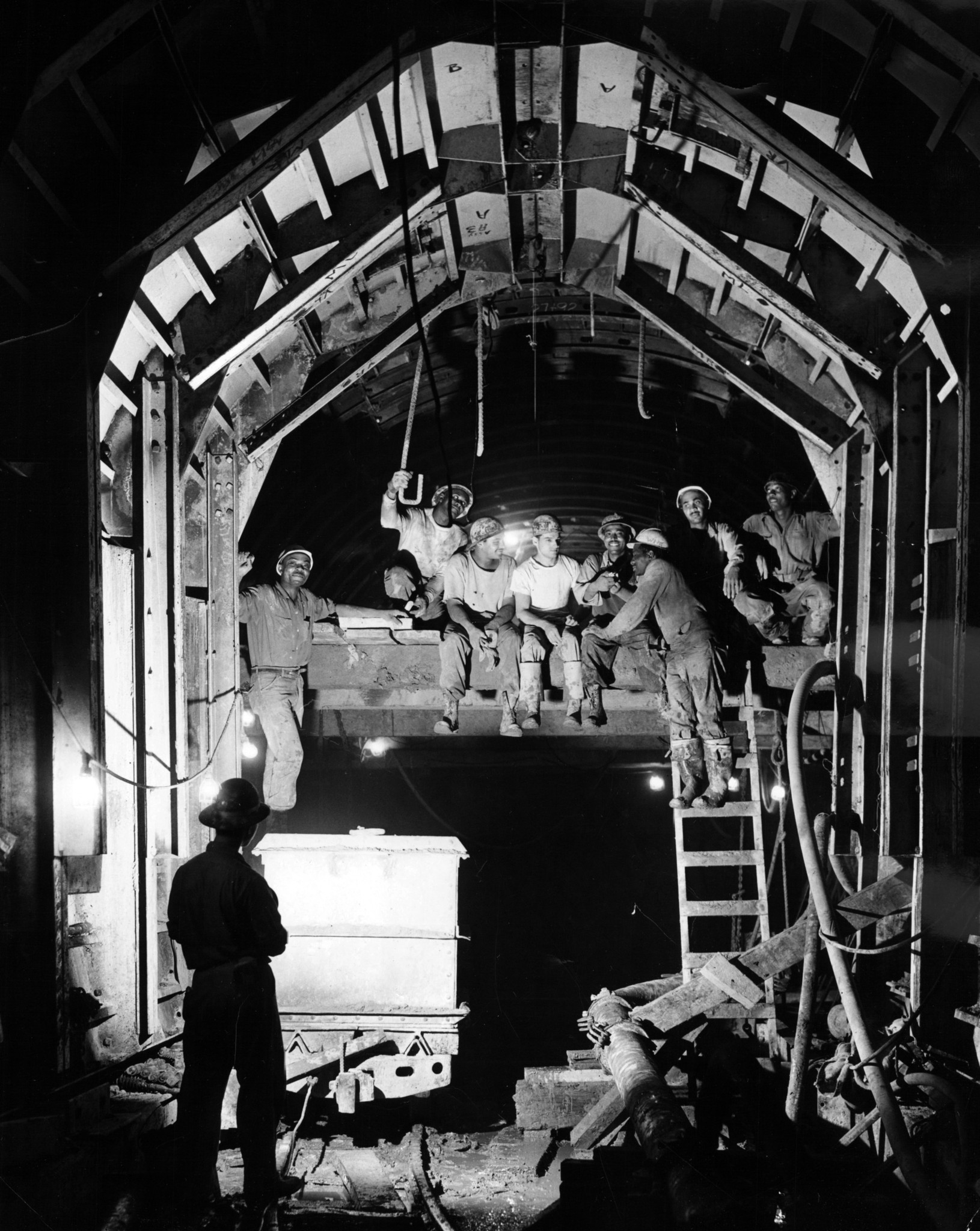
Workers take a break in a tunnel under the main post office where the Congress Street subway is being cut through clay in July 1955.
Men sit at the sorting bins for Air Mail to be handled by helicopter from the roof of the main post office building on March 25, 1950.
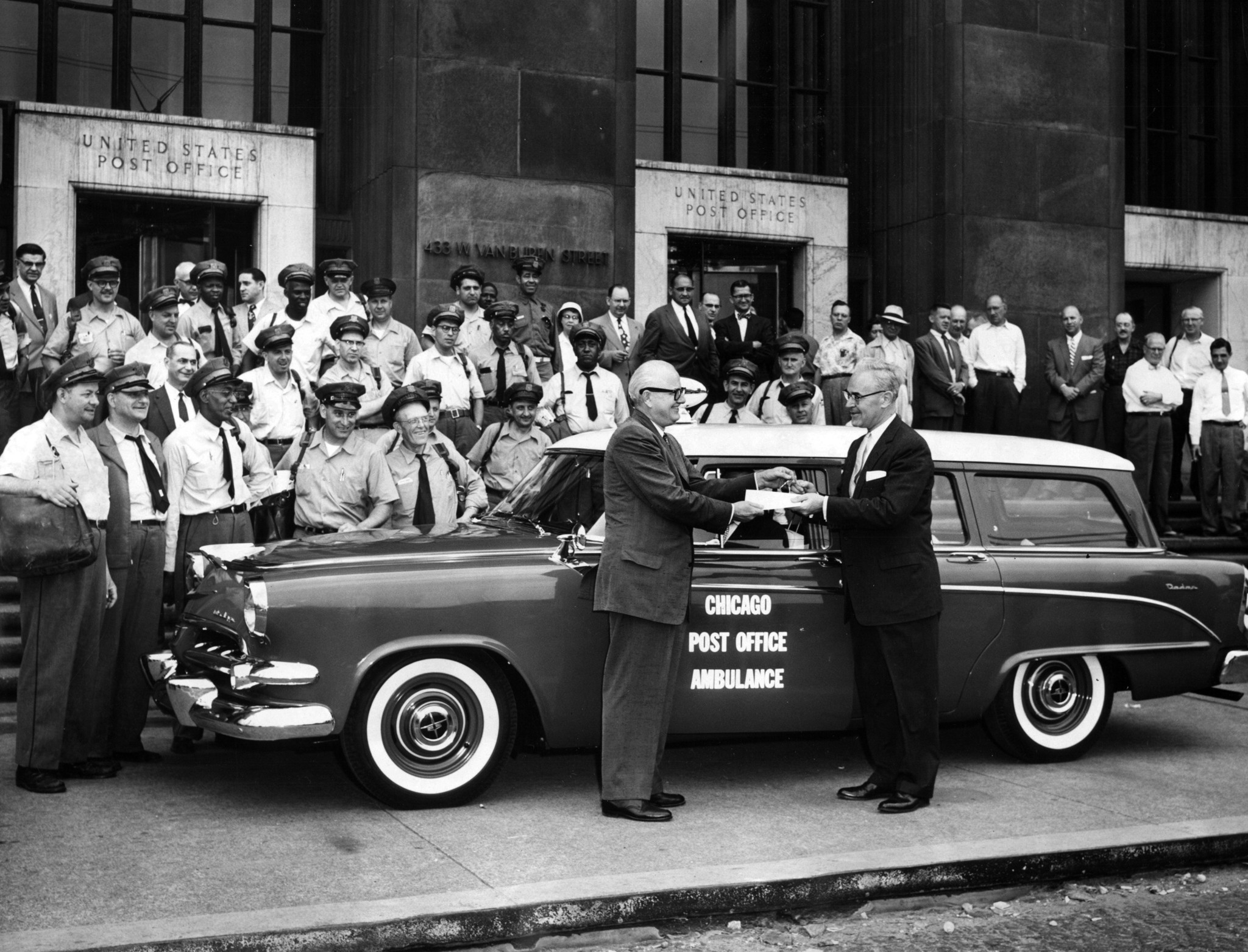
Postmaster Carl A. Schroeder, of Chicago, presents the keys to the new post office ambulance to Edward B. Landry, representing Postmaster General Arthur E. Summerfield, on June 19, 1956, outside of the main post office at 433 W. Van Buren Street. Landry is director of safety and health for the post office department in Washington, D.C.
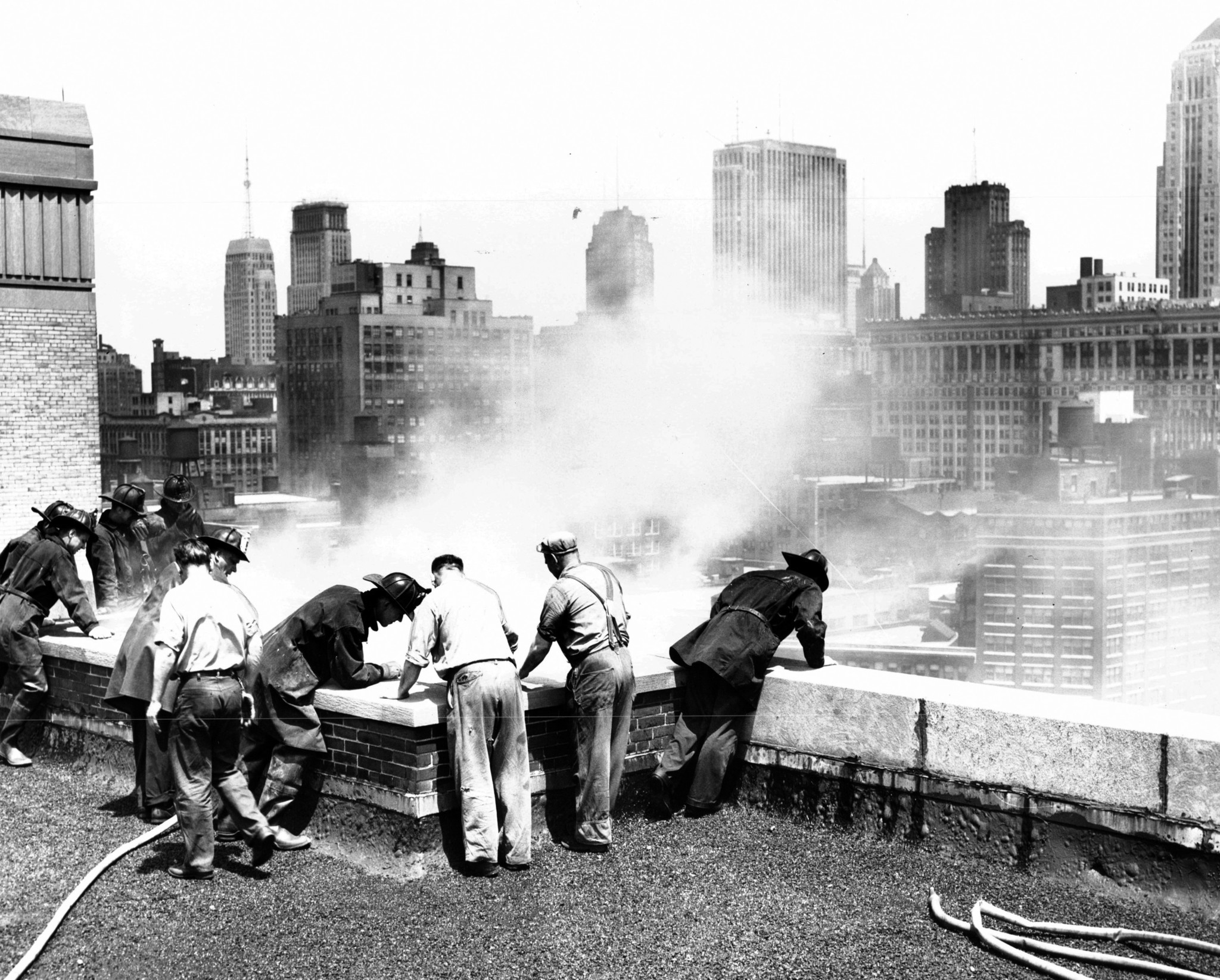
Firemen, assisted by post office employees, fight a fire on the roof of the main Chicago post office on May 31, 1956. The fire was in a smoke shaft extending from the railroad yards beneath the building and spread to lower floors. A mail helicopter was preparing to land and had to circle the roof three times before coming down to land with a load of mail.
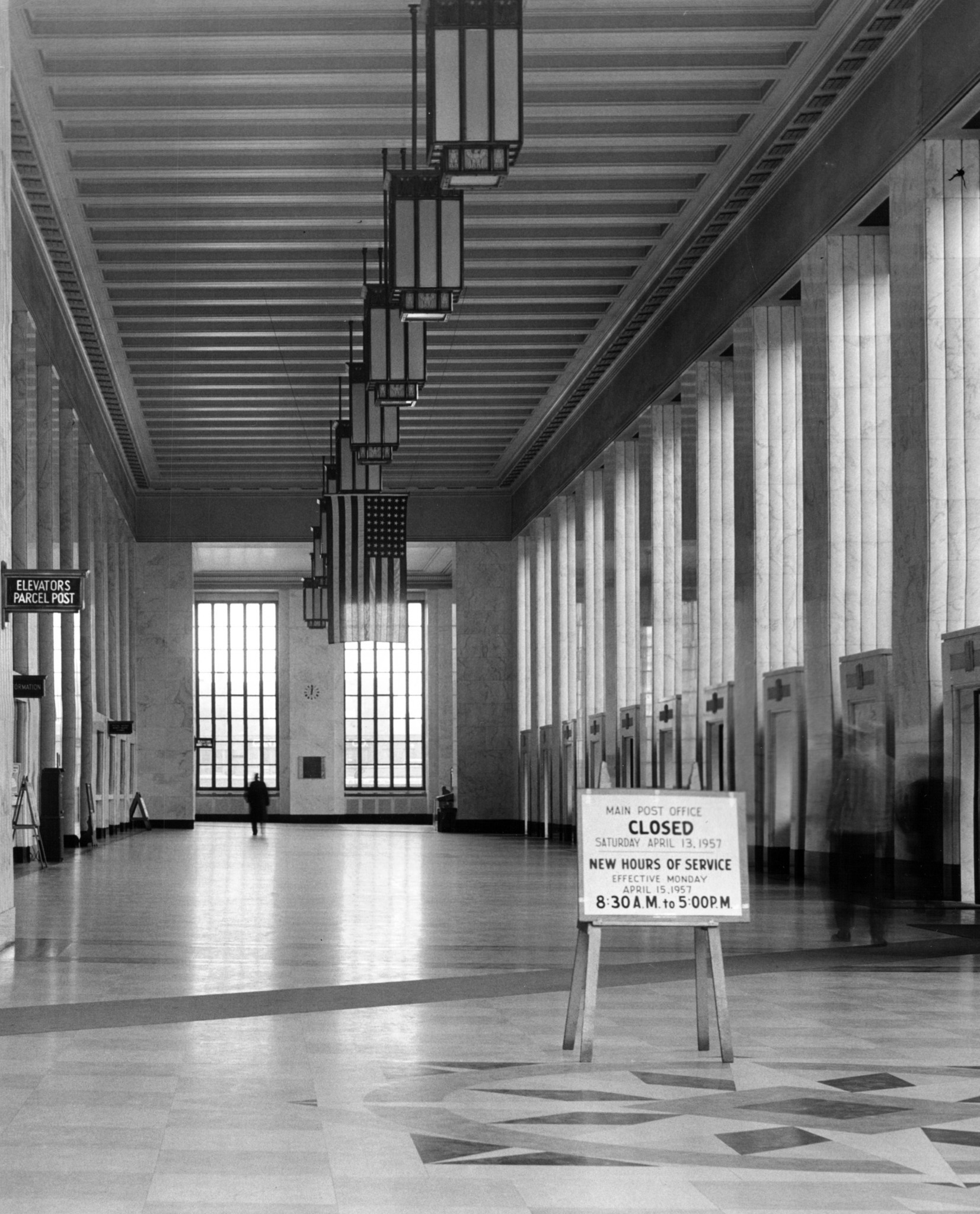
The interior of the lobby of the main post office features a sign announcing new hours for the post office in 1957.
Judith Yocius, 11, left, and her father, Dominick, view an array of typewriters as they stand with others at the post office “back to school” auction of unclaimed merchandise at the main post office on Aug. 14, 1962.
The Van Buren Street entrance of Chicago’s main post office shows the building getting a face-lift on July 30, 1965.
Hundreds of early arrivals wait at the main post office on Nov. 5, 1964, where applications were being taken for temporary jobs during the annual Christmas mail rush. A few of the applicants arrived as early as 3 a.m. to be in line when registration for the jobs began.
Charles Barton, a clerk in the main post office, pushes a mail cart past an idle conveyor belt en route to an elevator on the first floor on March 3, 1965. The conveyor, which cost $100,000, takes 20 minutes to move mail to the ninth floor for sorting operations. By elevator it takes only five minutes. Controler General Joseph Campbell has charged that bureaucratic bungling by postal officials in Washington resulted in $558,000 in new equipment in the Chicago post office that was never used.
Mail was moving well through the main post office during the holiday season on Dec. 20, 1966. Early mailing eliminated the usual last minute rush.
A crowd gathers in the lobby of the main post office on Oct. 26, 1965, as the first applicants arrive to seek Christmas mail jobs. Postmaster Harry Semrow, left, hands out application blanks. The post office was seeking 12,500 temporary workers to handle the rush of holiday mail.
The long conveyor belt, ever in motion in the environs of the Chicago post office, is the main artery of the parcel post system on Aug. 8, 1967. Every package mailed in the city is shuttled from here into the labyrinthine postal channels that lead eventually to its destination.
Delores Lynch sorts mail at the main post office building in 1969.
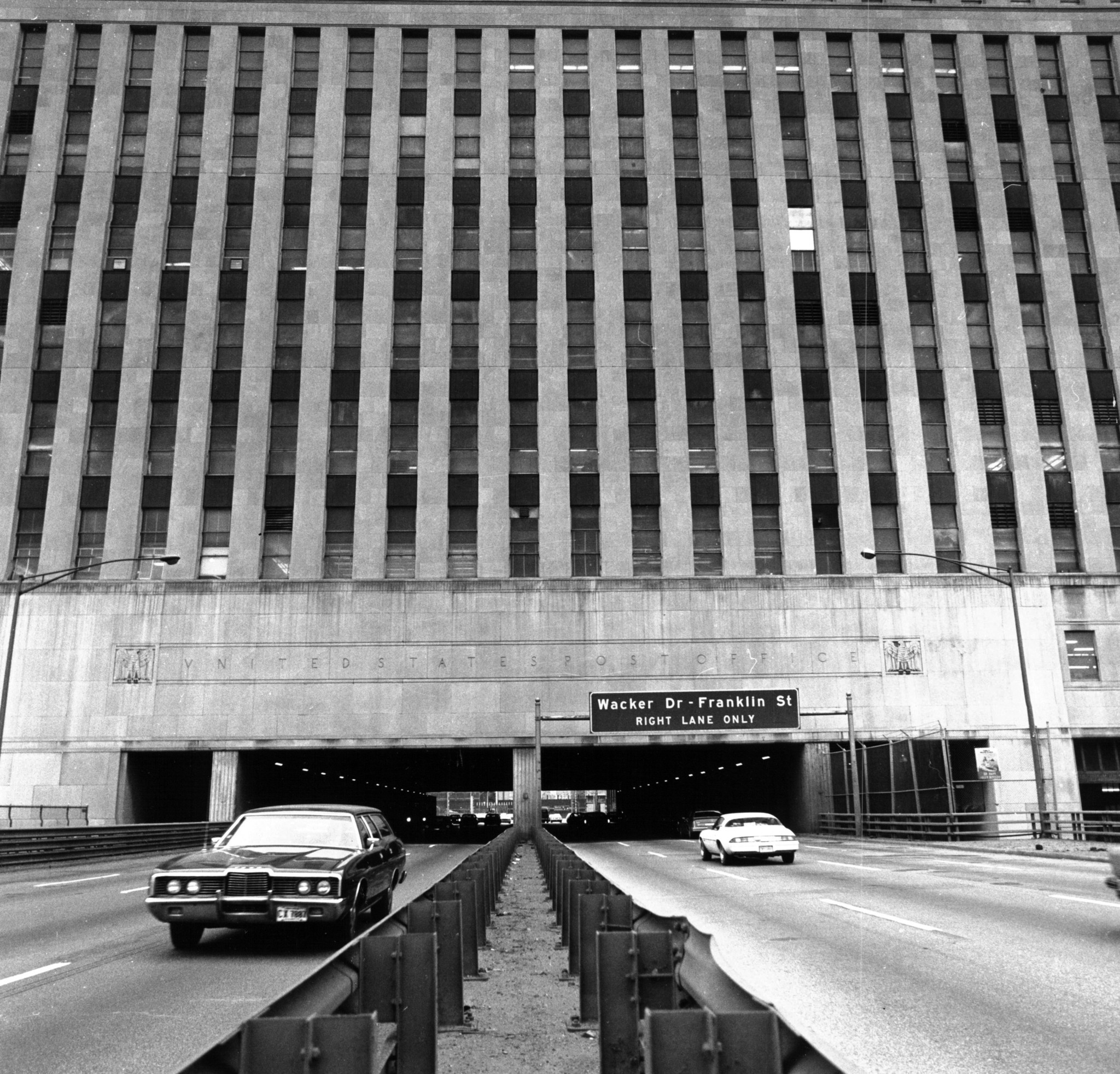
The nation’s largest post office, Chicago’s main post office shown here in 1978, has the Congress Parkway running through the center of it. Master planner Daniel Burnham cooked up the idea in 1909. The hole was provided when the building was constructed in 1932. The expressway opened in 1956.
Chicago’s main post office on Jan. 29, 1976.
Chicago postal workers Joe Meier and Wayne Harris cope with a large volume of mail with the aid of machinery that sorts mail by size at the main post office on Dec. 18, 1974.
A group of about 250 demonstrators have a brief shoving match with post office security personnel on May 11, 1978, at the main post office. The demonstrators were from the Westtown Citizens Coalition and were protesting what they considered discriminatory hiring policies from the post office.
Sorters at Chicago’s main post office separate mail by zip codes on Dec. 23, 1982. The central region has been processing mail so efficiently this holiday season that nonpreferential mail was being delivered the week before Christmas for the first time, officials say.
A view of the main Chicago post office from the Eisenhower Expressway’s approach on July 11, 1983.