

Orland Park residents will see a new village tax later this year on their electric and natural gas bills, as the village looks to generate more revenue to pay for capital improvement projects and reverse course on spending practices that were leading to deficit spending.
The Village Board voted Monday to approve the utility tax, although it won’t go into effect right away, and also approved increasing the village’s home-rule sales tax.
The utility tax would be enacted within 60 to 90 days after approval of the ordinance, according to the village.
The tax is estimated to generate $3.5 million to $3.9 million annually, and the revenue will be set aside for projects including an indoor police firing range and a police training center.
Residents will see the tax on their ComEd and Nicor bills, and the village estimates the average resident will see an increase of $12.55 per month between gas and electric costs.
The home-rule sales tax, in place since 2002, is 0.75% and would increase to 1.25% starting Jan. 1 of next year. The home-rule sales tax doesn’t apply to groceries or medicine.
Orland Park’s overall sales tax rate, now 10%, would increase to 10.5% at the start of next year.
The village estimates the half-point increase would bring an additional $7.6 million in revenue annually. According to the village, shoppers from outside of Orland Park account for generating 60% of revenue from the home-rule sales tax.
For 2023, the village estimates sales tax revenue, including the village’s share of state tax along with the home-rule tax, to be $44.8 million.
Mayor Keith Pekau and village trustees said work will continue to curb spending where possible, but revenue sources are needed to pay for big capital projects, such as roads and parks.
“The choice really is to do what we’re doing or let our roads and parks and all that not get fixed and let that decline,” Pekau said. “We were elected to be adults and make the hard decisions.”
The board also approved a five-year capital improvement plan, with the utility tax and higher home-rule sales tax providing revenue for those projects.
The capital plan, which extends through 2027, also calls for reducing property taxes paid to the village. Orland Park’s share of the tax bill is a bit more than 6% but the target is to bring that down to 5%.
The village is seeking $13.9 million this year for the 2022 tax levy, which is up 2.4% from the prior year’s levy of $13.6 million. The goal is to bring the levy next year down to $13.4 million.
Orland Park is also doing away with $30 vehicle stickers which funded pavement resurfacing. The revenue comes to $400,000 annually — the village estimates as many as a fourth of vehicles in the village lack a sticker — but the pavement program costs about $6 million a year.
The village has been using fund balances to pay for capital projects along with issuing bonds, but the report and spending plan adopted Monday says that practice isn’t sustainable.
The trend of positive fund balances in the village’s General Fund is projected to reverse course in the coming years, according to the report.
At the end of 2021, the General Fund ended with a balance of nearly 60% — or money that wasn’t spent and carried over into the 2022 budget year — but that balance shrank to 48% last year and the fund is expected to have an unspent balance at the end of this year of just under 24%.
The report states if the village continues to tap fund balances for capital projects, the General Fund will reach a negative fund balance of $20 million in 2025, growing to $60 million in 2027.
“The village’s revenues are not expected to keep up with the cost of current service and capital expenditures,” according to the report.
Based on the projections in the capital investment report, village officials have little choice, Trustee Cynthia Katsenes said.
“Do we cut services or do we look at other revenue sources?” she said.
Through 2027, according to the capital plan, total spending is estimated to be close to $198 million.
That will include nearly $71 million on streets, $57 million on facilities including an indoor police firing range, police training facility and public works garage, and $21 million on park upgrades.
Adoption of the capital plan is “neither a firm commitment to a particular project nor a limitation to a particular cost,” according to the plan.
Paying for the capital play will also include new borrowing on top of existing village debt, according to the report.
The report notes borrowing planned for this year of nearly $14 million, and the village last year completed two bond sales, one of $11.3 million for road improvements and land acquisition, and a second issue of $11.8 million for improvements at village parks.
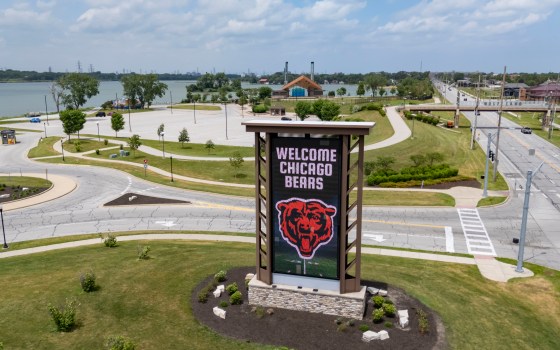
Schussler Park and Centennial Park West are among parks being renovated under the capital spending plan. The board also voted Monday to spend about $10 million for a concert stage at Centennial Park West. The village has been holding concerts there the past few years.
Under the terms of the contract, work is expected to be substantially complete by next April and include a stage as well as lawn seating, band rooms and a hospitality suite as well as restrooms and showers for performers.
mnolan@tribpub.com