A Union Station rail platform formerly used for U.S. mail trains, on Dec. 9, 2024. Construction is scheduled in 2025 to return some old platforms to active use. (Eileen T. Meslar/Chicago Tribune)
Long-running plans to revamp Chicago’s Union Station are poised to take a step forward in 2025, as Amtrak prepares to begin modernizing and boosting capacity at the commuter and intercity rail hub.
But the construction marks only one step of Amtrak’s plans to overhaul parts of the station. The railroad, which owns Union Station, still needs to line up more funding for the rest of the work, a prospect that could face questions with a new presidential administration set to take office.
Plans for Union Station include rehabbing old, abandoned platforms that once served trains carrying U.S. Postal Service mail, returning them to service to add capacity for more trains. Amtrak also plans to overhaul the station concourse to improve the way passengers move through the area, renovate and expand other platforms and bring them into compliance with the Americans with Disabilities Act, and make other upgrades.
The nearly 100-year-old station, which serves Metra and Amtrak trains, was last renovated in 1991. The latest work is intended to help accommodate more passengers, improving their flow through the station and allowing them to board and disembark trains quicker.
The work is set to begin next year with construction to return the former mail platforms to service, which could begin as soon as the spring, Amtrak spokesperson Marc Magliari said. Amtrak is also working on designing the revamped concourse, and plans later in the year to share initial ideas with the public, he said.
Construction outside Union Station on Canal Street will also continue into the coming year. The street has been closed near the station since summer 2023 while the Chicago Department of Transportation rebuilds the road, and Amtrak has had to stop using one of the tracks below during the work, Magliari said. CDOT spokeswoman Erica Schroeder did not provide an estimated timeline to finish the project.
For revamping the station and platforms, Amtrak has received about $137 million in federal grants and an annual appropriation, along with additional money for a larger Chicago-area rail improvement project. Combined with local money from Chicago and Cook County, the railroad expects to already have enough to complete construction on the former mail platforms, Magliari said.
But more money will be needed for work to widen the other platforms and redesign the concourse. Magliari declined to put a price tag on the rest of the project, saying costs couldn’t be estimated until design work was finished. The railroad is actively applying for more federal grants, he said.
Amtrak will be seeking more funding from the Trump administration and a Republican-controlled Congress likely to be less enthusiastic about funding passenger rail than President Joe Biden, well known to be an Amtrak fan. President-elect Donald Trump tried to slash funding for some Amtrak service during his first administration, though observers say it’s too soon to know what could be in store for station projects like those in Chicago in the coming years.
Chicago Tribune historical photo
Ellen Schmitz, 16, of St. Louis, waits in vain for a train at Union Station in 1960. Travelers were stranded in Chicago and other cities when the strike of the Pennsylvania railroad began. It also halted freight shipments.
Chicago Tribune historical photo
The concourse of Chicago's Union Station in July 1969. The Semaphore Luncheonette is on the left against the far wall and the Iron Horse Cocktail Lounge is on the right side of the far wall, both owned by Fred Harvey.
Chicago Herald and Examiner
People walk through the newly opened Union Station on May 16, 1925.
Chicago Tribune historical photo
Sunlight streams into the concourse of Chicago's Union Station in September 1957.
Karen Engstrom / Chicago Tribune
Travelers make the best of a delay and high water caused by firefighters dowsing a fire in an adjacent portion of Union Station on July 26, 1980.
Chicago Tribune historical photo
Rail fans swarm over an old steam locomotive (a Chicago, Burlington & Quincy 4-6-4 Hudson 3001) in Union Station after a trip from Chicago to Rock Island and back in 1958. The trip was made by 800 people.
Chicago Tribune historical photo
The concourse at Union Station in April 1969.
William Kelly / Chicago Tribune
Union Station on Aug. 16, 1972.
Irvin Heberg/Chicago Tribune
A group of boys wave goodbye on July 6, 1950, as they leave on a train out of Union Station for a Chicago Boys Camp in Winona, Indiana.
Chicago Herald and Examiner
Union Station is under construction in an undated photo. The building opened in 1925, after being under construction for over a decade. World War I impeded the construction process.
James Quinn / Chicago Tribune
The information booth in the center of the Union Station concourse, which served travelers since the station opened in 1925, was moved to make way for a Fred Harvey store. The new information booth, shown on Feb. 4, 1956, was at the west end of the Fred Harvey shop.
Al Phillips, Chicago Tribune
The Burlington Zephyr chorus sings traditional Christmas carols to travelers in the waiting room of Union Station on Dec. 23, 1964.
James O'Leary / Chicago Tribune
A throng of homeward-bound commuters waits in Union Station during the evening rush hour for a chance to board trains on March 19, 1965. Commuters were delayed almost an hour when three Burlington's Empire Builder cars derailed near 12th Street, blocking the tracks.
Chicago Tribune historical photo
Chicago's Union Station concourse is demolished in 1969.
Chicago Tribune historical photo
Members of the Dawn to Dusk club bid farewell to the Zephyr prior to an overnight dash from Chicago to Denver in 1936. "Zeph," the club's mascot, joined in the departure festivities.
Chicago Tribune historical photo
Men work to clear Union Station of floodwater in 1936.
Jack Mulcahy / Chicago Tribune
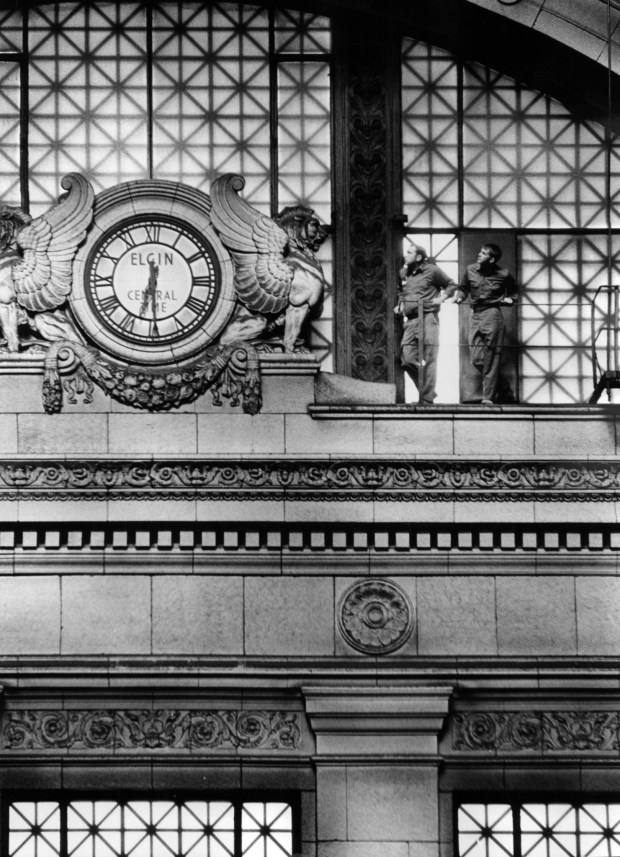
The Union Station concourse clock was stopped on May 16, 1969, exactly 44 years after the station opened at 6:30 a.m. May 16, 1925. Wayne Bratz, left, general manager of Boyas Excavating Inc. of Cleveland, stopped the clock ahead of construction work. Bratz is accompanied by assistant Jim Savory.
William Yates / Chicago Tribune
An early-morning strike added extra commuters to the Milwaukee Road & Burlington Northern trains, making Union Station, where both lines terminate, more crowded than normal on Sept. 5, 1978.
William Kelly, Chicago Tribune
In 1972, plans involving Union Stations air rights were bring considered. This photo is looking south from Jackson Boulevard to Van Buren Steet on Aug. 16, 1972.
Chicago Tribune
Alberto and Ada Guglielmi and their son, Jean, 7, pose with famous actor Rudolph Valentino and his dog, an Irish Wolfhound named Centaur Pendragon, at Union Station in Chicago during a visit in February 1926, just a year after the building opened. Celebrities stopped over at the station on their trips between New York and California.
James O'Leary / Chicago Tribune
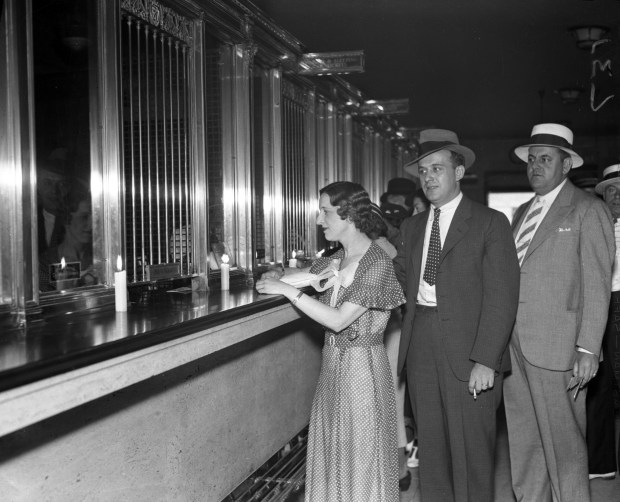
Long lines of travelers wait at the ticket windows in Union Station on July 8, 1966, after a strike against four airlines operating from O'Hare International Airport disrupted the flying accommodations for thousands of people.
Jack Dykinga / Chicago Tribune
A throng of people crowd Union Station as they prepare to leave the city for a prolonged Fourth of July holiday weekend on July 2, 1965. The crowd is lined up at the train gates.
Chicago Tribune historical photo
The concourse at Chicago's Union Station in 1956.
Bob Rea / Chicago Tribune
Roy Carlson and Charles Gorham give out information to the holiday crowds at Union Station in December 1935.
Chicago Tribune historical photo
The tracks running into and under the concourse of Chicago's Union Station in September 1953. Jackson Boulevard is in the foreground.
Chicago Tribune historical photo
Lt. O'Donnel holds a gun that was found in a trunk at Union Station on Feb. 9, 1939, after an accidental shooting at Union Station.
Chicago Tribune historical photo
Union Station's Great Hall is under construction, circa 1924.
Chicago Tribune historical photo
Union Station in 1924, before it opened to the public the following year. It took 10 years to build the railway terminal due to World War I delays.
Bob Rea / Chicago Tribune
Union Station ticketer George Robbins takes tickets from a happy crowd going home for the holidays in December 1935.
George Quinn / Chicago Tribune
A firefighters' strike halting Pennsylvania Railroad traffic was felt at Union Station on April 1, 1966, where the big waiting room, usually bustling with travelers, had only a few people waiting for trains. Union firefighters declared a strike at eight railroads and halted Illinois Central commuter service.
Carl Hugare / Chicago Tribune
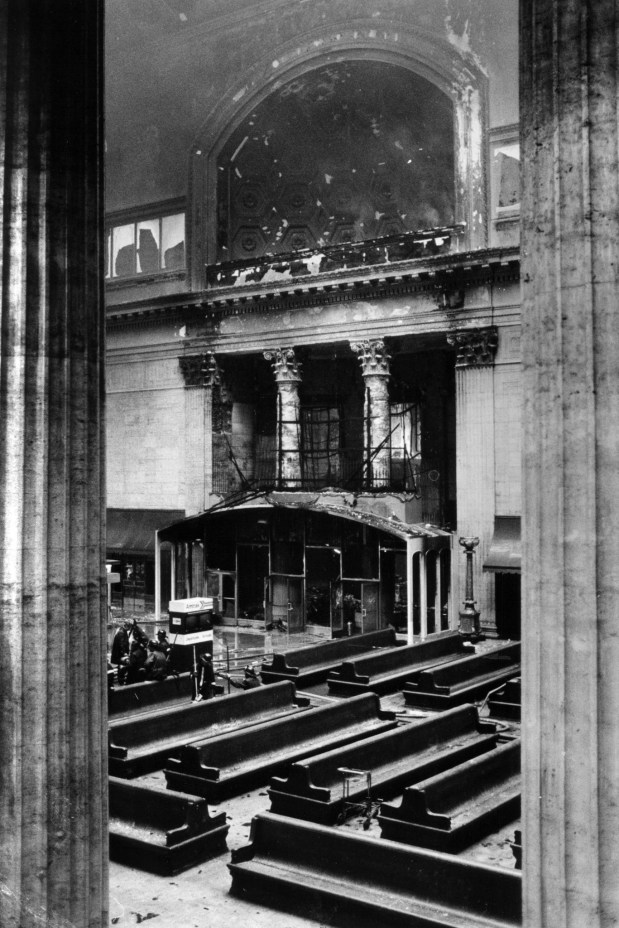
The charred damage can be seen where firefighters fought a fire in Union Station on July 26, 1980.
Chicago Tribune historical photo
A broken water main floods Union Station on July 21, 1936, stopping trains and travelers.
Chicago Tribune historical photo
People gather in the Great Hall during the official Opening Day of Union Station in Chicago in 1925. The Great Hall, one of the nation's great indoor public spaces, is no small thing. Designed by Chicago architects Graham, Anderson, Probst & White, the hall forms the heart of Union Station.
Chicago Tribune historical photo
People stand at the ticket gates at Union Station after a water main broke and flooded the station in 1936.
William Kelly / Chicago Tribune
The McClennan Plaza building rises above the old station on Aug. 16, 1972. This photo was taken at Clinton and Jackson streets. The Sears Tower, right, is under construction.
Chicago Tribune historical photo
A man stands in the floodwaters at Union Station on July 21, 1936, after a water main broke.
Chicago Tribune historical photo
The Abraham Lincoln train pulls out of Union Station on its first run with a diesel-powered engine in May 1936.
Carl Hugare / Chicago Tribune
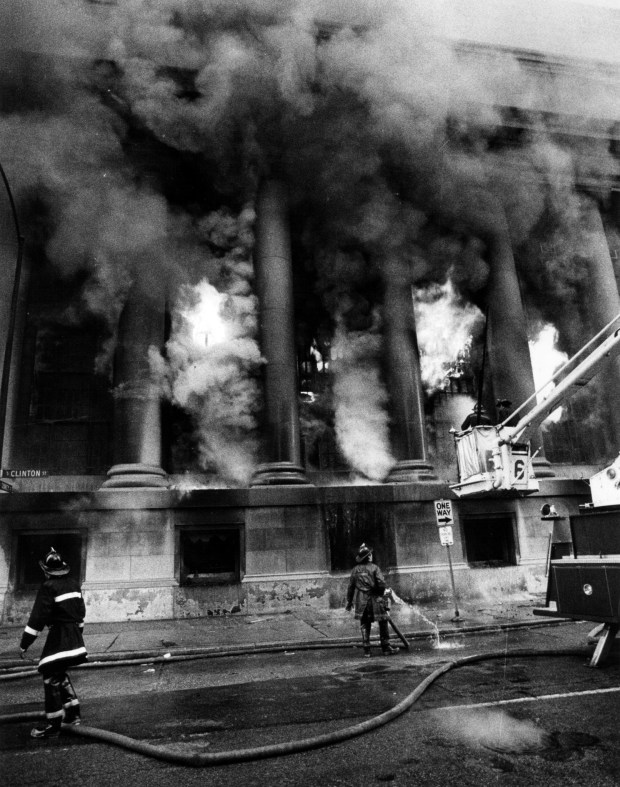
Firefighters battle a blaze in Union Station on July 26, 1980.
Alton Kaste / Chicago Tribune
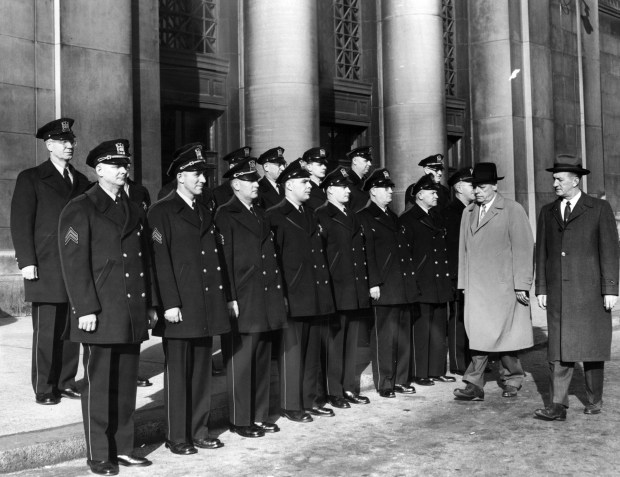
The annual inspection for Union Station police personnel is conducted by George P. Henson, second from right, the new Union Station general manager, and Patrick Tuoh, right, who is the chief of police at Union Station in 1957. Union Station employed its own police force.
Chicago Tribune historical photo
The concourse of Chicago's Union Station in an undated photo.
Chicago Tribune historical photo
A photo-diagram shows the entrance to the train shed at Union Station, where police Officer W. J. O'Brien fatally shot Earl Albitz after a shoot-out that started in the station in 1939.
Chicago Tribune historical photo
The old Union Station, shown here in 1915, would give way to a new building opened in 1925.
Chicago Tribune historical photo
Holiday crowds wait in Union Station on July 3, 1946, to board the Milwaukee Road's Chippewa train, which takes passengers to the vacation spots of northern Wisconsin and the Upper Peninsula of Michigan.
Leon Ardeleon / Chicago Tribune
Wreckers make progress tearing down the Union Station concourse building July 6, 1969. While demolition and construction was underway, commuters were rerouted through the main waiting area of the station office building.
Chicago Tribune historical photo
A view of the Canal Street entrance to Union Station shows the double stairway in 1925.
William Kelly / Chicago Tribune
An unusually large crowd waits at the commuter ticket windows in Union Station during rush hour on Aug. 30, 1962. Chicago's other transportation facilities were overwhelmed for a brief period because of the North Western railway strike. Extra ticket agents were assigned to relieve congestion and additional cars were attached to accommodate homeward-bound suburbanites.
Chicago Tribune historical photo
Chicago's Union Station is seen in 1959 with Jackson Boulevard on the left.
Chicago Tribune historical photo
A Pennsylvania train enters the terminal at Union Station on July 21, 1936, while the tracks were under water due to a broken water main. The station power plant and the basement of the new post office were also inundated.
Jack Mulcahy / Chicago Tribune
The exterior of Union Station on the east side of Canal Street, looking southeast, on Nov. 8, 1968. Note the Fred Harvey sign on the building.
Chicago Tribune historical photo
Three women walk on the tracks outside of Union Station in 1936, avoiding the flooded station.
Chicago Tribune historical photo
1 of 50
Ellen Schmitz, 16, of St. Louis, waits in vain for a train at Union Station in 1960. Travelers were stranded in Chicago and other cities when the strike of the Pennsylvania railroad began. It also halted freight shipments.
“Congress expects us to serve passengers well, they want to see ridership grow,” Amtrak CEO Stephen Gardner told Bloomberg Government in early December. “We’ve been able to do that, we’re going to continue to do that.”
Amtrak got a boost in funding from the 2021 infrastructure law, and grants funded under that law could be spared immediate cuts, said Audrey Wennink, transportation director for the Metropolitan Planning Council. The law funds infrastructure programs through 2026, and changes are more likely when it expires, she said.
Federal appropriations for Amtrak could change sooner, she said.
Still, work at Union Station is a strong candidate for federal money, Wennink said.
“I can’t project what this administration’s going to do, but there’s a lot of infrastructure here that exists and provides a lot of benefit,” she said. “And a lot of value can be generated by just some upgrades. I certainly hope that they’ll be successful (in getting more money), because it’s pretty chaotic in Union Station and we really need it.”
Old wiring at a rail platform formerly used for U.S. mail trains, on Dec. 9, 2024 at Union Station. (Eileen T. Meslar/Chicago Tribune)
The Union Station work is partly intended to accommodate more passengers. Amtrak recently announced the railroad reached record ridership nationwide during the year that ended in September, though ridership in Chicago has not yet exceeded prepandemic levels.
Union Station served slightly more than 3 million arriving and departing Amtrak passengers during the 12 months between October 2023 and September 2024, according to numbers provided by Magliari. That was up from 2.7 million the year before, but below the 3.3 million passengers Union Station served in 2019.
The station is also the terminal for six of Metra’s 11 train lines. About 110,000 Metra riders pass through the station on an average weekday, according to Amtrak figures. In 2019, Union Station served 32.6 million Metra passengers, but ridership on the commuter rail line has not fully rebounded since the pandemic.
An Amtrak employee drives people to board their train at Union Station, Dec. 9, 2024. (Eileen T. Meslar/Chicago Tribune)
Still, expanding Union Station’s passenger volume is critical to Chicago, said Rick Harnish, executive director of the High Speed Rail Alliance. With the rest of the funding for that work not yet identified, he called on the state, city and business community to step up efforts.
Even the money already awarded is a relatively small amount, especially compared with several large bridge and tunnel projects along Amtrak’s busy Northeast Corridor, he said.
“If we care about maintaining the strength of the Loop and the rest of the city, we need to figure out how to expand Union Station quickly,” he said.