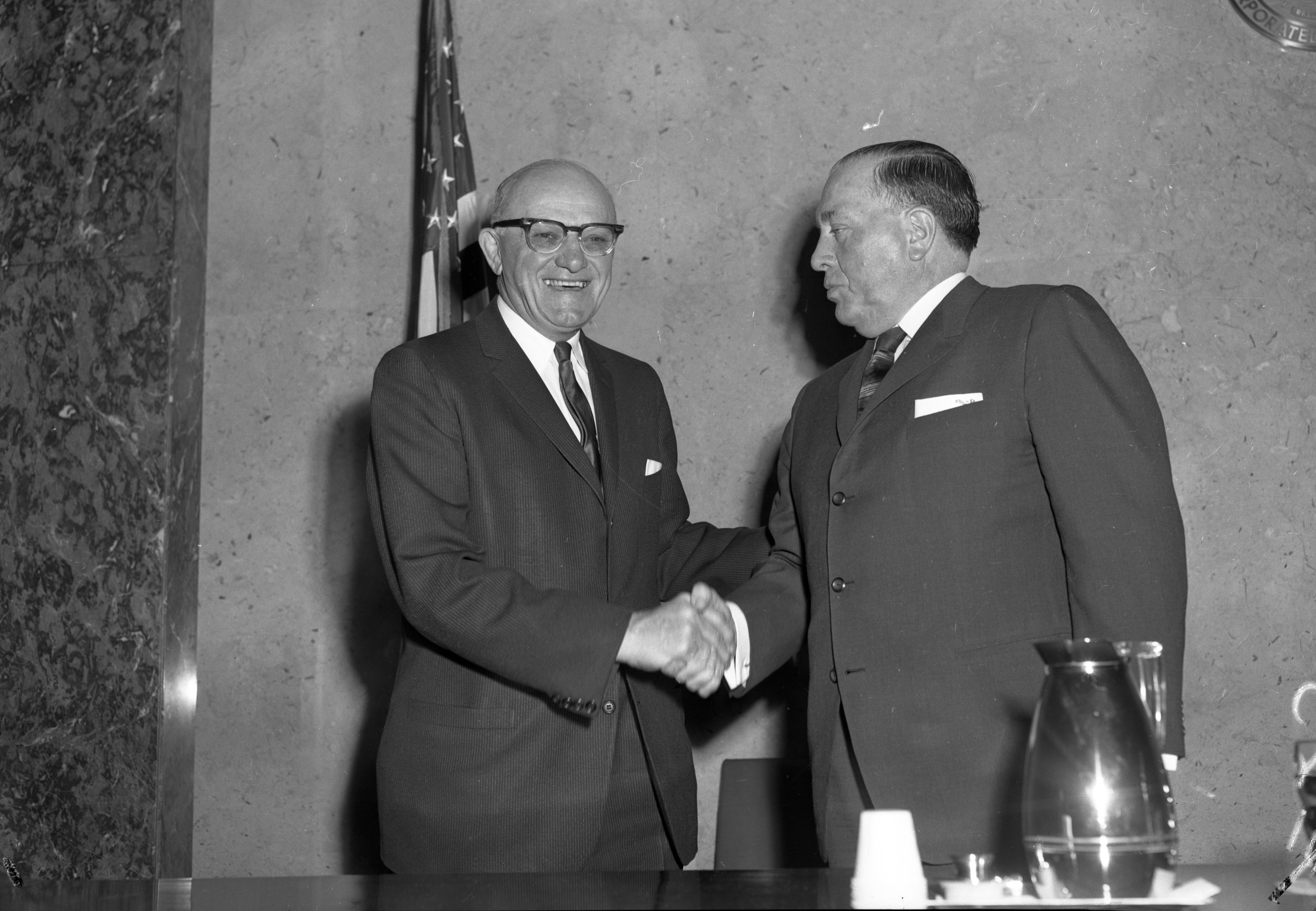
Bears coach George Halas, left, receives congratulations from Mayor Richard J. Daley on Dec. 18, 1963, at Chicago City Hall after being named Associated Press NFL Coach of the Year. (Frank Berger/Chicago Tribune)
“They’ll get the greatest contest they ever got in their life. They will like hell be called the Chicago Bears,” said the mayor of Chicago.
The year? 1975. The apoplectic mayor? Richard J. Daley. The provocation? A threat from the Chicago Bears to build a new stadium in Arlington Heights.
Daley huffed and puffed with red-faced indignation, even threatening a lawsuit over the intent of an NFL team to whisk Chicago’s proud name off to the northwest suburbs and stomp into suburban soil. As the great columnist Mike Royko pointed out at the time, Daley was not exactly on solid legal ground.
“And how will the great dumpling stop George Halas (who has been a Chicagoan even longer than Daley) from using the word Chicago?” Royko asked, rhetorically. “Apparently he has reached the point of thinking he has a copyright on the word ‘Chicago.’ If so, is he going to sue such suburban companies as the Chicago Cork Works of Niles, the Chicago Ink and Research Co. of Antioch, the Chicago Rubber Co. of Waukegan, the Chicago Scale and Slicer Co. of Franklin Park, the Chicago Automatic Door Co. of Skokie? And what about the Chicago Tavern on Route 50 in Wisconsin?”
Now here we are again, sans Royko. But instead of a theatrically enraged mayor of Chicago, we have a mayor basically washing his hands of the whole situation. “I’ve done my part,” Brandon Johnson said this week, blaming Springfield for not coming up with the public cash that the NFL franchise sought for a new stadium to be built on Chicago’s lakefront, a location that thwarted no less than George Lucas, master of the Star Wars universe. Lucas took his planned museum to Los Angeles; the Bears aren’t going nearly so far.
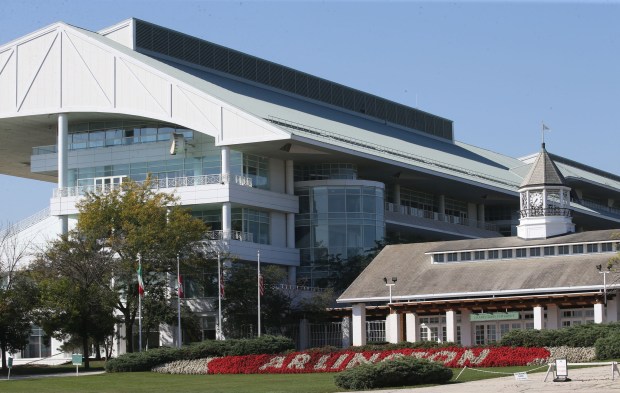
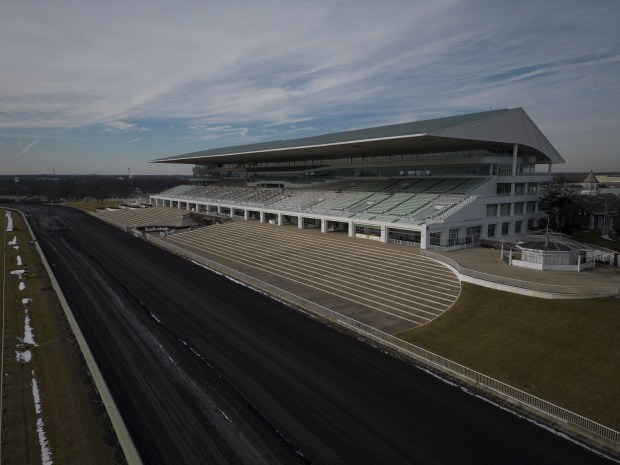
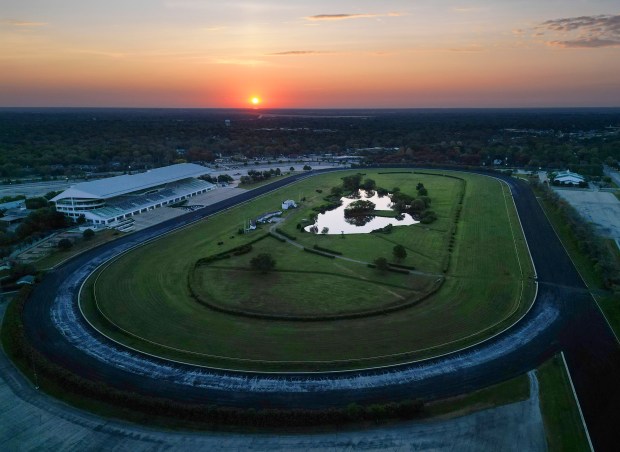
We long ago wearied of the media’s parroting of verbs like “pivot,” nouns like “focus” and squirrelly phraseology like “turning their attention towards,” all part of the Bears’ PR strategy to paint themselves as reluctant emigres. It’s been clear to us for several weeks now that Arlington Heights was the plan because Arlington Heights was always the plan. The actual moment when the Bears “pivoted” was when, in 2023, they finalized their purchase of a 326-acre plot of land for $197.2 million with the intent to build a domed stadium on the site of the former Arlington International Racecourse, just a matter of yards from where they threatened to go in 1975.
Sure, once the Bears hired Kevin Warren as their new president, an honest effort was made to consider a different future in the city of Chicago. But we’ve written many times before about the problems with that plan, which boiled down to two insurmountable obstacles: 1) the team’s illogical wish to build on the lakefront, with all its “forever open, clear and free” prohibitions, and 2) the lack of any appetite from either taxpayers or the governor of Illinois to subsidize the owners of a valuable NFL franchise with public funds from a strapped state. To make Chicago work, the Bears needed to offer far more skin in the game, which meant loosening familial ownership and picking a different site. (We had a few in mind.) But they did not. As is their right.
So while we guess there could be final twists and turns in this 50-year saga, time appears nigh to focus on one particular question: How much should Chicagoans resent this particular denouement?
We’ll stipulate that this move will come with some pain. There is poetry (of the Chicago style) to the Bears making their home in downtown Chicago. For some die-hard sentimentalists, it will never be the same.
But it’s long been true that the live Bears are mostly a local and suburban draw, far lagging the economic impact of, say, the Chicago Cubs, both in terms of appeal to tourists and the number of games. Thus the Bears’ departure will be an economic loss for the city, but it won’t be catastrophic. Other cities have survived. After all, the Dallas Cowboys play in Arlington, Texas, the New York Jets and Giants in East Rutherford, New Jersey, and the San Francisco 49ers play in Santa Clara, some 43 miles from the Castro. That’s 5 miles more than the distance from Soldier Field to the Arlington Heights site.
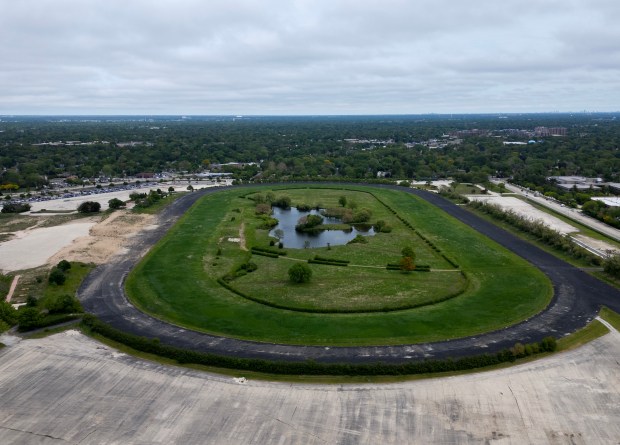
The former Arlington International Racecourse is seen on May 19, 2025, in Arlington Heights. The Chicago Bears own the property and may build a new stadium and entertainment district there. (Stacey Wescott/Chicago Tribune)
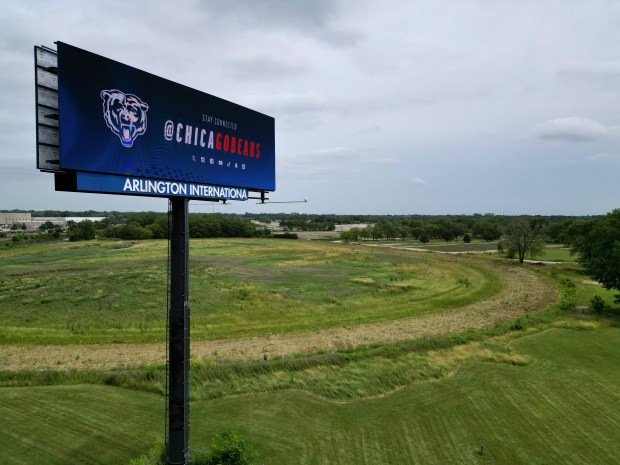
A digital billboard advertising the Chicago Bears sits near the practice track of the former Arlington International Racecourse near Route 53 and Northwest Highway on June 25, 2024, in Arlington Heights. (Stacey Wescott/Chicago Tribune)
The view from the neighborhood northeast of the former Arlington International Racecourse on Dec. 30, 2024, in Arlington Heights. The Chicago Bears own the property and could potentially build a stadium there. (Stacey Wescott/Chicago Tribune)
An aerial photo shows the former Arlington International Racecourse on March 12, 2024, in Arlington Heights. (Stacey Wescott/Chicago Tribune)
The former Arlington International Racecourse is seen on March 12, 2024, in Arlington Heights. The Bears purchased the Arlington Heights property last year. (Stacey Wescott/Chicago Tribune)
Stacey Wescott/Chicago Tribune
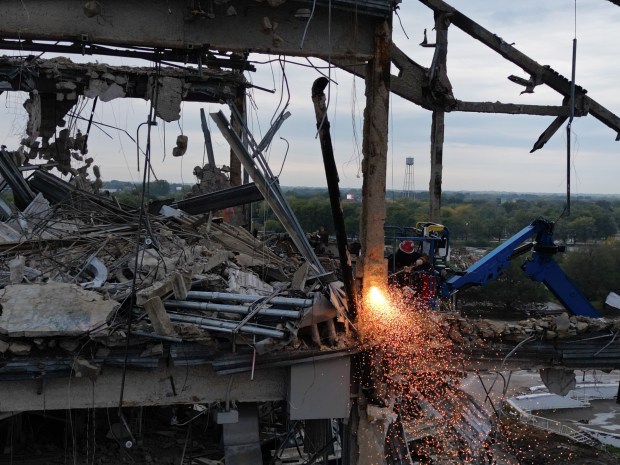
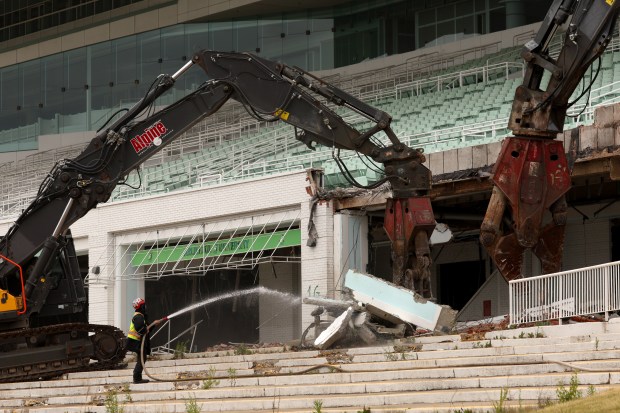
The grandstand at the former Arlington International Racecourse is dismantled on Sept. 25, 2023, in Arlington Heights.
Stacey Wescott/Chicago Tribune
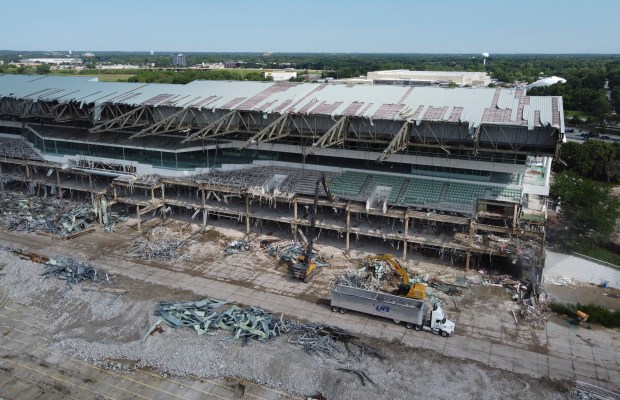
The shell of the grandstand remains at the former Arlington International Racecourse as crews continue to demolish it on Aug. 31, 2023, in Arlington Heights.
Brian Cassella / Chicago Tribune
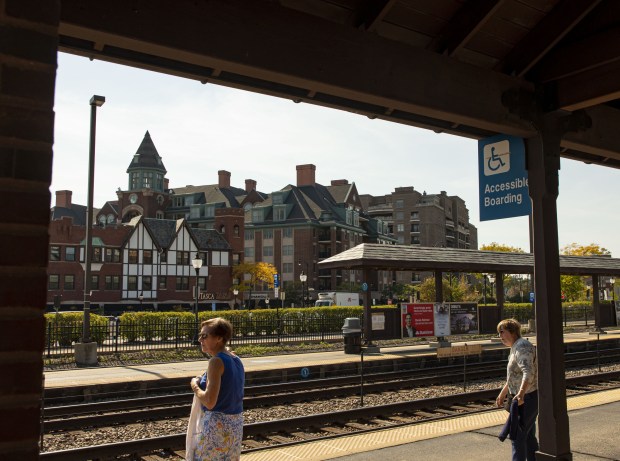
Riders wait for a Metra train at the station in downtown Arlington Heights on Sept. 29, 2021.
Antonio Perez / Chicago Tribune
People wait for a Metra train in downtown Arlington Heights on Sept. 29, 2021.
Antonio Perez / Chicago Tribune
Downtown Arlington Heights features a small park, condos, retail shopping and dining on Sept. 29, 2021.
Chris Sweda / Chicago Tribune
People walk through the intersection of Vail Avenue and Campbell Street in downtown Arlington Heights on Oct. 14, 2021.
Eileen T. Meslar / Chicago Tribune
Arlington International Racecourse property in Arlington Heights is seen on May 1, 2023.
Stacey Wescott/Chicago Tribune
Workers gather in a parking lot outside of the former Arlington Park to begin demolition on May 30, 2023, in Arlington Heights.
Stacey Wescott/Chicago Tribune
Demolition continues on the grandstand at the former Arlington International Racecourse on July 11, 2023, in Arlington Heights.
Stacey Wescott/Chicago Tribune
The grandstand of the former Arlington International Racecourse is razed on Sept. 25, 2023, in Arlington Heights.
Chris Sweda / Chicago Tribune
Selso Nuñez, of Palatine, dressed in Bears garb, peeks over the gate of Arlington International Racecourse as he looks for a spot to watch the fireworks following a day of races on Sept. 25, 2021.
Antonio Perez / Chicago Tribune
The former Arlington International Racecourse is shown behind the Arlington Park Metra train station on Oct. 28, 2021.
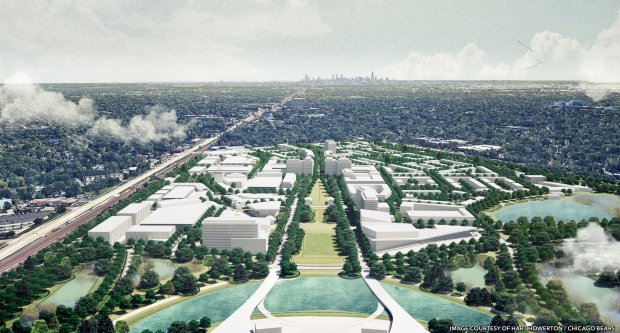
After buying the former Arlington International Racecourse in Arlington Heights in 2023, the Chicago Bears proposed building a $2 billion stadium there as part of a 326-acre development including entertainment and residential uses. (Chicago Bears)
Armando L. Sanchez / Chicago Tribune
Clouds pass over the now-closed Arlington International Racecourse on Sept. 6, 2022, in Arlington Heights.
Chris Sweda / Chicago Tribune
A rendering of the plan is shown as representatives from the Chicago Bears present their concept for building a new stadium and entertainment district on the site of Arlington International Racecourse during a public meeting at Hersey High School in Arlington Heights on Sept. 8, 2022.
Hart Howerton/Chicago Bears
A rendering released by the Chicago Bears shows the view from the proposed stadium of the Arlington Park entertainment district.
E. Jason Wambsgans / Chicago Tribune
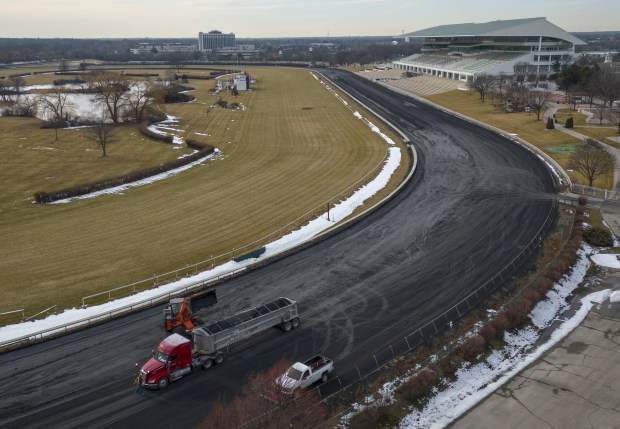
The synthetic racing surface is removed from the track at the Arlington Park International Racecourse property in Arlington Heights on Feb. 8, 2023.
Eileen T. Meslar / Chicago Tribune
The Arlington International Racecourse property in Arlington Heights is seen on May 1, 2023.
Stacey Wescott/Chicago Tribune
Construction equipment stands ready for expected demolition at the former Arlington International Racecourse at sunrise on May 30, 2023, in Arlington Heights.
Stacey Wescott/Chicago Tribune
Demolition continues on the grounds of the former Arlington International Racecourse on June 13, 2023, in Arlington Heights.
Stacey Wescott/Chicago Tribune
Demolition crews hired by the Chicago Bears begin knocking down the grandstand at the former Arlington International Racecourse on June 16, 2023, in Arlington Heights. The Bears are looking at the site to build a possible new stadium for the team.
Trent Sprague/Chicago Tribune
Demolition continues of the main grandstand at the former Arlington International Racecourse in Arlington Heights on Aug. 1, 2023.
Stacey Wescott/Chicago Tribune
Demolition of the grandstand continues at the former Arlington International Racecourse, Aug. 7, 2023.
Stacey Wescott/Chicago Tribune
Demolition of the grandstand continues at the former Arlington International Racecourse, Aug. 7, 2023.
Stacey Wescott/Chicago Tribune
Demolition continues on the grandstand and surrounding structures at the former Arlington International Racecourse, Sept. 25, 2023, in Arlington Heights.
E. Jason Wambsgans / Chicago Tribune
Arlington International Racecourse property in Arlington Heights is seen on Feb. 8, 2023.
Stacey Wescott/Chicago Tribune
A Metra train passes the former Arlington International Racecourse at sunrise on May 30, 2023, in Arlington Heights.
Antonio Perez / Chicago Tribune
Arlington Park International Racecourse in Arlington Heights is seen on Sept. 29, 2021. The Chicago Bears have signed a purchase agreement for Arlington International Racecourse, the near-century-old facility that likely hosted its final horse race last Saturday.
Erin Hooley / Chicago Tribune
Arlington Park International Racecourse is seen on Oct. 6, 2021, in Arlington Heights. The Chicago Bears have signed a purchase agreement for Arlington International Racecourse, the near-century-old facility that likely hosted its final horse race.
E. Jason Wambsgans / Chicago Tribune
A view of the former grandstand of Arlington Park International Racecourse property in Arlington Heights is seen on Feb. 8, 2023.
Stacey Wescott/Chicago Tribune
The former Arlington International Racecourse is seen at sunrise on May 30, 2023, in Arlington Heights. Demolition is expected to begin soon.
Trent Sprague/Chicago Tribune
Crews demolish the main grandstand of the former Arlington International Racecourse in Arlington Heights, July 14, 2023. The site may become the future home of the Chicago Bears.
Trent Sprague/Chicago Tribune
Main grandstand demolition continues at the former Arlington International Racecourse in Arlington Heights, Aug. 1, 2023.
1 of 38
The former Arlington International Racecourse is seen on May 19, 2025, in Arlington Heights. The Chicago Bears own the property and may build a new stadium and entertainment district there. (Stacey Wescott/Chicago Tribune)
For the state of Illinois, however, Arlington Heights and the associated development on the vacant land will be a big win.
There’s no question that the move will stimulate development of the land along I-90, which after a period of rapid late-20th century growth has sputtered in the 21st. At least one Super Bowl and other high-profile events are likely to take place in the new stadium. There will be more hotels and restaurants and jobs in the area.
An argument can be made that the new site will be far more accessible to fans coming from the north and south (up and down Route 53), from Iowa, Rockford and the west (along I-90) and from Chicago’s O’Hare airport, just 20 minutes away without so great a risk of delays as the trip downtown. Moreover, the site already has one of the nicest Metra stations on the commuter rail network, alleviating the need for a retrofit that could have cost billions. This could be a boon for the strapped public transit agency, if it gets its act together and benefits surrounding communities with increased service. The Bears and the village of Arlington Heights will have a chance to plan the project together without the threat of lawsuits from Chicago’s lakefront advocates.
It’s a huge piece of boring, flat land. Might as well put a state-of-the-art stadium on it.
If this were a different moment for the city of Chicago and the state of Illinois, a moment with booming economic fortunes and flush public coffers, we’d feel differently. But this situation has to be assessed in tandem with the times: The Bears wanted funds we cannot currently afford and wanted to spend them on a problematic site.
Of course, Arlington Heights and various local taxing bodies are being asked for concessions, too. But that village has much to gain and, people often forget, Chicago needs its suburban feeders to be economically prosperous so the residents there can spend money in the city. And, of course, it needs the state of Illinois to be as healthy as possible. It has many asks of Springfield.
We don’t claim the average Bears fan in Chicago should see this as a win. Of course not. But if done right, the notion of the Chicago Bears of Arlington Heights isn’t worth a rise in our collective blood pressure.