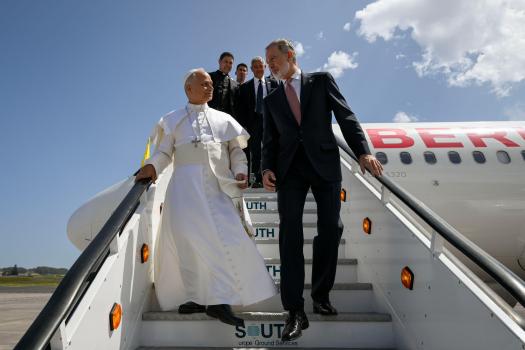
In one of the most exhilarating moments in his half century as a priest, Cardinal Blase Cupich watched in awe from an adjacent balcony in May as newly-elected Chicago native Pope Leo XIV gave his first address to the world on the loggia of St. Peter’s Basilica,
While the experience was unprecedented, the head of the Chicago Archdiocese says he has felt that same spirit of joy and elation laced throughout his five-decade career, ever since he was ordained Aug. 16, 1975.
“I have to say that I brought the same excitement of that day to every day that I’ve been a priest,” he told the Tribune during a recent interview. “I’ve always looked for moments in which being a priest could be a benefit to other people.”

Cupich will celebrate the 50th anniversary of his ordination with a golden jubilee Mass at 5:15 p.m. Saturday at Holy Name Cathedral in Chicago. The service will be livestreamed for those who can’t attend in person.
Despite major challenges facing the global Catholic Church — from financial woes to ongoing fallout from the church sex abuse crisis — Cupich says his love for pastoring and service hasn’t waned since his ordination five decades ago.
“Whether I was teaching kids in high school my first years after I was ordained or serving in the Vatican embassy in Washington, D.C., or being the pastor of a parish, and then of course being named bishop, I always felt that every day was an opportunity to live out my priesthood,” he added.
Born in Omaha, Nebraska, in 1949, the grandson of Croatian immigrants believes his roots helped shape his ministry and leadership, particularly in an ethnically and racially diverse part of the country such as Chicago, where he was installed as archbishop in 2014.
At the helm of the third-largest Catholic archdiocese in the country, he serves roughly 2 million Catholics at 216 parishes.
Cupich, the third of nine children in a devoutly Catholic home, recalled his grandparents “tried as immigrants to come here and start a life and family that would become more prosperous than where they came from.”
“And I think that is the story of all immigrants,” the 76-year-old cardinal said. “That’s why I’m so very focused on immigrants’ rights, not only to protect their dignity but also to make sure that the country doesn’t forget that we’ve been enriched by immigration.”

Often deemed more a pastoral leader and less authoritarian in style than his predecessor, the late Cardinal Francis George, Cupich has been criticized by a more conservative faction of Catholics for his focus on issues such as gun violence and poverty, as opposed to more politically right-of-center causes such as abortion opposition.
Illinois abortion opponents last year condemned Cupich for giving the invocation on the opening night of the Democratic National Convention in Chicago, an event that included pro-reproductive rights organizations, including Planned Parenthood.
Yet the archbishop of Chicago says that he’s championed the dignity and sanctity of human life throughout his ministry, adding that “the full gamut of issues that deal with respect for life have always been a center of my attention.”
“It may be that people don’t see that gun violence and poverty and homelessness and war and peace are necessarily pro-life. I would disagree with that,” he said. “I think that the Holy See, the teachings of the church and the catechism and the works done by (Pope) John Paul II all the way to Pope Leo are very clear: We have to have a consistent ethic of life.”
In 2016, Cupich’s influence over the international church expanded when Pope Francis elevated him to cardinal at St. Peter’s Basilica in Vatican City. During the ceremony, he received the iconic red hat, also known as a biretta, which symbolizes a cardinal’s willingness to shed blood in service of the church.

The service was attended by then-Chicago Mayor Rahm Emanuel and the governor at the time, Bruce Rauner, as well as members of Cupich’s family.
“I told myself, as I went up to the pope to receive the red biretta, that I was going to just drink in the moment and enjoy it as much as I could and be present to the situation. And not be distracted by anything else,” Cupich recalled. “It was a proud moment, not just for me, but I think for Chicago. Chicago has had a special place in the life of the church and I think that was recognized on that occasion.”
As cardinal, Cupich took part in the papal conclave’s May historic election of Pope Leo, the first American-born leader of the world’s estimated 1.4 billion Catholics, who grew up in south suburban Dolton.
During Pope Leo’s first three months, Cupich has seen a renewed spirit among local Catholics as well as excitement across the area among folks of all faiths and backgrounds that a Chicago native was named pontiff.
It’s like nothing the archbishop has seen in his 50 years of service since ordination as a priest.
“There’s a new pride that I’m seeing in having the pope come from Chicago, for people to know that Chicago produced a pope,” he added. “So there is a new kind of energy that I’m seeing.”