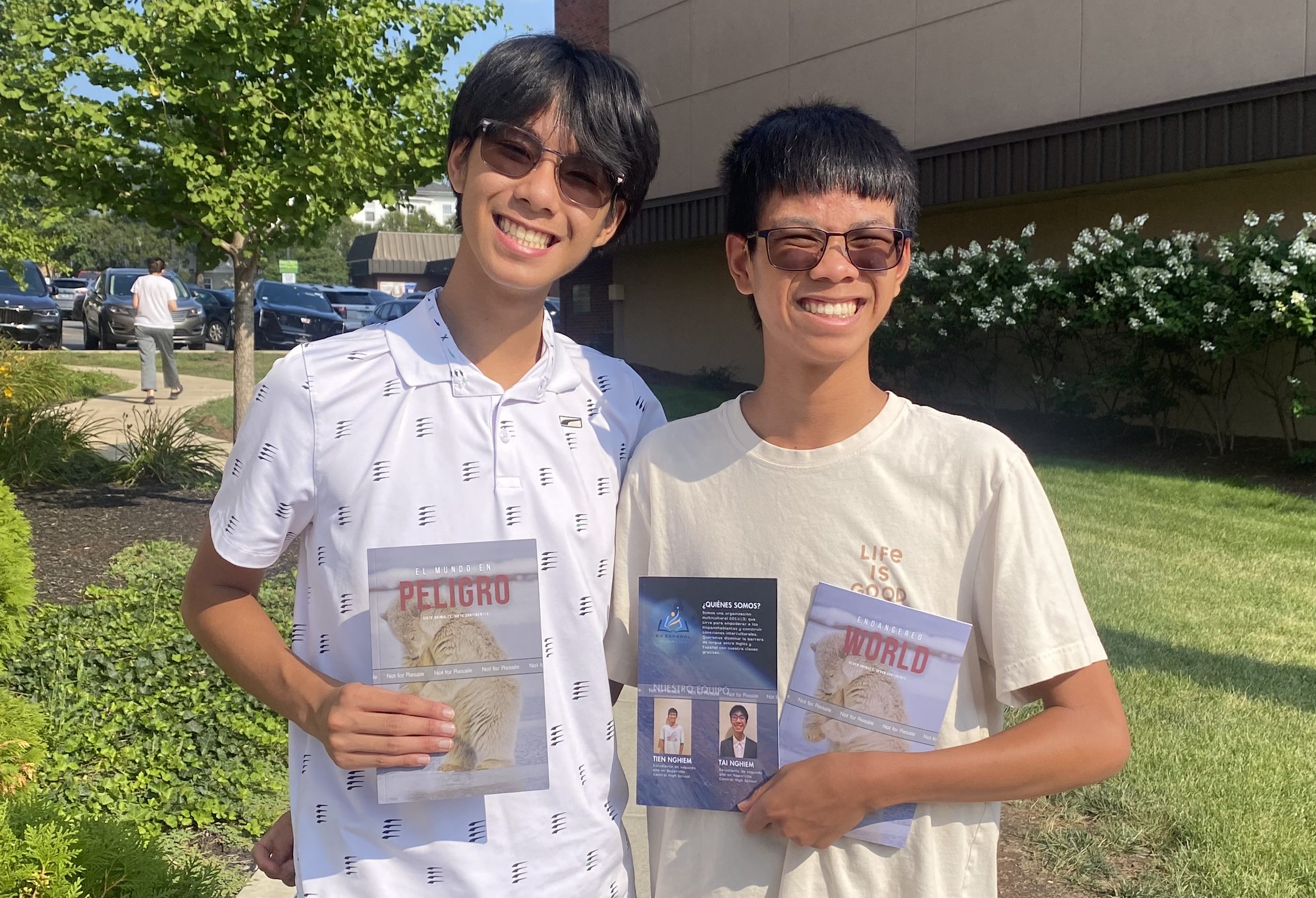

Tai Nghiem is a lover of languages, literature and culture.
The Naperville Central High School junior grew up in a multicultural household with his twin brother, Tien. At home, they switched between speaking English, Thai and Spanish. Their parents speak Vietnamese and Thai, but family friends — who often stepped in to help with childcare — introduced the boys to Spanish.
“I actually used to sleep with books instead of animals when I was a young kid,” Tai, 16, said. “I felt literature was really important and I found that I was able to read bilingual books in Spanish and English, and I feel that that gave me a dual perspective.”
As the boys got older, they knew they wanted to use their language skills and cultural experiences to make a difference in their community. Growing up, they noticed their mom’s Spanish-speaking friends struggled to find opportunities that would let them advance.
“They grew up in Mexico. They grew up in small cities, small villages, and they didn’t have as many lingual opportunities,” Tai said. “A lot of other Hispanic adults I know didn’t complete high school, didn’t complete secondary or post-secondary education. So due to this, I thought that it would be great to possibly teach them English language learning skills.”

Together, the twins started a nonprofit last September called “En Español” to bridge the opportunity gaps they witnessed. The organization started off focusing on free English classes for Spanish-speaking adults, but has since expanded to include other types of tutoring, most notably STEM classes for children.
“A lot of Hispanic parents actually told me that they wish they saw more STEM opportunities in this area, specifically in the Aurora area,” Tai said. “I was telling them about these English classes and they were like, ‘Oh, yes, we’re interested — and we’d also love to see STEM opportunities for our kids.’”
While some of the English classes are taught in-person, many are also taught online, with the first online classes held in January, Tai said. Their clientele consists not only of local English language learners, but people outside of the U.S. who also want to learn the language. The brothers use a mix in-person cultural fairs and social media platforms to connect with prospective language students.
Since starting, the brothers say their classes have reached hundreds of students from more than 20 different countries.

In May, En Español started offering STEM courses for children, partnering with local organizations like the now-closed Parent Power Center in Aurora and the West Suburban Community Pantry in Woodridge. They also have a team of volunteers who help out both with language and STEM courses.
“We’re very grateful to these young men for their efforts and for what they have done for our tutoring program,” Nancy Chatterjee, support services coordinator at West Suburban Community Pantry, said.
Chatterjee said that the two high school students had previously volunteered with the pantry’s tutoring program, but had approached the organization about hosting their own courses.
“When they came, summer was approaching and I was already faced with a concern about what summer tutoring would look like, especially for kids who are not in school,” she said.
At first, Chatterjee was skeptical about the proposal. The two boys were high school students, after all, and high school students can sometimes be disorganized or not good at keeping commitments, she said. That turned out to be far from the case with the brothers.

“I was flabbergasted by their level of professionalism but, more importantly, their commitment to education and the very detailed planning that they had when it came to what their goals were, what their method of teaching would be and what their hope for the incoming students were,” Chatterjee said.
The STEM classes typically include building everything from LEGO boats to spaghetti bridges, Tien said. One popular activity is recreating lungs with straws and plastic bags, he said.
“We would give the supplies to everyone, do a little lecture about how the lungs worked, guided the students in making their lungs, show them how they worked,” Tien said. “So when you breathed in, you could see the bags expanding, and we said that was the air going into the lungs. And then when the bags flattened, that was the air going out of the lungs.”
Their efforts, Chatterjee said, have paid off.
“The STEM has really helped a lot of students,” she said. “We had one student who had trouble reading. She’s nine years old but home schooled. And through their work and through their STEM projects, she is now reading and really working up to her potential.”
For Tai, some of his favorite moments are when he gets to sit down with the students one-on-one. One conversation with an 11-year-old STEM student who built a LEGO boat stood out in particular.
“(Her boat) was the first to be able to float and I really enjoyed having a conversation about, ‘Why is it floating?'” Tai said. “She was able to provide reasons for why it floated, the science behind it and I just get really happy when I have moments like those.”
Book Drive
Classes are not the only ways the brothers are giving back to their community. The twins are hosting a book drive through which they plan to donate books to local libraries, schools in Mexico, local children’s hospitals and even an orphanage in Thailand.
The book drive started when the boys realized they owned a lot of bilingual books in Spanish that they were no longer using. Since mid-July, they say they have collected more than 850 books, with about 100 coming from their home and the rest coming from donations. They plan on donating all of the books in mid-October.
Some of the donations also include books Tien has written himself, including copies of an English-Spanish book he wrote on endangered species and how people can help protect those animals.
“I saw that there were a lot of bilingual resources, a lot of books in English and Spanish, but I didn’t see that there were lots of STEM, science resources,” Tien said. “I think that it’s really important that not only are we teaching kids languages and STEM, we’re teaching them how to become leaders … and that’s motivated through bilingual books, which I feel like there’s not that many.”
That drive to expand bilingual education is what keeps the boys motivated to hopefully continue the nonprofit even when they both head off to college.
“We’re still going to be as hands on as we can be, but of course, when we’re pursuing post-secondary education, when we’re in college, we won’t be able to give the same kinds of classes, especially with STEM,” Tai said. “We hope that some of our students who participated in our STEM classes, and are currently active participants in the organization will continue and assume leadership roles.”
cstein@chicagotribune.com