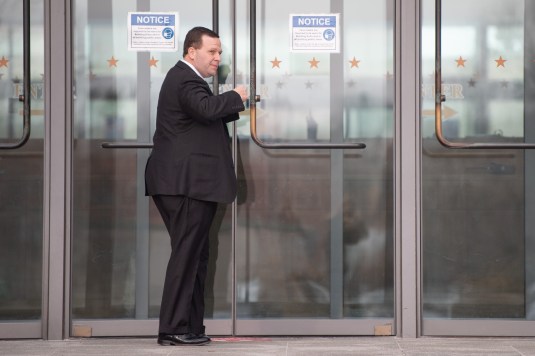

Former Portage Mayor James Snyder’s sentencing on his obstruction of the IRS charge was moved from later this month to January 14, 2026.
For his sentencing, Snyder also hired a new attorney, Joshua Minkler, who requested that the Oct. 16 sentencing date be continued to “afford counsel the necessary time to receive and review all relevant materials,” according to court records.
The motion to continue the sentencing date is the second time Snyder requested a new sentencing date, Minkler wrote in the motion, but the motion “is not made for purposes of delay.”
In an email to the Post-Tribune, Minkler declined to comment, citing pending litigation.
Snyder was scheduled to go to trial for a third time in U.S. District Court in Hammond on a bribery charge involving a $13,000 payment for a garbage truck contract. But, prosecutors have stated they would like to sentence Snyder on the obstruction of the IRS and forgo a third trial on his bribery charge.
Prosecutors noted the case has been pending for nearly nine years, and that Snyder “stands convicted of the felony offense of corruptly obstructing the Internal Revenue Service’s administration of the federal revenue laws,” according to court records.
“At this point, the United States believes the interests of justice are best served by proceeding to sentencing on the current count of conviction for Count 4 (the tax conviction), at which time it intends to present evidence of defendant’s bribery activities as part of its presentation on the factors to be considered in imposing a sentence,” prosecutors wrote.
If Snyder is sentenced on tax conviction prosecutors will move to dismiss the bribery charge after imposition of sentence. Prosecutors requested the court to set a sentencing date on the conviction charge within the next 90 days.
The condition of dismissing the bribery charge upon sentencing “holds the defendant (and the court) hostage until the government is satisfied that a sufficient penalty is imposed,” Snyder’s attorney Andrèa Gambino wrote in a May 23 court filing.
“Apart from pointedly ignoring the Super Court’s determination that the conduct for which he was convicted was not a crime, this is neither fair nor just,” Gambino wrote.
The U.S. Supreme Court’s June 26 decision determined, among other matters, that the payment to Snyder from the Buha brothers, owners of Great Lakes Peterbilt, was a gratuity because Snyder received the money, reportedly for consulting work, after the business got the garbage truck contracts and not before.
Prosecutors don’t have more evidence today than “at the time of the first sentencing in support of its argument that Mr. Snyder should be sentenced as if the alleged gratuity were a bribe.”
“The government’s continuing attempt to apply the bribery guideline without obtaining a bribery conviction smacks of vindictiveness,” Gambino wrote.
After multiple twists, turns and delays since Snyder was indicted on Nov. 17, 2016, in U.S. District Court in Hammond on two bribery counts and one of obstructing the IRS, a jury found Snyder not guilty on a bribery count involving a towing contract and guilty on the other two counts.
The second bribery conviction, over allegations surrounding a $13,000 payment involving around $1 million in contracts for garbage trucks, stood after two trials, only to get overturned when the Supreme Court ruled that the payment was a gratuity, not a bribe, and criminalizing the payment put even routine campaign contributions at the risk of the federal government’s wrath.
Overturning Snyder’s conviction had a ripple effect on countless other cases, most notably prominent cases in Illinois, including the trial of ex-House Speaker Michael Madigan and the case of the “ComEd Four” who were convicted of a scheme to bribe him.
Federal prosecutors have described Snyder in their filing as “a thoroughly corrupt public official, twice convicted by a jury of his peers for receiving a $13,000 payoff,” and note there is “no sound legal basis” for a windfall dismissal because of an omission from jury instructions, which was one of the contentions of Snyder’s attorneys.
Snyder, a Republican, was first elected mayor in 2011 and reelected in 2015, a term cut short by his federal conviction in February 2019.
Snyder received a sentence of 21 months in prison for the bribery and IRS convictions and a year on supervised release from U.S. District Court Judge Matthew F. Kennelly of the Northern District of Illinois.
Still, Snyder successfully argued that the start of his sentence should be postponed until his bid to have the Supreme Court hear his case was complete.
akukulka@post-trib.com