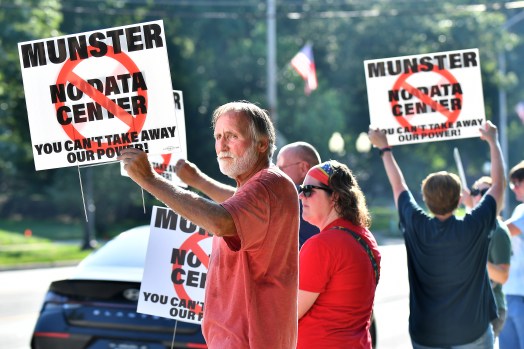
In the past couple of years, Indiana has seen about 60 data center companies come to the state with little local government rules about the developments, according to data from the Citizens Action Coalition.
Now, groups statewide are asking to slow down the development.
“In 2026, I would say it’s really hit a crescendo, and we’re seeing a continued influx of data center proposals across Indiana,” said Ben Inskeep, program director for the Citizens Action Coalition. “I think people are growing increasingly anxious about the impacts.”
The Citizens Action Coalition announced Thursday that it and 26 othere public interest organizations across Indiana are calling on local governments to enact data center moratoriums, which could slow down the controversial developments statewide.
The groups call for local moratoriums on new data center development, permitting and construction to allow local governments more time to adopt policies and regulations to protect Hoosiers. A moratorium would allow government officials more time to hear from constituents and develop protective zoning and regulations, according to a news release.
Thirteen Indiana counties have enacted data center moratoriums, Inskeep said, including Fulton, Marshall and Starke counties.
“It’s heartwarming to see local governments pressing pause on this development and taking the time necessary to adequately examine the issue, hear from their constituents, and when necessary, press pause so they can craft the right protections,” Inskeep said. “It’s incredibly encouraging to see support across Indiana for data center moratoriums and for better protections for the environment and Hoosiers.”
Sam Carpenter, executive director of the Hoosier Environmental Council, traveled to Gary in March for a forum on whether the community needs data centers. The Hoosier Environmental Council was one organization that joined the Citizens Action Coalition in its call for moratoriums.
The Hoosier Environmental Council’s team has traveled to various communities statewide to have conversations on creating local protections for data center development, Carpenter said.
Data centers are resource-heavy in the amount of electricity and water used, Carpenter said. The developments also use natural gas and fossil fuels, he added.
“We have this uneven disbursement of resources throughout our state,” he said. “The concern is that it’s going so fast … it’s also a very new technology, and it’s a new type of development in the amount of resources that they use. Communities don’t have the information they need to make sound decisions.”
The biggest effect of a moratorium would be giving local governments more time to make rules and get community input, Carpenter said.
“There’s really pretty emphatic opposition in a lot of communities about data centers,” he said. “I think the local government needs time to allow for people’s voices to be heard to develop some transparency into the process, so that it can be more reflective of what the community wants and its protections.”
Just Transition Northwest Indiana also joined the call for moratoriums. Ashley Williams, JTNWI executive director, agrees that community input is necessary in the process for data center development.
“This buildout is not inevitable,” Williams said. “What we’re trying to do is draw the hard line in the sand with our local governments.”
Williams believes moratoriums are important in Northwest Indiana because of environmental and public health concerns that residents already have.
She hopes the call for a moratorium will help empower local communities and bring forth protections that protect residents. Putting protections in place now could protect future residents and community development.
“We want to see cities jump in and ultimately enact these moratoriums,” Williams said. “I know it’s going to take a mass mobilization in this region from community to community to do that.”
Although the task is daunting, Williams said JTNWI feels supported and empowered in the fight for transparency and community protection because of how many organizations statewide are fighting for the same.
“It really underscores that we are not alone and that we are valid in what we’re seeing and experiencing,” Williams said. “It’s validating, and it’s a reminder of what is possible if we can collectively come together to call for a pause.”
For Inskeep, it’s fantastic to see 26 organizations join the Citizens Action Coalition in their work to advocate for moratoriums.
“I certainly was not expecting as many organizations to sign on,” he said. “I was blown away by the outpouring of support for this concept, and now we’re getting additional organizations reaching out to us, contacting us, trying to get added to the list as well.”
Data center development began to grow as the use of artificial intelligence increased, Inskeep said. More developments have been built, but they’ve also been constructed at a larger scale, he added.
The U.S. is also in a race with China to create more artificial intelligence, multiple sources said.
Indiana is a desirable location because of tax credits and subsidies that are typically passed for data center developers, Inskeep said, and because of the lowered risk of major natural disasters, like hurricanes or wildfires.
“We’re collectively working to try to slow down this rapid pace that’s unsustainable, and we can’t meet it reasonably,” Inskeep said. “We have to figure out how we can create the right policies and protections for Hoosiers to make sure there aren’t any more consequences and negative impacts.”