
What’s in a name?
A lot, when the administration of President Donald Trump decides the Department of Defense should become the Department of War, and at the same time is demanding that the media conform to new restrictions in the name of national security.
Early in the classic 1970 movie “Patton,” about famed World War II Gen. George S. Patton Jr., actor George C. Scott, portraying Patton, appears before a gigantic American flag to address an audience of his troops. He delivers an inspiring, at times ominous, speech about upcoming combat with Nazi Germany’s powerful forces.
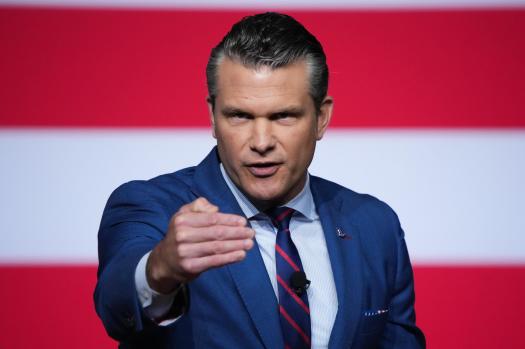
In a duplication, Secretary of Defense Pete Hegseth on Sept. 30, before a gigantic American flag, delivered a lecture emphasizing war-fighting capabilities. On Oct. 15, forces were ordered to review the speech and a new media policy was underscored.
Hegseth has decreed that news outlets are to sign a pledge not to “obtain or use any unauthorized material,” classified or unclassified, or they will lose their press credentials and access to the Pentagon. All information used must be approved by an “appropriate authorizing official.”
The new policy is both counterproductive and misguided. Predictably, with rare exception, established media organizations across the spectrum rejected the dictum, including the Associated Press, CNN, Fox News, National Public Radio, The New York Times and The Wall Street Journal.
How to evaluate this latest Trump disruption? I turn to General George C. Marshall, “a dedicated public servant,” as people used to say
As chief of staff of the U.S. Army, Marshall did essential work to get a dangerously unprepared nation at least partially ready for World War II, and then led the mammoth organizational effort required for victory. This included the large-scale Louisiana Maneuvers held in 1941 and involving more than 400,000 men.
Col. Dwight Eisenhower first came to public prominence in this mammoth exercise, along with the brilliant armor commander George Patton and others.
Marshall later served as secretary of state and secretary of defense during the trying post-war years, when both the Cold War and Korean War began. War and diplomacy are unavoidably intertwined.
FDR considered Marshall indispensable and stated publicly that he could not go to sleep at night if the general were out of the country. Marshall wanted to lead the Normandy invasion, but that mission went to protégé Dwight Eisenhower.
Ever the loyal soldier, he apparently never directly pressed his desire with the president. Roosevelt shrewdly, skillfully finessed the matter. Marshall did his duty, consistently focused on the nation’s interests, not his own.
In a defining encounter early on, Roosevelt presented to assembled officials his ideas on aircraft production. When he turned to Marshall, expecting confirmation, he received instead a devastating critique. FDR quickly left the meeting, but he sought out Marshall immediately thereafter..
Roosevelt also trusted Marshall never to leak to the press. Their partnership flourished.
Marshall is rarely discussed today, unfortunately, given his valuable example. He carefully put very little personal information in the public record and never wrote memoirs.
He feared inadvertently revealing classified information and other details best kept confidential. In addition, incredibly from a contemporary perspective, the record is clear that he felt that patriotic citizens should not benefit financially from government office.
For George Marshall, public service was literally just that. Such selflessness is not very visible in Washington today.
Also, remember, in a free society, conflict between authority and open media is unavoidable.
Learn More: Forrest C. Pogue, “George C. Marshall.”
Arthur I. Cyr is the author of “After the Cold War – American Foreign Policy, Europe and Asia” (NYU Press and Palgrave/Macmillan).
Contact acyr@carthage.edu