Skip to content
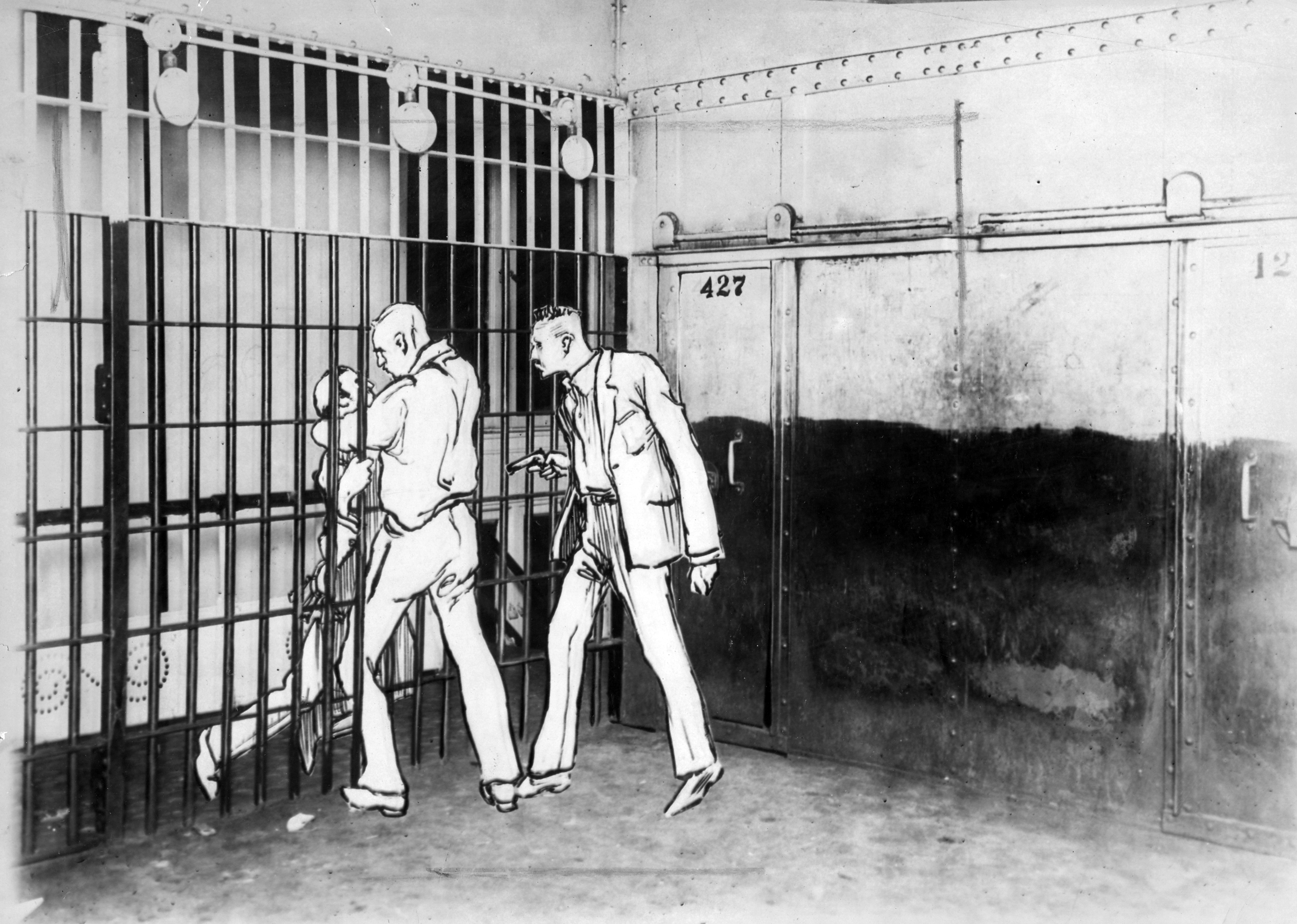
In this illustration that ran in the Chicago Tribune on Dec. 12, 1921, jail guard David Strauss was grabbed around his neck, choked, and held to the bars by James La Porte, Tommy O'Connor's cellmate. O'Connor held the gun, a nickel-plated revolver. After his keys were taken, Strauss was bound and gagged and thrown into a cell. The jail break occurred Dec. 11, 1921. (Chicago Tribune illustration)
In this illustration that ran in the Chicago Tribune on Dec. 12, 1921, jail guard David Strauss was grabbed around his neck, choked, and held to the bars by James La Porte, Tommy O’Connor’s cellmate. O’Connor held the gun, a nickel-plated revolver. After his keys were taken, Strauss was bound and gagged and thrown into a cell. The jail break occurred Dec. 11, 1921. (Chicago Tribune illustration)
PUBLISHED:
Getting your Trinity Audio player ready...

Here’s a look back at what happened in the Chicago area on Dec. 11, according to the Tribune’s archives.

Is an important event missing from this date? Email us.

Weather records (from the National Weather Service, Chicago)

  • High temperature: 61 degrees (1949)
  • Low temperature: Minus 5 degrees (1972)
  • Precipitation: 1.73 inches (1949)
  • Snowfall: 9.5 inches (2000)
A group of assistant states attorneys gather for their first and last look at the County County Jail gallows as the county prepares to destroy the contraption on June 17, 1977. The gallows ended up being auctioned off. The gallows were saved in case "Terrible" Tommy O'Connor, who escaped before his execution in 1921, was never apprehended. (Chicago Tribune historical photo)
A group of assistant state's attorneys gather for their first and last look at the County County Jail gallows as the county prepares to destroy the contraption on June 17, 1977. The gallows ended up being auctioned off. The gallows were saved in case "Terrible" Tommy O'Connor, who escaped before his execution in 1921, was ever apprehended. (Chicago Tribune historical photo)

1921: Three days before he was scheduled to be hanged, “Terrible” Tommy O’Connor and two other prisoners escaped from jail in Chicago and were never seen again.

Henrietta Bradberry's invention shows in detail how to house and deploy a torpedo underwater while preventing the liquid from penetrating inside the mechanism. (U.S. Patent Office)
Henrietta Bradberry’s invention shows in detail how to house and deploy a torpedo underwater while preventing the liquid from penetrating inside the mechanism. (U.S. Patent Office)

1945: Henrietta Bradberry earned her second U.S. patent — for a torpedo discharge means.

While her husband William was at work, the Kentucky native brainstormed ideas for useful devices in their Chicago home on Champlain Avenue. Her two patents could not be more different in purpose and design.

Vintage Chicago Tribune: Inventions and innovations by Black Chicagoans

Bradberry’s got her first patent May 25, 1943, for a collapsible rack — meant to hold bed sheets and pajamas — that could attach to a bed’s frame.

Coach George Halas of the Chicago Bears congratulates quarterback Johnny Lujack on setting the National League aerial gain record of 468 yards on Dec. 11, 1949, in their victory over the Chicago Cardinals, 52 to 12, at Wrigley Field. Editors note: this historical print has a hand painted background and graphics added to the print. (Chicago Tribune illustration)

1949: Quarterback Johnny Lujack threw six touchdown passes and set a record with 468 yards in the air in one game as the Chicago Bears beat the Chicago Cardinals 52-21 at Wrigley Field.

The NFL’s oldest rivalry continued at Soldier Field. A look back at the teams that started it all in 1920.

1965: “I just got mad. They shouldn’t have thrown me out.”

That was the reason given by 24-year-old Robert Lee Lassiter after he splashed gasoline inside a West Side tavern and used a borrowed match to set it ablaze. The fire killed 13 patrons of the Seeley Club, 2026 Madison St., Chicago, and injured 22 others.

Lassiter’s confession, however, was suppressed after a judge ruled the electric company laborer had been deprived of his right to an attorney.

He was found guilty in March 1967, and sentenced to up to 150 years for each of the 13 deaths.

Five men plunged to their deaths at the State of Illinois Center construction site on Dec. 11, 1981, when the metal basket they were riding in gave way. (Chicago Tribune)

1981: Five iron workers plunged 100 feet to their deaths at the construction site for the State of Illinois Center when a platform on which they were riding nearly eight stories above ground broke loose from a mobile crane and spilled the crew into the excavation site. Phillip Rios was the only survivor.

Chicago Blackhawks defenseman Bob Murray draws a bead on Edmonton's Glen Anderson during the first period of a game on Dec. 11, 1985, at Chicago Stadium in Chicago. The Oilers outscored the Hawks 12-9. (Ed Wagner Jr./Chicago Tribune)

1985: The Edmonton Oilers beat the Chicago Blackhawks 12-9 at Chicago Stadium. The 21 goals scored tied for the highest-scoring game in NHL history, but the 62 points awarded broke the old record of 53 set by Quebec and Washington in 1981. The Hawks had 46 shots on goal and the Oilers had 44.

Chicago Cubs general manager Jim Hendry introduces Japanese baseball player Kosuke Fukudome on Dec. 19, 2007, at Wrigley Field in Chicago. (Phil Velasquez/Chicago Tribune)
Chicago Cubs general manager Jim Hendry introduces outfielder Kosuke Fukudome on Dec. 19, 2007, at Wrigley Field in Chicago. (Phil Velasquez/Chicago Tribune)

2007: The Chicago Cubs signed Japanese outfielder Kosuke Fukudome to a four-year deal. He was introduced to fans here eight days later.

In 2008, he made the All-Star game, the cover of Sports Illustrated and hit a game-tying home run in the ninth inning on opening day in Wrigley Field.

Fukudome was traded to Cleveland in 2011, then signed a two-year deal with the Chicago White Sox in 2012.

‘Proud and honored’: Kosuke Fukudome, the Chicago Cubs’ first Japanese player, reconnects with team in Tokyo

Want more vintage Chicago?

Subscribe to the free Vintage Chicago Tribune newsletter, join our Chicagoland history Facebook group, stay current with Today in Chicago History and follow us on Instagram for more from Chicago’s past.

Have an idea for Vintage Chicago Tribune? Share it with Kori Rumore and Marianne Mather at krumore@chicagotribune.com and mmather@chicagotribune.com