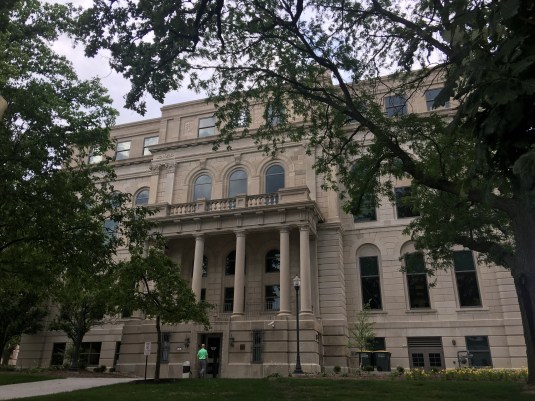
The majority of attendees at Monday’s La Porte Common Council meeting supported an annexation of about 1,000 acres of land for a data center.
But some residents still testified in opposition of the annexation and development, worried about how it might be detrimental to local environmental and public health.
The council hosted a public hearing Monday night about the annexation to add on to a Microsoft data center. Representatives from Microsoft were at the meeting and gave a presentation.
Supporters of the annexation — including La Porte Mayor Tom Dermody — wore yellow shirts that say, “Tech yeah,” to show their interest in the data center.
“This is a new day in La Porte, and a once in a lifetime opportunity for our community, my hometown as well,” Dermody said at Monday’s meeting. “Change is never, never easy, but we live in a time, as a community, that if we do not choose to evolve and grow … we will miss the chance and the opportunity.”
In June 2024, former Indiana Gov. Eric Holcomb announced that Microsoft would invest $1 billion to build a data center in La Porte, claiming that it would create up to 200 new jobs by the end of 2032, according to the city’s website.
The data center will help power the Microsoft Cloud and support the adoption of cloud computing and artificial intelligence. The facility is still being developed.
Microsoft planned to construct a 245,000-square-foot data center on 489 acres in La Porte’s Radius Industrial Park. The potentially annexed land is located south of Boyd Boulevard near Highway 35 to County Road 250.
Mike Stockwell, land development and permitting program manager for Microsoft, said the company has started “early land development work,” including tree clearing to prepare for “the vertical build,” which is scheduled for the fall.
The annexation could add 11 buildings to the data center property, Stockwell said. Currently, they have six buildings planned.
Microsoft will work with city staff to conduct a traffic study and plans for water and wastewater expansion, Stockwell said.
“There’s a lot of planning to be done yet,” Stockwell said. “Once we get through the initial due diligence, and we’ve closed successfully on the property, we’ll start design and future timelines for development.”
Bert Cook, executive director of the La Porte Economic Advancement Partnership, said that the annexation is about nine parcels, and it’s “super voluntary” by property owners.
“We want to try and be as transparent as we can with that,” Cook said.
Cook addressed resident concerns about data centers, specifically with water usage. The Microsoft project in La Porte will use a closed loop cooling system that won’t require water for usage, Cook said. A proposed
He also said that residents’ electric bills will not increase because the data center will use NIPSCO’s GenCo model to provide electricity. Noise levels will be about 55 decibels, “which is similar to that of a household refrigerator,” Cook said. Diesel generators will only run as backup power, Cook added.
He also told meeting attendees that Microsoft “has been a good partner from the beginning of time.”
“We’ve worked with them for over three years at this point,” Cook said. “They’ve shown just the type of partner they are. They address information openly and honestly, and they have answered questions.”
In early March, La Porte leadership approved an updated tax agreement for Microsoft’s data center, according to the city’s website. The agreement would allocate 15% of the data center’s tax revenue to the La Porte Community School Corporation over a 40-year term. The agreement would also include a payment of up to $100 million to the city redevelopment commission and school corporation.
La Porte Community School Corporation Superintendent Sandra Wood spoke in support of the annexation and data center Monday. The district has responded to a “pattern of decline” for about 20 years, Wood said, and the investment sets the schools up better for the future.
“As educators, we have worked hard to meet the needs of those who remain, but we have largely been reacting to the trend rather than changing it,” Wood said. “This project represents the first real opportunity to shift that trajectory. It signals a willingness to embrace thoughtful growth, to move forward and to position La Porte for long-term success.”
Other school officials, including a school board member and teacher, testified in support of the annexation.
Heather Ennis, president and CEO of the Northwest Indiana Forum, said data centers bring infrastructure and jobs to the local economy. She testified during Monday’s hearing that the region is “so very fortunate” to those investments.
“They build out our infrastructure, they support our schools and our communities,” Ennis said. “They bring well-paying jobs, as well as great construction jobs. I strongly support this super voluntary annexation.”
Multiple La Porte residents commented in opposition to the annexation.
La Porte resident James Baum said he’s “totally, 100% against” the annexation for the data center.
“It’s not fair,” Baum said. “There’s more people who don’t want a data center. I’ve put 30 years in here, and I bought properties. I didn’t buy them to be around a data center.”
Baum is concerned about how a data center would impact children in the community and those with health risks.
“I have an 11-year-old daughter that I’ve got to raise,” Baum said. “This air is going to be polluted, and people who have lung problems and asthma are going to pay the price. … We’re destroying a part of this land that we’re supposed to preserve and take care of.”
La Porte resident Gautama Logwood also opposes the annexation, saying that residents have only received basic information about the data center and don’t know specifics. He wants to know what the development means for water usage, other environmental aspects and for residents’ taxation.
“It’s the equivalent of a legal pinky swear,” Logwood said.
Alicia Firanek is another La Porte resident who is concerned about a data center in the city and what the annexation could mean for farmland. Firanek said Indiana has some of the top agricultural land nationwide, and the state has lost hundreds of thousands of acres in the past 40 years.
Firanek is also concerned about the environmental effects of a data center and what it might mean for public health, specifically those with asthma.
“For a state that labels themselves as conservative, I do not see much conserving of our lands, our health or of our livelihood,” Firanek said.
Microsoft plans to host a public meeting with more information for residents at the La Porte Civic Auditorium from 4 p.m. to 7 p.m. April 21. The council will vote on the annexation at a later date.