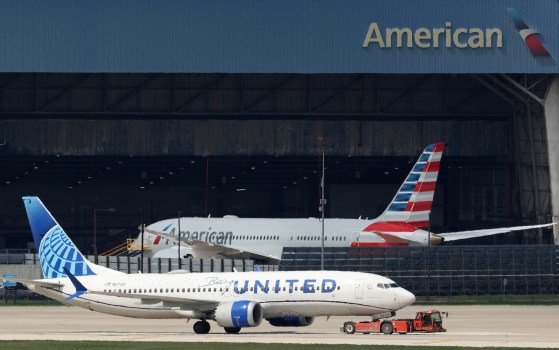

American Airlines says it is not interested in a merger with United Airlines, putting the kibosh on an idea aviation and antitrust experts already saw as a long shot.
“American Airlines is not engaged with or interested in any discussions regarding a merger with United Airlines,” the airline wrote in a statement Friday.
United CEO Scott Kirby floated the idea of a merger with archrival American to President Donald Trump earlier this year, Bloomberg and Reuters reported.
Such a merger would have invited significant antitrust scrutiny from federal regulators. Experts said a merger involving the two massive airlines would be very unlikely to gain regulatory approval.
A spokesperson for United declined to comment.
The merger idea also came as United and American are engaged in a turf war at O’Hare International Airport, where they together control about 80% of the airport’s gates.
The airlines have added so many flights out of O’Hare — where gates are allocated by an airline’s flying frequency the previous year — that the Federal Aviation Administration stepped in to break up the party, saying the airport wouldn’t be able to handle the volume of flights planned there this summer.
The feds last week ordered airlines to cut hundreds of flights per day at O’Hare between mid-May and late October this year, with flights allocated based on airlines’ schedules last summer.
United is likely to need to cut significantly more flights than its rival, American executives said in a note to employees last week. United might need to cut more than 200 operations per day, while American may only cut about 40, the executives said.
In its Friday statement rejecting the merger idea, American said that “while changes in the broader airline marketplace may be necessary, a combination with United would be negative for competition and for consumers, and therefore inconsistent with our understanding of the [Trump] Administration’s philosophy toward the industry and principles of antitrust law.”
A spokesperson for the airline did not immediately specify what those industry “changes” might be.