
Clarendon Hills officials ultimately agreed on what is being billed as a compromise for a major component of the often-discussed Downtown Improvement Plan.
At the center of most discussions was the possibility of eliminating the right-turn slip lane that is part of the Sloan Triangle at Prospect and Park avenues to create a permanent plaza. Several residents expressed opposition, saying it would compromise safety and result in traffic congestion near the railroad tracks, about a block north on Prospect.
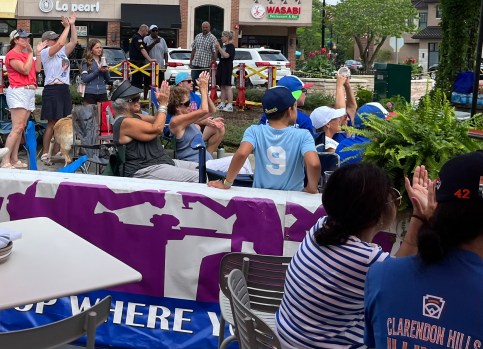
The Village Board decided to keep the slip lane, but provide removable bollards to allow for flexible closure for events/peak season, thereby maintaining traffic flexibility, allowing seasonal dining and a temporary plaza and piloting long-term improvements.
Assistant Village Manager Mera Johnson said hardscape-like pavers will be added along with bollards to allow for closing and opening the right-turn lane. She said it has yet to be decided whether the bollards will be used seasonally or put in and taken out more often for specific events.
“This decision was arrived at through extensive work with the community, outside experts, staff and my fellow elected officials,” Village President Eric Tech said. “It represents a commitment to getting input and encouraging dialogue.”
Tech said the overriding strategy is to maintain a long-term vision of making Clarendon Hills a pedestrian safe and accessible community for generations.
“It also allows flexibility and enhances our ability to host multiple functions throughout the year in a safe and attractive manner,” he said. “The fact that this board came to an unanimous consensus demonstrates the strength of this vision and this process.”
Plans now call for design and engineering in May and June, the project going out for bids in July and construction from September to November.
While the future of the Sloan Triangle slip lane has been at the center of discussion, the total downtown improvement plan is scheduled to be a four-year venture, based on a study done by consultant Houseal Lavigne.
The study was bounded by Railroad Avenue to the North, Ann Street and Eastern Avenue to the east. Park Avenue to the south and the Walker Avenue alley to the west.
“The plan identifies potential improvements within this area, with a primary focus on enhancing the the public realm to strengthen and elevate the downtown experience,” said Nik Davis of Houseal Lavigne.
He said the recommended improvements were based on a comprehensive community engagement process, which included a project kick-off workshop, visioning workshop, open house, online survey and interactive mapping tool.
“The recommendations are also supported by field reconnaissance and professional urban planning expertise,” Davis said.
The entire process is scheduled out over four years, starting with the bollards and additional hardscape improvements this year at an estimated cost of $1.6 million.
Additional work and estimated costs include the Burlington Plaza and Village Hall Plaza, $400,000, along with the Walker Avenue alley, $390,000, all in the second year; Railroad/Prospect and Ann/Prospect in the third year, $250,000; and a downtown aesthetics refresh for an estimated $1.5 million in the fourth year.
Chuck Fieldman is a freelance reporter for Pioneer Press.