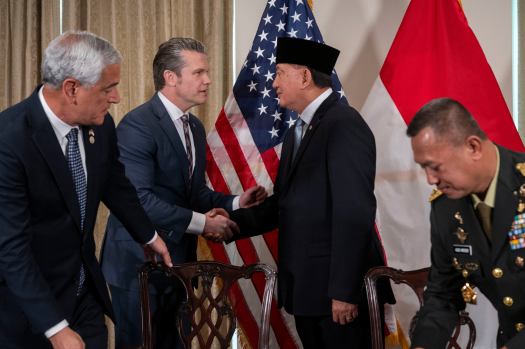

Indonesia and the United States formally established a Major Defense Partnership on April 13 at the Pentagon. The agreement will significantly expand cooperation in military modernization, operations, training and other tasks.
The geostrategic significance is profound, including Indonesia’s significance as an oil producer. Unfortunately, the Iran war has overshadowed this development.
The Super Garuda Shield is an annual multilateral military exercise led by Indonesia and the U.S., expanded from a bilateral event in 2022. The exercise, held annually in Jakarta, is hosted by Indonesia. The most recent, in the late summer of 2025, included Australia, Brazil, Canada, France, Germany, Japan, the Netherlands, New Zealand, Singapore, South Korea, and the United Kingdom, along with Indonesia and the U.S.
The war with Iran has drawn concern to the Strait of Hormuz. Indonesia is linked to numerous narrow waterways, also important to international maritime shipping since ancient times: the Lombok Strait, the Makassar Strait, the Strait of Malacca, the Sunda Strait and others. China’s slow but sustained maritime expansion is raising tensions along with geostrategic stakes.
This latest agreement between Jakarta and Washington, D.C., occurs in the context of positive developments. In February 2024, successful national elections were held in Indonesia. This occurred in an enormous nation with an autocratic history.
The winner of the presidential contest was Prabowo Subianto, a retired army general and former defense minister. He received nearly 60% of the votes.
Indonesia is the world’s third-largest democracy, and the largest nation with a Muslim majority. The election was the largest one-day free election in the world, with more than 200 million participants.
Over 17,000 islands comprise the national territory, including the large islands of Java, Sulawesi, Sumatra and parts of Borneo and New Guinea.
In 2018, a Gallup Poll found that an unprecedented 75% of Indonesians believed elections were honest. This was the highest percentage ever, in a long-term upward trend in public confidence, following a troubled national history.
Gruesome earlier events provide graphic, important context. In May 2018, the Islamic State conducted bloody terrorist attacks in Surabaya, Indonesia’s second-largest city.
Terrorism has been continuing, though not frequent. In a 2016 attack, four people died. In 2002, the worst attack killed 202 people on Bali, including many foreign tourists.
In 1998, opponents forced Indonesia’s long-time autocratic president and former general Muhammad Suharto from power. Since then, the nation has had representative government. Dictatorship has ended, though corruption remains a problem.
During the height of the Cold War, Indonesia enjoyed the status of a pivotal power among Third World nations. Flamboyant nationalist President Sukarno played the Soviet Union and the United States off against one another. Failed CIA efforts to bring Sukarno down boomeranged, providing strong impetus for Indonesia-Soviet cooperation.
During the 1960s, cooperation between Indonesia and the Soviet Union expanded exponentially. The Soviet and Indonesian navies were integrating their crews, and combined with other cooperation was ominous.
This development, influential in the massive U.S. military intervention in Vietnam in 1965, is rarely mentioned regarding that war.
British, Australian and New Zealand forces defeated Indonesia’s attacks on Malaysia. Earlier, Britain suppressed a communist insurgency in Malaya, today part of Malaysia.
Britain’s military avoided massive firepower, in contrast to the U.S. in Vietnam and elsewhere. Given the U.S. emphasis on firepower with technology, we should study and reflect on the British approach and experience.
Freedom expands in the world. Our military veterans, especially from the Vietnam War, should feel pride in this long-term success.
Arthur I. Cyr is the author of “After the Cold War” (Macmillan/Palgrave and NYU). Contact acyr@carthage.edu.