
NEW YORK — A truism named for the late political scientist Wallace Sayre holds that, in any dispute, the intensity of feeling is inversely proportional to the value of the issues at stake. Put more simply, the smaller the argument, the madder people always get.
Henry Kissinger used that argument to explain why academic feuds are so bitter. But as anyone who has argued over a set of new windows can attest, condo boards are a better example. School boards, too. And let’s not get started on neighborhood historic preservation gatekeepers where, say, using the wrong balusters on your porch can set off World War III with your neighbors.
That’s the premise of David Lindsay-Abaire’s keenly observed new satire, “The Balusters,” which is kind of a mash-up of Jonathan Spector’s “Eureka Day,” which poked fun at a Montessori-like school board, and Tracy Letts’ “August: Osage County,” which argued that underneath our polite exteriors we’re capable of the most horrific treatment of our fellow human beings.
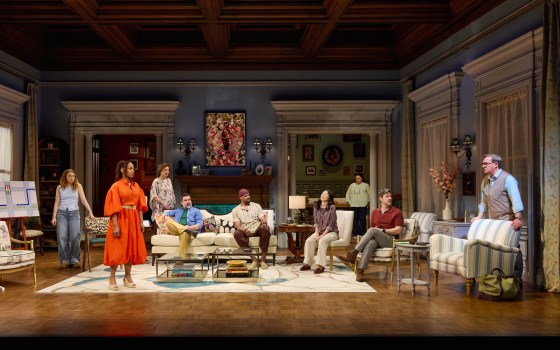
Here, we meet a lively group of neighbors who collectively form the Vernon Point Neighborhood Association, a diverse array of people who are charged with, depending on the individual point of view, either making their small community better or fighting tooth and nail to ensure that nothing changes.
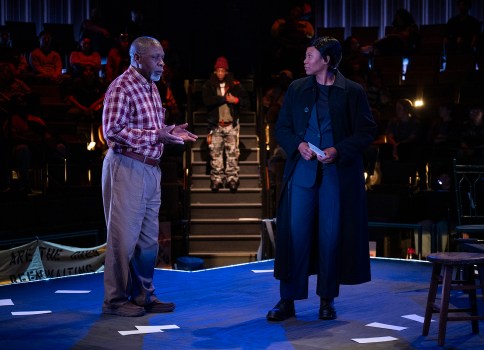
The latter argument in this play is made by a local realtor, Elliot Emerson, played by Richard Thomas in a self-aware bit of casting within director Kenny Leon’s Broadway production by Manhattan Theatre Club. Elliot wants to keep these historic blocks just as special as they always have been, fighting off those who want permission for cheap and inappropriate renovations or other atrocities and even extending this POV to opposing a stop sign on one of the blocks, so as to keep the vista free and clear.
Folksy Elliot has his voting block on the rambunctious board he chairs in his folksy way. But the status quo is upended by the arrival of Kyra Marshall (Anika Noni Rose), a woman with young kids who wants a stop sign for safety reasons. As the two alternately charm each other and fight, the other members of this diverse but uniformly wacky group of animated eccentrics (Marylouise Burke, Ricardo Chavira, Carl Clemons-Hopkins, Margaret Colin, Michael Esper and Maria-Christina Oliveras play the remainder of the Vernon Park watchdogs) get to show their true colors.
As with “Eureka Day,” “The Balusters” is intended to make the audience feel superior to this bunch of hypocrites, whose various forms of carefully concealed self-interest gradually are exposed as the play unwinds. And to his credit, Lindsay-Abaire has created a bunch of witheringly annoying and yet highly entertaining characters, from the local contractor who seems like a good guy, but only at first, to the non-binary young person whose presence on the board has exposed them as the pitiably local equivalent of a nepo baby.
Clearly, we’re in a moment in the American theater when, after years of caution, writers finally are beginning to find the courage to expose the hypocrisy of our newly sensitive language, tiptoeing toward reminding us that the mercenary, Edward Albee-like characters of the previous generation are still very much with us, only better schooled in progressive buzz words like “holding space” or “I see you.” People desperately holding onto power, or trying to acquire it while pretending otherwise, are a time-honored structure for tragedy and comedy. And even if credible veracity comes and goes, Lindsay-Abaire mines them for plenty of laughs. Including a couple of total howlers.
These kinds of citizen groups are easy targets, of course. And Lindsay-Abaire only is willing to inflict surface cuts with his satirical scalpel on characters he likes more, such as Rose’s Kyra, whose sins are, well, minor, compared to her white patriarchal antagonist. I’d argue the play would be better if it was more even-handed, but that would take yet more courage.
Chris Jones is a Tribune critic
cjones5@chicagotribune.com
At the Samuel J. Friedman Theatre, 261 W. 47th St., New York; www.manhattantheatreclub.com