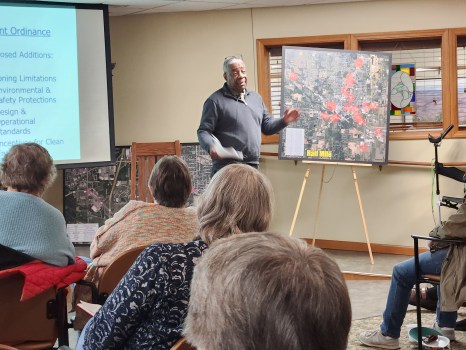

From potholes to questions about Immigration and Customs Enforcement in the city, a small crowd of Valparaiso residents attended the mid-term town hall held by Valparaiso City Council Members Robert Cotton, D-2nd, and Barbara Domer, D-3rd, Saturday afternoon.
“We do these to get a sense of what’s on your mind,” Cotton told the group of about 20 gathered in the meeting room of The Pines Retirement Community. He and Domer gave the crowd background on how they each came to seek public office and what they find to be the city’s pressing issues right now.
Cotton said his involvement in city government has roots in his years as a precinct captain that morphed into his first campaign for city council in 2015. Eleven years later, he’s in his third term. “I do know, in order for government to work, it has to be inclusive of everyone,” he said.
He gave a presentation on the need to upgrade permit requirements for gas stations, which have rebranded themselves under the term “C stores,” short for convenience stores.
“I struck out on getting the fullest extent of reform,” he said, before asking the crowd, “Does anybody ever have a hard time finding a gas station in Valparaiso?”
Cotton said the city relies completely on groundwater for its potable water supply and said the over 100 “buried items” the city already holds from past and existing gas stations are a concern enough.
“We’re well-served and I would like to prevent the proliferation of unnecessary saturation,” he said, adding that the city has 33% more gas stations than the national average and that is projected to grow as national chains have identified Indiana “as a place where they’d like to place an additional 150 stores.”
As the city’s Unified Development Ordinance undergoes an overhaul, Cotton said he hopes the current ordinance, which he finds light on requirements for pump and canopy setbacks, canopy design and removal, and tank and pump removal, will be amended to include zoning limitations, environmental and safety protections, design and operational standards, and incentives for clean energy.
“Why not be more conservative about the value of our land, the valuable resource of our water?” he asked.

Domer said it was a huge pothole in front of her driveway on Yellowstone Road, where she’s lived for 33 years, that initially got her involved in city government. When “no through traffic” signs were removed and large truck traffic was diverted to her street, it began to deteriorate until one day a chunk of yellow-striped asphalt was kicked up onto the sidewalk.
After being ignored by her city council member, she took the chunk to a city council meeting and held it up as she told her story during the public comment portion.
“It was a very dramatic act of mine, but it was sincere,” she said. “I was very disappointed that I had to make a dramatic act to get some attention.”
Her focus is still on roads, and she gave the audience a tutorial on the city’s infrastructure budget. She explained that repeated requests on her part finally saw the city conduct a “true-up” of the city’s paving budget, which is the difference between what it’s budgeting and what it’s actually collected.
“We budget $1.6 million, but we’re collecting more than that every year,” she said. “I was concerned. Why aren’t we using this money?”

Domer said another $2.6 million was available for paving on top of the budgeted amount and appropriated.
“I also got to see how much exercise, how much energy it took to get that number,” Cotton added.
She said the sidewalk budget was doubled for 2026 to $800,000 and showed a chart that said the city will have spent $25.7 million on infrastructure needs from 2024 through 2026.
“That is amazing,” she said. “When you hear about municipalities across our state, there are not numbers like this,” unless they’re really large cities like Lafayette.
Domer said when she ran for city council, one of her priorities was better streets and sidewalks.
“You can toot your own horn, Barb. We don’t care,” said Nancy Tiernan, of Valparaiso. “Some of these sidewalks are 100 years old.”
Moving forward, Domer said Mayor Jon Costas has agreed that a true-up will be conducted annually.
When it came time for questions the audience asked about rumors the city was going to begin using Lake Michigan water for its water source, the relationship between the city and Valparaiso University, if a map of Flock cameras could be made available, what other issues the councilmembers themselves would like the council to address, and what the status of ICE activity is in the city.
Cotton said the question of whether the city would cooperate with ICE hasn’t been fully answered.
“I think there’s an expectation or a dictate from the state that says, ‘You must,’ but I haven’t gotten the impression our chief is inclined to that,” he said.
Shelley Jones is a freelance reporter for the Post-Tribune.