
School’s almost out for summer, great news for class-weary kids looking forward to a break.
For Chicago Public Schools, though, the year is winding up in the red.
CPS is projected to end the current school year with a $45 million deficit, WBEZ reported, following a $102 million deficit last year, a shift that returned the district to deficits for the first time since 2017, when the state updated its school-funding system. In the years that followed, $2.8 billion in federal COVID aid propped up CPS spending. That money dried up last year, but it did allow the district to paper over its underlying financial problems for a while.
District officials used one-time COVID cash to fund ongoing costs without aligning spending to a post-pandemic revenue reality. All as the district works to put together a budget, which is projected to face a $529 million — and growing — deficit for next school year.
The problem isn’t hard to explain. CPS is now paying for a school system sized for far more students than it serves today. Since 2020, CPS has added roughly 7,000 employees even as enrollment has fallen by about 8%, as Civic Federation President Joe Ferguson testified last year at a hearing on Chicago Public Schools’ finances.
Now would be a good time to have some unpleasant but necessary conversations, such as identifying near-empty schools that should be closed.
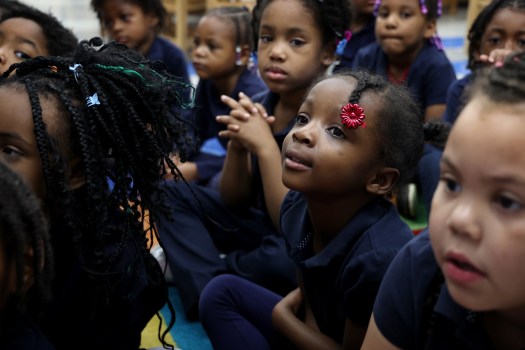
CPS is educating a little over 80% of the students it did a decade ago, with enrollment of 316,224 down from 392,285. By the Civic Federation’s analysis, CPS is using far more building space than it needs: 58% of schools are underutilized, and about 1 in 10 are running at one-third capacity or less. CPS spends thousands more per student at these nearly empty schools — roughly $5,000 more in elementary schools and more than $12,000 more in high schools.
In the face of such realities, the Chicago Teachers Union and Mayor Brandon Johnson speak of school consolidation as if it’s unthinkable. But it’s inevitable.
Indianapolis, just 180 miles southeast of here, serves as a cautionary tale.
Indianapolis’ consolidation story gained momentum several years ago, when IPS closed multiple schools amid a structural deficit and declining enrollment. But the steps were too tepid for Republicans who dominate state government.
In 2025, the state legislature considered dissolving the district entirely before ultimately creating a new agency — the Indianapolis Public Education Corporation. In this restructuring process, the new agency of mayorally appointed members will control IPS facilities, transportation, and wield key financial powers for both IPS and charter schools.
This isn’t just a budget fix, it’s a governance workaround designed to move faster on decisions elected school board members have struggled to make.
What happened in Indianapolis is unlikely to be replicated in Chicago. Indiana’s approach depends heavily on mayoral control and alignment between city and state leaders — conditions that don’t exist here.
If Chicago continues to avoid consolidation, however, the pressure for more drastic fixes will grow. In Indianapolis, lawmakers shifted significant authority to the mayor.
In Chicago, the risk is losing control of the district altogether.
Talk of greater state oversight already surfaced here when state Rep. Curtis Tarver, a Chicago Democrat, in 2025 introduced a bill to place the district under the state’s watch. That bill didn’t go anywhere, but it was consequential, coming not from a downstate or suburban conservative, but a city Democrat.
And it’s not without precedent, as we wrote after Tarver’s bill emerged. In January 1980, Gov. Jim Thompson hammered out a deal with the city, the Chicago Teachers Union and CPS to have the state essentially take over financial decision-making for Chicago’s public schools.
CPS itself describes its three biggest financial drivers as increasing labor costs, outstanding pension obligations and aging infrastructure. CPS says it “must divert between $400 and $500 million from the classroom annually to pay for debt service to fund school construction and repairs.” That makes little sense for a system with so many empty seats.
Until CPS aligns its footprint with the number of students it actually serves, deficits will persist.
Chicago isn’t Indianapolis, and the particulars in terms of public-school politics differ. If CPS’ fiscal mess gets to the point, for example, where it’s shut out of the bond markets, it’s highly unlikely control of Chicago’s schools would revert to the mayor.
But the dynamics otherwise are eerily similar. CPS next year will be overseen by a fully elected school board for the first time in its history. Job One for that board will be making these tough decisions.
Submit a letter, of no more than 400 words, to the editor here or email letters@chicagotribune.com.