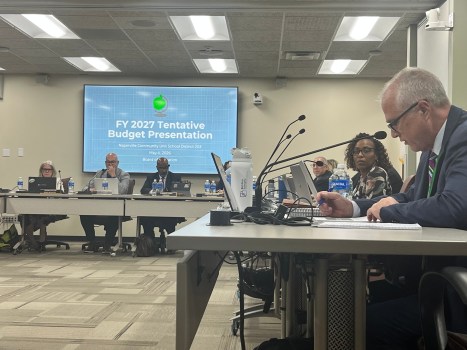

The projected deficit in Naperville School District 203’s tentative 2026-27 budget has been reduced from $12.4 million to about $4 million with the elimination of 59 positions, planned spending cuts and no new initiatives.
School board members were given an overview of the plan Monday night by Chief Financial Officer Michael Frances, who told them the district would not be filling the equivalent of seven administrative positions, 43 certified educator positions and nine educational support personnel left open through retirements and resignations.
Other reductions include a 15% reduction in individual school site budgets, 25% reduction in district department spending, cuts to professional learning, conferences, travel, catering, staff appreciation gifts and employee events, and elimination of duplicative software platforms, Frances said.
To capture additional revenue, the district has raised fees on some courses, driver’s education, early childhood tuition and facility rentals to more accurately reflect the true cost of providing these services.
The district will consider increasing costs for cafeteria services in the future to offset a $1.6 million deficit in the cafeteria fund, Frances said.
Officials are also planning to reduce the number of replacement buses purchased in the upcoming budget cycle, resulting in a temporary savings of about $1.2 million, he said.
The projected 2026-27 spending plan calls for about $366.2 million in revenue, up by 3.39% increase, and $370.1 million in operating fund expenditures, a 2.76% increase. The operating fund encompasses the day-to-day costs of running the district.
Personnel costs make up the bulk of the budget, with about $238.6 million earmarked for salaries and $59.5 million for benefits.
The school board in October approved spending about $7 million in infrastructure maintenance costs, such as replacing generators, chillers, roofs, water heaters, piping and other work needed at various buildings, noting that deferring maintenance could lead to significantly higher costs and more expensive emergency repairs.
The district’s fiscal year starts July 1. Although school districts in Illinois have until Sept. 30 to adopt their budgets, it has been a District 203 practice to approve the plan before the start of the fiscal year.
District 203 will put its budget on display Friday at the Administration Center, the Nichols and Naper Blvd. libraries and the district website and will hold a public hearing June 15 before voting to adopt the document.
Because temporary federal pandemic funding has expired, the district is working towards having a workforce at pre-pandemic staffing levels and aligned with student enrollment, Frances said.
The district hired more specialists and educators in recent years to prevent post-pandemic learning loss.
While the school board wanted to see what it would look like to have a 2026-27 budget with no deficit, members didn’t like what was proposed. The board in March rejected a plan to lay off 38 teachers as part of a reduction in force after community members, parents, students and teachers made it clear that the move did not have their support.
School board members said they want to prioritize classroom needs and student learning as cuts are considered.
However, the projected deficit is not for just one year. District officials and board members are anticipating growing costs over several years, which they will need to deal with annually before the budget is brought back into the black.
“Based on feedback from the community we decided it’s going to take us several years to get ourselves in balance,” board member Marc Willensky said. “… I don’t want us to lose sight of the fact that we do have an operating deficit that we still have to address over the course of this coming year and in the future years. So I want to make sure we’re all focused on how we get that to zero as quickly as we can and without impacting the student experience.”
Frances said one concern he has is unknown expenses.
The district, for instance, spends about $650,000 to $700,000 on fuel, but the cost of diesel has increased due to the war in Iran and it is unknown when prices might go down. The district doesn’t have a choice not to fuel its buses, Frances said.
“The good news is that because we have a sufficient fund balance, we can weather a short-term storm,” Frances said.
Board member Melissa Kelley Black suggested the school board consider pushing back its approval of the budget to August to have more accurate estimates on its expenses and revenues.
The district’s labor agreement with the Naperville Transportation Association expires June 30.
Michelle Mullins is a freelance reporter for the Naperville Sun.