
In his new non-fiction book “Fire and Clay: How Bricks Reveal the Hidden History of Chicago,” Will Quam writes that brick in Chicago is “such a ubiquitous material that it is quite easily forgotten or ignored, simple background noise to everything else.” And yet, ever since the Great Chicago Fire of 1871, brick has been a key driver in shaping the city’s look.
“The new Chicago is being built mostly of itself,” is how the Tribune put it in the years immediately after the fire. “The skyline that rises above Michigan Avenue is simply a pleasingly modified form of clay like that deposited in the land a few hundred feet to the east.”
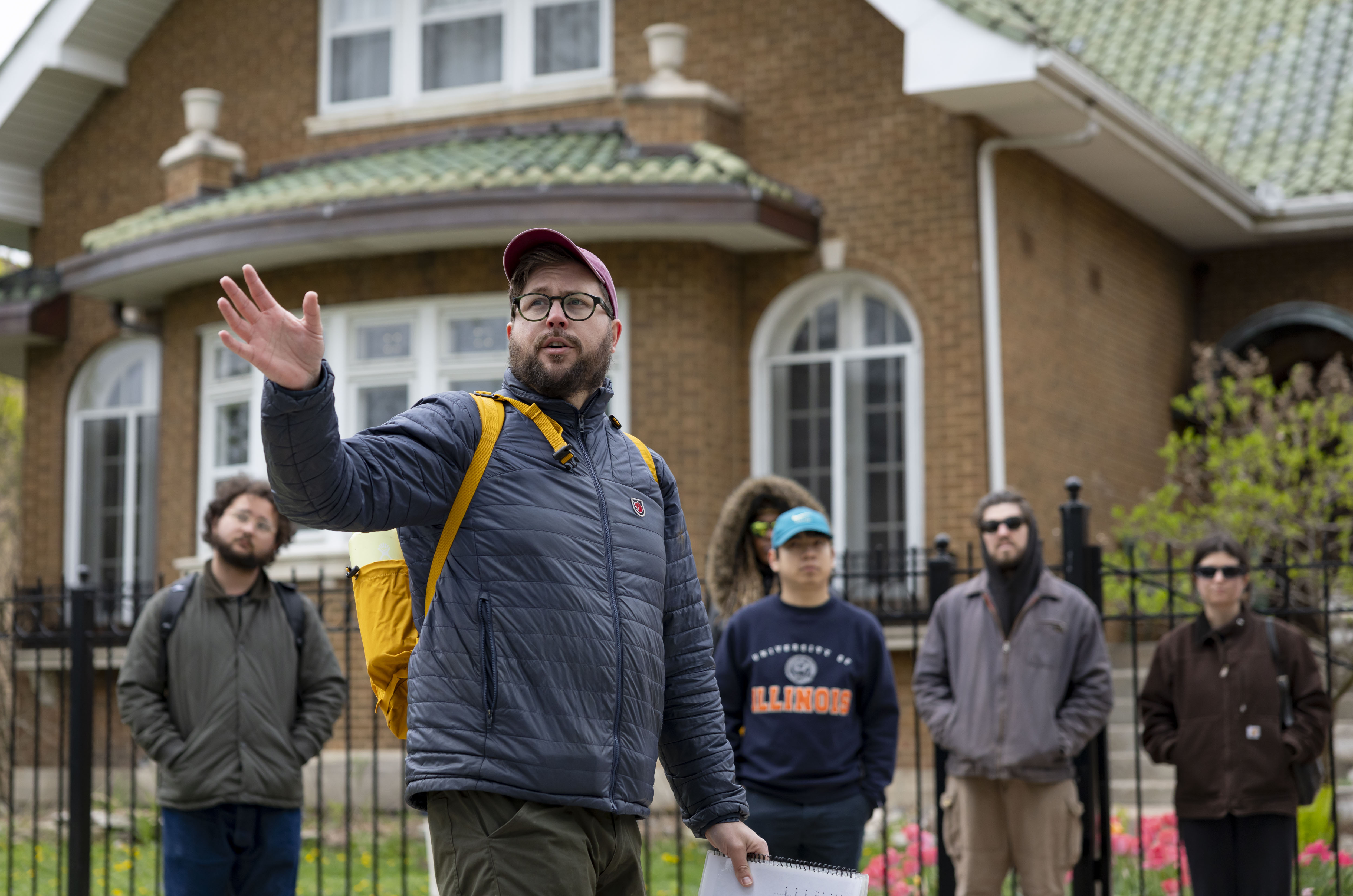
For the past decade, brick has been an obsession for Quam. An architecture photographer, writer and researcher, he also gives tours through 12 neighborhoods across the city focused on brick. “It’s so omnipresent in our lives that your eye just slides right off of it. But when you actually start to dive in and see the influences of design and architecture and labor and manufacturing built into the building. You can really see the history just through the brick.”
Not everyone agrees. “I did contact a plains architecture historian in the Chicago region and he wrote back saying he did not think it was an interesting topic or a useful way to look at Chicago.”
Well, his loss.
Even with new construction, “they’re still putting brick on it,” Quam said.

Ironically, the home Quam owns is … made from wood.
We talked about the ways in which bricks tell us about Chicago’s history. The following conversation has been edited for clarity and length.
Q: How did your interest in brick begin?
A: The first inspiration was when I read a really wonderful book called “On Looking” by Alexandra Horowitz, where she takes these walks around New York City with different experts in things and tries to see the world through their eyes. It’s everyone from a bug scientist to a sign painter. I just loved it, and it made me start to look closer at things. And brick was the thing I started paying attention to, because you can’t go anywhere in Chicago without noticing it.
I started taking pictures and created an Instagram account of bricks that I liked, and it took off from there. People were asking questions, so I started researching and falling down the rabbit hole. It made for a much more interesting way to live and be in the city — and think about the city.
One of my friends, when I started the Instagram account, it took her about a year to realize I was serious.
I give these tours, and a lot of people who come are there because they have a friend who’s like, “Did you hear that there’s a brick tour? What could that possibly be?” I’m picking different neighborhoods that are representative of different eras or different styles of brick architecture. But then what else can we see in the built environment that tells a story about this neighborhood?

Q: Are there brick experts in Chicago? How were you piecing it together?
A: When I started taking it seriously, a guy named Brent Schmidt, who runs a brickyard in Chicago called Bricks Inc., reached out to me and was like, “Hey, we should know each other.” We’ve become friends, and he’s sent me to brick manufacturers around the country, which is where I learned a lot of the technical stuff.
There are not a ton of books written about brick. So there was a lot of searching through newspaper archives. And there were also these trade publications that were started in the 1890s for people in the brick industry. Some were based in Chicago, and a lot of them wrote about Chicago. A lot of that is digitized online. After 1928, it’s not public domain, so I had to drive down to the University of Illinois Urbana-Champaign a few times, where they have the full bound compilations of one of the last trade magazines.
In the early 20th century, when Chicago was this titan of brick manufacturing, so many of the articles were about the output in Chicago, or features on the manufacturers, or what were the new machines that had just been brought online. So through that, I was able to track a lot of the history of the brickmaking industry in Chicago.
And in terms of the labor, there was a union publication, which had some information. Brick was then being laid into buildings by these waves of immigrant masons from Europe who came to Chicago. And you had these massive manufacturers here employing hundreds of thousands of men and women — and children, too — making bricks that were used to build our buildings.
Q: We know the Great Chicago Fire was pivotal for brick, but you point out why the timing was so important.
A: Other cities have burned before, but they weren’t able to rebuild with brick because they couldn’t make enough brick. Chicago burns at the time when the machinery to produce brick is perfected. And so Chicago brick manufacturers, for the first time ever, are able to produce enough brick to fill demand.
I write about how Boston just kept burning, because they kept rebuilding out of wood because that’s what they had; they couldn’t make enough bricks. But Chicago could because we had the machines and this inexhaustible supply of clay right underfoot.If the fire had happened 10 years earlier? The city probably would not have been able to be rebuilt out of brick.

Q: One of the things you write about is the distinction between the brick we see, called face brick, and the brick that is behind the “pretty” brick, which is called common brick. Chicago was a brick powerhouse for manufacturing common brick, but the clay here wasn’t conducive to face brick.
A: Common brick was made with no care for what it looked like. But with the invention of brick-making machines, now suddenly you could make bricks that were a little more intentional and looked better. And you get these epicenters across the country where the clay was just a little bit nicer. It was more uniform, it was already pretty fine, you didn’t need to grind or sift it, and it had mineral qualities that made it look interesting. So in Pennsylvania and St. Louis and Milwaukee and Ohio especially, they could make the brick look interesting, look nice, and most importantly, be consistent.
And what made Chicago so different was that our clay could make a perfectly fine brick, but it was never able to be made in a way where it would come out looking consistent. The minerals were so varied and there were all these stones and pebbles gathered throughout the clay.
Q: Were there builders or architects who looked at the Chicago common brick and said: I like that lack of uniformity, this is going to be my aesthetic?
A: Oh, yeah! Starting in the 1920s, there are Chicago architects who really take a shine to it because it is so varied and wonky, and that’s the era when they’re building in a lot of revival styles — gothic, tudor — and building new buildings, homes especially, and trying to make them look old and weathered, like they’ve been plucked out of the European countryside. So they were taking advantage of this cheap, messy-looking brick to build mansions in the North Shore or Beverly or Sauganash that had this very rustic appearance.
Q: What an irony: The humble common brick was used to build expensive homes.
A: Hundred percent. The working-class people are not building with the cheap brick; they want the face brick on the bungalow because it looks nice. The wealthy people want the cheap stuff because it evokes a weathered look, like it’s been there for centuries.
And in the Depression, a new generation of modern architects are really drawn to the common brick because it is cheap and it’s honest, it’s real, it’s true, which goes with this Frank Lloyd Wright idea of: Let a material look like what it is.

Q: We live in a moment where prices are high and developers are always looking for a way to maximize profit. Why do we not see more buildings built with common brick on the outside right now?
A: Common brick has not been produced since 1981. The American Brick Company, which was producing in Dolton and Munster, Indiana, was the last common brick manufacturer in the United States. It was a two-pronged event that led to the end of the common brick. The biggest was that after WWII, labor became the most expensive part of a building. And a common brick is a small unit — you need to buy a lot of them to fill your wall, and it takes your laborer a long time to lay it. So concrete block started to take over. It’s a much larger unit and you can build a wall faster, so it saves a lot of money on labor.
Q: So cement block replaced bricks for the bones of a building?
A: Yes, and even more so now, it’s wood! Fire-retardant treated lumber.
So as that change was happening, brick companies started to close down.
But the other big factor was environmental. In 1970, the EPA was formed, and at that point, there were two common brick manufacturers left in the area, and they were some of the most polluting brick makers in the entire country. They were told by the federal and Illinois EPA that they had to clean up or shut down, and there was just no way they could do that financially and make a profit.
The way Chicago manufacturers made common brick was with scove kilns, where you take all your unfired bricks, stack them in a big pile and light it on fire from the inside. It’s not an enclosed kiln or oven, so all those emissions are going right into the air. I write about how in Blue Island, residents would find that their noses and eyes would burn if they were close to the plant. The smoke would be so thick you couldn’t see through an intersection on the days they were burning.

Today, the Chicago common brick is one of the most sought-after bricks. When a building in Chicago is demolished, the common brick is saved for the same reasons those architects from the 1920s loved it: it makes new buildings look old. So there’s an enormous industry today of reclaiming the Chicago common brick from a demolished building and reselling it.
Q: You talk about seeing certain kinds of bricks in one neighborhood, and then finding that same kind of brick in an entirely different neighborhood across town, and specifically how brick binds Chicago in ways that we don’t think about.
A: The common brick is everywhere, because it was in everything being built. But the face brick, the brick that you see, that was tied to fashion. And that changes decade to decade. So you can look at buildings and tell when it was built by looking at the face brick. And it also connects the city of Chicago as it develops outward. So when Lincoln Park was being developed, these large, expensive homes for the German elite were being built out of this beautiful red brick. But at the same time, in Pilsen or in Bridgeport or Pullman, that same brick is being used on much more humble buildings without the same levels of decoration, but the same brick. Because that was the fashion at that time: This smooth, red brick that they called the perfect brick, because it was very uniform. This is the 1880s and 1890s.
And that flipped, and by the 1920s, people wanted brick that’s much more textural and colorful and visually interesting. And at that time, the city is developing at the edges. So Rogers Park and South Shore and West Garfield Park, so you’re seeing that brick in these more outlying areas. And then in the mid-century period, you’re getting smooth but colorful bricks that are laid in block patterns that are almost Mondrian in style. And you see that in areas like West Ridge and Beverly.
So very different parts of the city that are unified by this material based on the era they were built in and what the design styles were at that time.

Q: So many new builds right now are very generic and boxy, with almost no decorative features, but many are still brick. It’s one small consolation, I guess.
A: The brick layers really love to do more interesting things, and they know how to do it. And they want to do it. It’s just — somebody has to pay for it, because it takes a little more time. I push back when I get comments like, “We don’t make ‘em like we used to,” or, “Nobody knows how to do this kind of work anymore.” People still know how to do it, and they want to do it, but developers or homeowners are not as willing to pay for it. Or, you get developers or architects themselves who become convinced that this skill doesn’t exist anymore, so they don’t design for it. But there are really great examples in the book, from the last 20 years, that do do this. The brick layers want to do it.
Q: Is there a “brick-est” neighborhood?
A: (Laughs) Rogers Park is maybe my favorite era of brick architecture with its tapestry-style brick. That part of the city really exploded in population in the 19-teens and you see architects treating brick as fabric as they build their buildings. And also, there’s a lot of really spectacular terra cotta.
Brick of Chicago Walking Tours run most Saturdays, Sundays and select weekdays, with upcoming tours in Rogers Park and Uptown (11 a.m. and 2:30 p.m. May 10) and Albany Park (6 p.m. May 11); tickets $28, plus more tours and information at brickofchicago.com