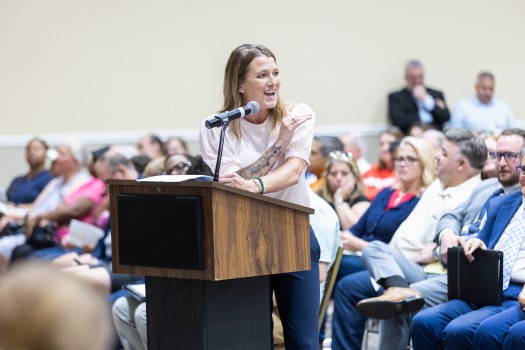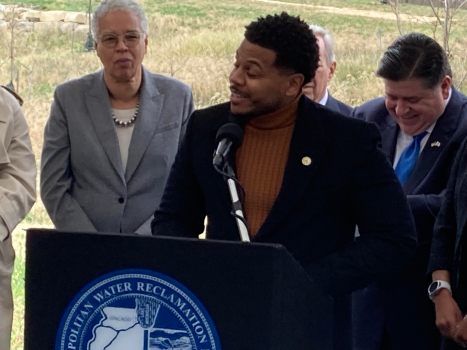
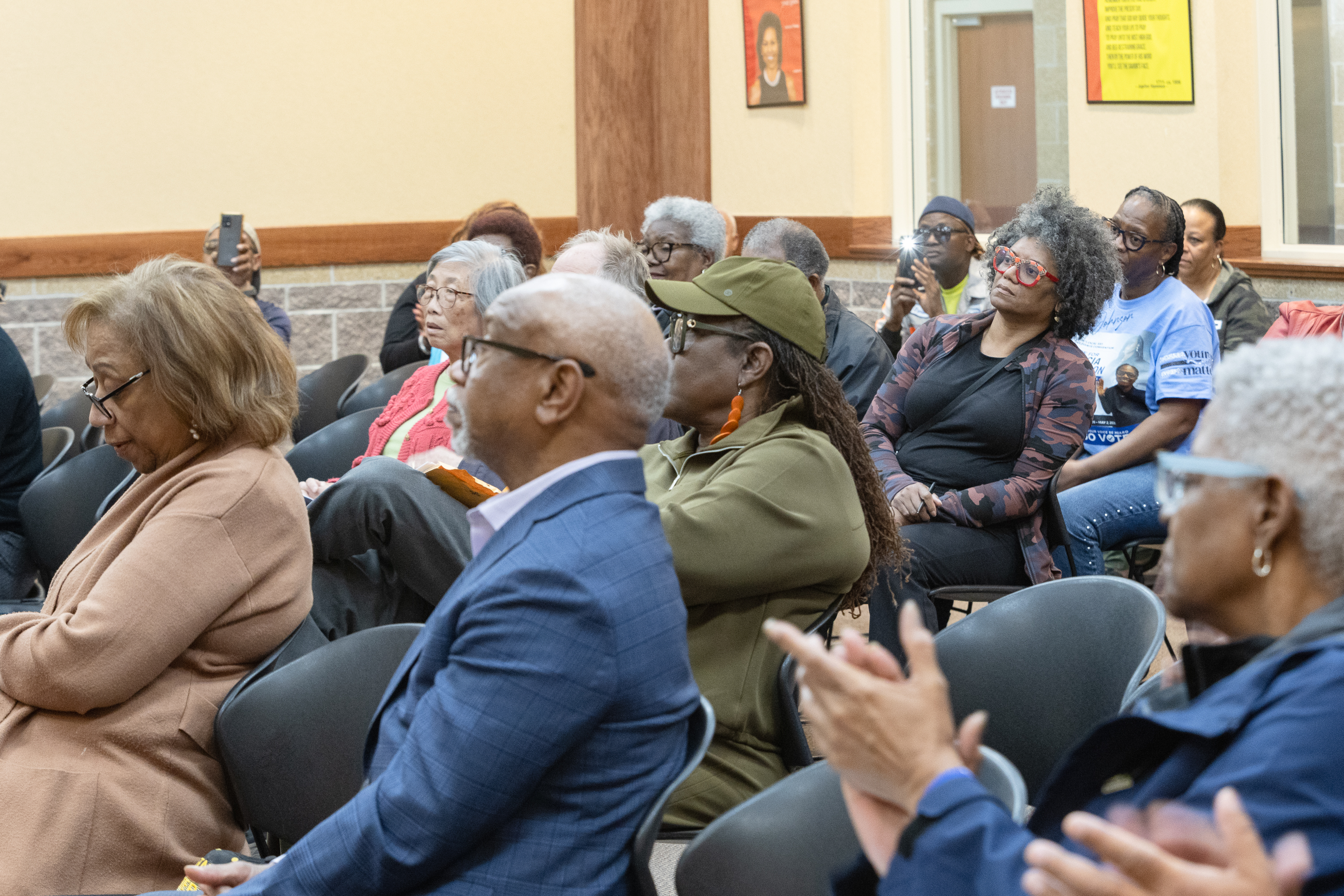

“Not on my watch,” a room full of south suburban Black leaders repeated Wednesday night.
The leaders gathered at Markham City Hall to discuss their concerns with an April U.S. Supreme Court decision they said gutted racial protections in the Voting Rights Act of 1965 and prompted redistricting maps in Southern states that dispersed historically Black voting districts.
Guided by Cook County Commissioner Kisha McCaskill, the leaders pointed to low voter turnout numbers in the south suburbs and urged the audience to mobilize neighbors, clergy and even the people sitting around their dinner tables to vote in the November midterm elections.
“A voteless people is a hopeless people,” repeated several speakers, quoting a phrase used to mobilize Black voters in the 1930s.
Despite Illinois being a supermajority Democratic state, officials, including former U.S. Rep. Jesse Jackson Jr., said they worry the Supreme Court decision could affect Illinois, as the protections that informed the state’s existing voting map are formally gone.
Leaders said future redistricting needs to be transparent and urged state officials to prepare for federal lawsuits over their maps.
Community members also started planning initiatives to educate young area voters, such as a partnership between the Rev. William Fleshman, a Dolton pastor, and Thornton Township High School District 205.
McCaskill said the event was the first in a series of efforts to mobilize and educate voters across the state, and some attendees said this was their first political event.
“I didn’t know nothing about this until today,” said Demetrius Criggluy, a senior at Thornton High School. “I feel like this should be taught in school.”
The Rev. Isaac Greene, a Chicago Heights pastor, said it was his first time speaking at a political event. He said he and the community had “fallen asleep at the wheel” and needed to be more proactive.

“It’s a shock to be here, in 2026, to discuss the 1965 Voting Rights Act being undone,” said Greene as the crowd chimed in saying “wake up, wake up.”
“In a democracy, the vote is not merely a privilege. It is the people’s voice. It’s our power,” Greene said. “Let us all take the initiative to take our protest to participation.”
What began as a panel of speakers Wednesday quickly turned into a room discussion, with people expressing distress and others responding with solutions or ways to get involved, such as signing up as a registrar, to register voters.
Mayors, trustees, NAACP leaders, pastors, retired officials and area residents attended the event.
“Some people say ‘McCaskill, why do you have so many clergy members on your panel,'” McCaskill said. “It’s because that’s where the Black family starts. … If we’re going to do this thing right, we have to establish it from the foundation up.”

The audience nodded, clapped and cheered on each speaker — an energy that rose to a palatable buzz when former U.S. Rep. Jesse Jackson Jr. walked in the room.
Jackson, who recently lost a comeback effort for his south suburban seat, called the voting act the “crown jewel” of legislation that resulted from the Civil Rights Movement and said it informed the drawing of several congressional districts around Chicago.
The act, signed by President Lyndon B. Johnson five months after the “Bloody Sunday” attack on civil rights marchers in Selma, Alabama, aimed to prohibit racial discrimination in voting.
The act has been narrowed through the years, including a 2013 change that removed a provision mandating advance approval for voting-related changes in certain states.
Under the most recent change, the U.S. Supreme Court found taking race into account when drawing electoral maps unconstitutional. Jackson said race was a provision used to draw the congressional seat he held from 1995 to 2012.
Jackson also said the provision shaped the 1st, 4th and 7th Congressional Districts in the Chicago area and include Black and Hispanic voting blocs. Most notably, he said, the 4th District was created to unite a community of Hispanic voters across Cook County and comply with the Voting Rights Act.
Jackson said he expects the U.S. Department of Justice to file a lawsuit against these districts, which he said worries him, as the districts protect historically marginalized areas, and he said any one district change could affect the lines of other districts.
He pointed to the economic struggles in Ford Heights and Harvey and said “people don’t care about us until we make them care about us.”
“We have to hold people in the present accountable to the business deals that we have for our communities now,” he said.

McCaskill brought action items to the meeting Wednesday, including a packet educating attendees on the Voting Rights Act and a county resolution aiming to support stronger voting right protections, encourage public hearings and discussion, urge federal action and commit to voter outreach.
She said she asked the county to support communities and clergies in their efforts to increase voter registration and education.
“I really want to see us a lot more involved because the voter apathy is going to put us in very poor conditions,” she said. “The residents here tonight speaks volumes and tells you people are concerned and they’re looking for somewhere to discuss their concerns and get some guidance.”
She also urged area residents to support an amendment to the state constitution that aims to enshrine protections for majority-minority districts, but was paused in late April.
awright@chicagotribune.com