
After abandoning the centerpiece idea in his voting legislation honoring Rev. Jesse Jackson, Mayor Brandon Johnson moved ahead Tuesday on a plan to celebrate the late civil rights icon with toned-down measures.
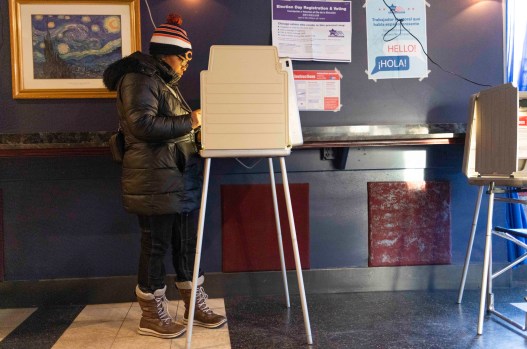
Johnson initially proposed “democracy zones” near Chicago polling places that banned federal immigration agents. He cited the possibility that President Donald Trump would try to use agents to intimidate voters.
But the altered ordinance advanced by Ethics Committee aldermen Tuesday dropped the measure.
Instead, Johnson’s “Reverend Jesse L. Jackson Sr. Fair Access to Democracy Ordinance” would strengthen requirements on landlords to maintain secure mailboxes, impose fines against people who “dox” government workers and create a new advisory group tasked with expanding access to democracy.
“The idea here is to take very seriously the threats that are coming from the federal government and recognize that there are going to be multiple strategies that we are going to have to use to respond,” Johnson policy chief Sheila Bedi said after the Tuesday vote.
Bedi said Johnson dropped the “democracy zones” to instead more broadly focus on addressing “a number of issues” by creating the advisory council, but did not directly respond when asked why the administration did not still include the effort to block federal agents, which Johnson and other officials touted as a key part of the legislation.
“When we were socializing that idea, other ideas came to the table,” Bedi said, pointing to poll accessibility as a top complaint. “There was a desire to create a platform where all of those ideas could be put on the table.”
Johnson had in March sought a quickly planned special City Council meeting to pass the “democracy zones” measure before the state’s primary election, but backed off the idea and said he would instead aim to get it approved and implemented before the November general election.
The policy would have established boundaries extending 100 feet beyond the existing campaign-free zones codified under state law, and established fines against federal agents who violated them.
But like many of the efforts to use or create city laws to punish federal immigration agents, the policy was likely to face both legal challenges and daunting questions of how Chicago police could enforce it against on-duty federal agents.

During the meeting Tuesday, Stephen Thurston, chief impact officer at Jackson’s Rainbow PUSH, warned aldermen that the Voting Rights Act is now only “a hollow shell.”
“The courts have proven that they will not protect the vote, but this City Council can do its part,” he said. “Holding this ordinance in committee is just holding a knife to the throat of Rev. Jackson’s legacy. History will not remember who stayed neutral while democracy was under siege.”
Pressed by Ald. Samantha Nugent, 39th, a Johnson attorney said state law already bans “doxing,” or publicly identifying someone’s private information.
The city’s additional law would add a mechanism that can be enforced by city attorneys, Bedi said after the vote. It would also double down on protections for election workers, she added.
“There’s an added element to doxing if it’s being done because of the role an individual does making democracy work,” she said.
The measure bans doxing against all government workers, and not just election workers, in part because drawing the line between the two was “getting too messy,” she said.
Bedi also said the mailbox requirements, critical for voting by mail or securing federal aid, would put Chicago in line with other big cities, such as New York.
But some aldermen questioned the necessity of the 11-member “Reverend Jesse L. Jackson Sr. Advisory Council on Access to Democracy” that the ordinance creates.
Ald. Scott Waguespack told Johnson’s staff that “everything in” the ordinance seemed to be under the jurisdiction of the Chicago Board of Elections.
But Bedi said the council could go beyond the election board’s purview by pushing for funding to improve polling place accessibility. The body’s members could make recommendations on where ramps or parking could be added at polling sites, or work in their neighborhoods to talk with voters directly, she suggested.
“One example would be specific strategies to engage disengaged voters, recognizing that some of those strategies need to happen at a hyper-local level,” she said.
But Waguespack fired back, arguing the Board of Elections already regularly engages voters.
“There’s nothing here that you’ve said that they don’t already do,” he said.
Moments later, a frustrated Ald. Matt O’Shea, 19th, asked the panel of Johnson appointees and ordinance backers to name the three commissioners of the Chicago Board of Elections.
He waited. No one did. Then he listed off their names.
“I’m done,” he said, before grabbing his papers and leaving the room.
The committee then voted to pass the measure, with Waguespack as the lone no vote.