
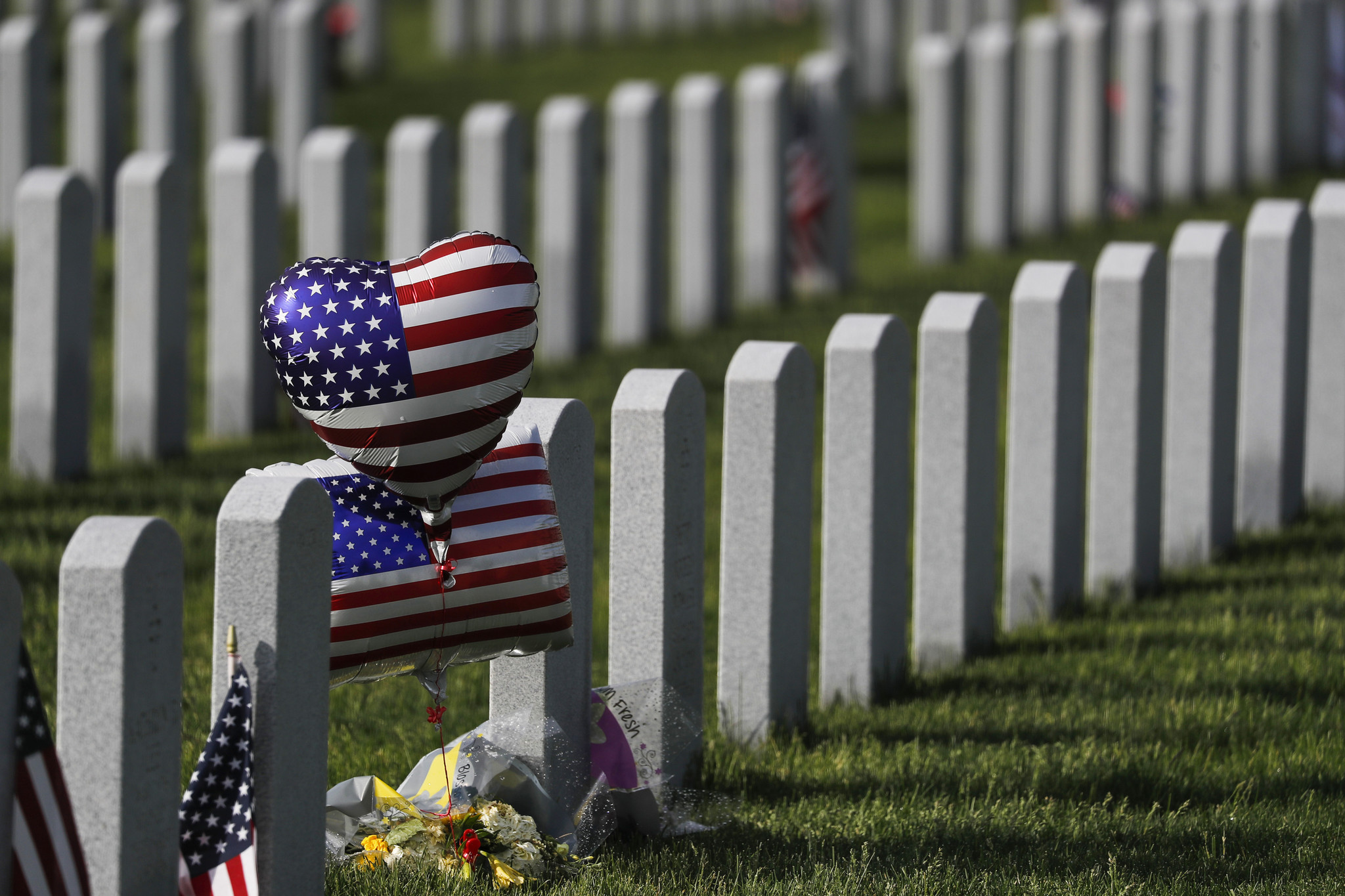

The fact that war is still a thing shows how little humans have evolved when it comes to conflict resolution. We’ve made all kinds of progress with technology and embraced ways to solve every problem under the sun … except our differences.
Author John Steinbeck had it right when he said war is a symptom of man’s failure as a thinking animal.
Granted, war has sometimes seemed the only method of ousting tyranny. But too often it is motivated by greed. Dating back centuries, the pursuit of profit seems to know no bounds. Someone wants someone else’s property or wants to boost their weapons-building business or doesn’t want to share trade routes or pay taxes or pay homage to another entity.
Sometimes war is simply the result of hate. Someone can’t abide someone else’s existence.
Whatever the reason, it does seem that evil is always at the root of it.
And so the people in charge send the people they’re in charge of to duke it out.
It is admirable that humans can muster the courage to become soldiers and stand guard in defense of their nation but sad that the cause of their deaths is often due to someone else’s unjust pursuits.
As we busy ourselves with barbecues and holiday sales this three-day weekend, I hope we can at least stop to ponder the many, many American lives that have been claimed by war. We see the statistics in news reports but we often don’t put faces to the numbers and we certainly don’t ponder the dreams and possibilities that died with the soldier.
The number of battle casualties in modern history, from World War II to the current Iran War, stretches well into the hundreds of thousands, according to Defense Casualty Analysis Systems and recent news reports.
In addition to deaths, hundreds of thousands more soldiers have been injured, physically or psychologically. And just about everyone who served during wartime left with crushing stories of despair — souvenirs that can’t help but endure.
That’s a whole lot of grieving families, a whole lot of dreams interrupted and a whole lot of potential cut short. Who knows, maybe one of those downed soldiers might have gone on to come up with a way nations can resolve their conflicts without physically damaging each other.
The older I get, the younger an active military member seems to be. Though bravado is the hallmark of youth, I cannot imagine the real terror racing through the hearts of young people as they march off to battle.
My uncle, Ernest Luna, was one of those people. Six months after he graduated Tilden High School in Chicago, he was drafted and then sent to Vietnam. It was 1966 and he’d been working for Commonwealth Edison as a meter reader so the Army assigned him to the radio repair crew.
From the start, his tour of Southeast Asia was scary.
“We arrived in Vietnam on Jan. 9, 1969,” he recalled. “We had to circle for a while because of mortar fire. When we finally landed at Bien Hoa Air Base, it was after dark. It was spooky.”
One time, while he was on guard duty in Dong Tam, the 9th Infantry base camp about 40 miles south of Saigon, where he was stationed, came under fire.
His bunker was not hit but the one 50 feet to the left was destroyed.
“Those soldiers died,” he said.
Another time, his unit’s sergeant and another officer were killed on their way to visit another radio tower.
“The jeep they were riding in hit a mine,” he recalled. “I was supposed to be driving but a buddy of mine named Tom volunteered to take my place. He lost his right arm.
“I felt really bad,” he said.
My father-in-law, Homer Vickroy, had a similar close call. While serving in Germany during World War II, he suffered frostbite on his feet and was sent to the field hospital. While in recovery, his unit was wiped out. His best buddy was killed.
Though the incident left an emotional scar, he wasn’t able to talk about it with family for several decades.
Luck brought bought men home from battle but the experience left them with horror stories.
Although neither my Navy-veteran husband nor my Air Force-veteran brother-in-law saw battle, both lived on the edge of it.
Remembering those who fought for America — either because they believed in the cause or because they were conscripted — is the purpose of Memorial Day.
Originally called Decoration Day, the federal holiday dates back to the American Civil War, when people began placing flowers on the graves of those who had been killed in battle, according to www.Britannica.com.
“The first national observance was in 1868. After World War I, the name was changed to Memorial Day, and in 1971 it became a federal holiday,” the encyclopedia states.
When it morphed into a barbecuing, sale-shopping, three-day salute to the start of summer, I don’t know.
I only know that as an American and as a human, each of us should at least pause and pay respects to those whose lives were cut short or altered because someone else declared war to be the only solution.
Donna Vickroy is an award-winning reporter, editor and columnist who worked for the Daily Southtown for 38 years. She can be reached at donnavickroy4@gmail.com.


