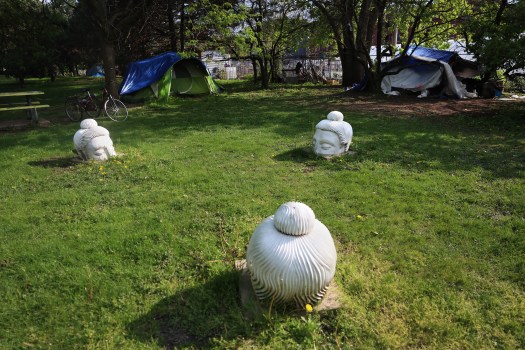
Mayor Brandon Johnson’s vision for Chicago 2050 sounds inspiring on paper (“Building the city for a bright future,” May 17). The words are polished, hopeful and ambitious. But for many Black residents who have lived through decades of broken promises, disinvestment and exclusion, this vision feels more like political theater than lived reality.
Johnson speaks of equity, opportunity, affordable housing and economic growth “for everyone,” yet many grassroots Black communities still see little evidence that these investments are truly reaching us. According to recent data from the city of Chicago and advocacy organizations, Black-owned businesses continue to receive a disproportionately small share of major city contracts and access to development capital compared with their representation in the city’s population. At the same time, many longtime Black residents have been displaced from historically Black neighborhoods due to rising costs, lack of homeownership protections and uneven economic investment.
Large-scale developments, billion-dollar projects and tourism records may look impressive in headlines, but who is truly benefiting? Too often, these opportunities circulate among well-connected developers, corporations and outside interests, while longtime Black residents and small Black contractors remain locked out. Many Black communities are not experiencing revitalization — they are experiencing removal.
The reality on the ground does not match the rhetoric. Families are still struggling to access affordable housing, quality mental healthcare, sustainable employment, and real pathways to ownership and wealth creation. Black entrepreneurs continue to face tremendous obstacles securing funding, city contracts and institutional support. According to U.S. census data, the median household wealth and homeownership rates for Black Chicagoans remain significantly lower than those of white households, reflecting long-standing systemic inequities that speeches alone cannot solve.
Chicago cannot claim progress while entire Black communities feel invisible within that progress.
If Chicago 2050 is truly about building a city where every resident can thrive, then accountability must accompany vision. Equity cannot simply be a talking point used in speeches and press releases. It must produce measurable outcomes in Black neighborhoods that have historically carried the burden of economic inequity, violence, environmental injustice and political neglect.
Chicago’s future should not be built on smoke and mirrors. It should be built on transparency, inclusion and direct investment into the people who have remained committed to this city despite decades of being pushed aside.
The question remains: Will Black communities finally be true participants in Chicago’s future prosperity — or merely witnesses to it?
— Theresa B. Hughes, Chicago
How will state fix oil well sites?
I read with interest the May 17 article “1 mysterious company, 603 abandoned oil wells” about abandoned oil wells in Southern Illinois, the continuing contamination dangers facing the area and the potential cost to the state to resolve the issue. The reporters present a through explanation on what led up to this crisis, but other than giving a cost figure on resolving it, they do not offer any answers on how the state can resolve it.
A follow-up article on how and when state officials are planning to do so would be appreciated by all, particularly those in the areas where these wells are located.
— Bernard Biernacki, Aurora
Memories of Sianis, the Goat
I worked my way through college at the Tribune when its offices were on Michigan Avenue at Tribune Tower. I was 21 and living paycheck to paycheck. My co-workers and I would go out on payday (every other Friday) and enjoy a little of the downtown bar scene, but would always end the night back at Billy Goat Tavern. It was a good meeting spot as it was conveniently located underneath the Tower, and the cost of a beer was a better fit for our budget.
I remember stopping in many times with my friends just before the closing hour to get a cheeseburger and a beer before calling it a night. At that hour, the place was fairly empty. But you would always see the owner, Sam Sianis, talking with one of the regular barflies. Of the many in that category, the two most memorable to me were Mike Royko, the famous local columnist, and Charlie Finley, the wealthy businessman and owner of the Oakland A’s. One or the other always seemed to be there when we stumbled in.
We would respectfully sit down and try to join in their conversations. I recall Royko didn’t suffer fools very much and accordingly didn’t engage much with our group. But Finley was a fun-loving, storytelling guy who embraced our drunken company despite all the stupid trade proposals we made on behalf of our beloved White Sox and Cubs.
I was sorry to hear about Sam’s recent passing but had to smile as it rekindled fond memories of late nights gone by.
— Steven Fortuna, Naperville
Visit firefighter memorial, too
Regarding the op-ed about the 1934 Union Stock Yards fire and the suggestion to go see the Stock Yards Gate (“The Union Stock Yards burned in a city still holding on to a century of progress,” May 19), I would also recommend viewing the nearby memorial to Chicago firefighters. It’s only a few steps behind the gate in a shaded park. A sculpture “The Fallen 21” commemorates the 21 firefighters killed in a more deadly Stock Yards fire in 1910. Also etched in the base of the memorial are the names of the many Chicago firefighters killed in the line of duty.
— Linda LaMontagne, Willowbrook
Stop giving store owner publicity
Will the Tribune please explain why it continues to give free publicity to the Trump Truth Store? A story about it was on the front page twice previously and was on Page 3 of the May 16 paper.
— Alice Herman, Highland Park
Make the prep liquid palatable
I’m in 100% agreement with Dr. Andrew Albert (“Get screened for colorectal cancer,” May 17) regarding the importance of getting screened for colorectal cancer.
However, I have found it to be one of the great mysteries of life that science has been able to put a man on the moon but unable to make a colonoscopy prep liquid that tastes like chocolate.
— David Grossman, Chicago
Note to readers
We’d like to hear from CTA riders about what frustrates you about the CTA as well as what you’re grateful for. (Sincere thoughts only.) Send a letter by Thursday, May 28 of no more than 400 words to letters@chicagotribune.com. Be sure to include your full name and city/town.
Submit a letter, of no more than 400 words, to the editor here or email letters@chicagotribune.com.