
Candidates in Chicago’s historic school board races have collectively raised nearly $2 million, with fundraising surging in recent months — even before many political players have entered the fray.
The top spenders in the 2024 race, including the Chicago Teachers Union and pro-school-choice groups such as the Illinois Network of Charter Schools and the Urban Center, have yet to make major contributions. Some board hopefuls are still fending off ballot challenges, meaning the final list of candidates is not yet finalized.
A Tribune analysis of more than three dozen active committees found that candidates have raised about $1.94 million over the past year, according to state campaign finance records. That figure includes loans and in-kind donations covering staffing, services and event space.
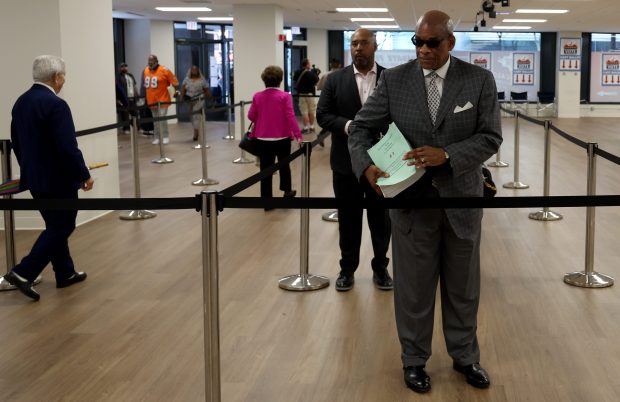
Business attorney Victor Henderson, running for the citywide board president seat, now has $598,000 in cash on-hand, more than any other candidate. Much of that stems from $500,000 in personal loans to his own campaign — lifting contribution limits and opening the door to larger donations in what will be one of Chicago’s most closely watched contests in November.
“I can’t ask other people to invest if I’m not willing to do the same thing,” Henderson said.
Contribution limits are lifted when a candidate’s self-funding or spending from independent expenditure committees adds up to more than $100,000 in an election cycle.
Four other candidates are running for president: current board members Jessica Biggs and Jennifer Custer, former board appointee Sendhil Revuluri and CTU political director Hilario Dominguez. Revuluri has amassed the second-largest war chest, with $216,000 on-hand — meaning money raised minus money spent. Biggs and Custer follow with $121,000 and $24,000, respectively, while Dominguez reported $0 in contributions and spending.
The fundraising total this filing period, which stretches from April to June, marks a significant uptick in recent months. It also outpaces the last school board race in 2024, when only 10 seats were on the ballot — but the field was similar in size, with 47 candidates filing to run.
For the first time, all 21 Board of Education seats will be up for election. Previously, the body was made up of seven mayoral appointees. It is currently in a two-year transition period, with a hybrid elected/appointed board. A total of 51 candidates filed to run in May, and after ballot challenges, 46 are still in contention.
Several candidates reported no contributions or had not yet filed paperwork with the Illinois State Board of Elections. Generally, only those who raise or spend more than $5,000 during a 12-month period are required to form a committee and file disclosure reports.
CTU, special interest groups hold off
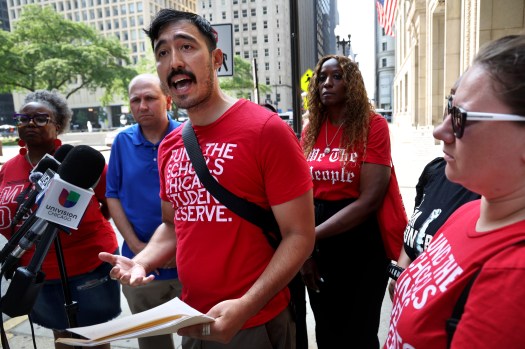
CTU released its slate of endorsements earlier this week, as did SEIU Local 73, which represents service staff in Chicago Public Schools. Both unions said they are largely holding off on spending until campaign season ramps up.
“It’s certainly too early. Endorsements are still fresh out of the oven,” said Kathryn Zamarrón, the legislative committee chair of CTU’s political action committee.
The two PACs affiliated with CTU had about $379,000 at the end of the latest filing period.
Meanwhile, INCS and Urban Center have made smaller contributions to a handful of incumbents and provided in-kind petition support. The political fundraising arm of INCS reported $3.85 million on-hand, while Urban Center reported $102,000.
Common Ground Collective, which was launched in 2024 by a former cabinet member of ex-CEO Pedro Martinez, has also provided in-kind consulting to several candidates. The nonprofit had $527,000 in its two affiliated committees.
Urban Center CEO Juan Rangel said the nonprofit is surveying candidates, but won’t make significant contributions until closer to Election Day. The group plans to invest strategically in the most contested districts.
“Unfortunately, there’s a political reality … We are looking for candidates that are willing to take on the challenge of going toe to toe with (CTU),” Rangel said.
School board races in many urban districts become contests between teachers unions and charter school advocacy groups, according to Sarah Reckhow, a Michigan State University political science professor. School board elections in Illinois are nonpartisan, and in many blue cities, endorsements from unions and other interest groups effectively become party labels, Reckhow said.
“In this specific form of school board elections, outside money is often Democrats versus Democrats,” she said.
INCS President Andrew Broy said the group is drumming up support from its own network of donors to cast a wide net in the election. He noted this is the first and only time all 21 seats will be up for grabs: half of the board will serve two-year terms, while the other half will serve four-year terms, creating a staggered election cycle going forward.
Broy added that INCS is still weighing whom to support in the board president race, and has not ruled out the possibility of backing multiple candidates.
“It’ll be the only citywide race on education, and then it also positions a new person to be a very major political force in the city broadly,” he said.
Early money favors incumbents
Outside of the board president seat, a group of elected incumbents has pulled ahead in the money chase. At the top of the list are North Side board member Ellen Rosenfeld, with $81,000, Northwest Side board member Carlos Rivas, with $60,000, and South Side board member Che “Rhymefest” Smith, with $49,000.
That’s in part due to a pool of affluent donors contributing $7,300, the maximum under state law, to several incumbents who have challenged the union. They include billionaire Democratic donor Michael Sacks, Allstate Corp. CEO Thomas Wilson and his wife, Jill Garling, and investor Paul Finnegan and his wife, Mary Finnegan. Some of those donors have also given to INCS, Urban Center and Common Ground.
Most candidates aligned with CTU have comparatively smaller campaign coffers — and the union has criticized the involvement of the uber-wealthy in the election. Others counter that CTU will likely bring its own big money into the race.
Rosenfeld, whose district covers one of the wealthiest areas of the city, is running unopposed. A total of five districts are likely to be uncontested after ballot challenges.
Even with the fundraising advantage held by incumbents, several first-time candidates are preparing to build competitive campaigns of their own.
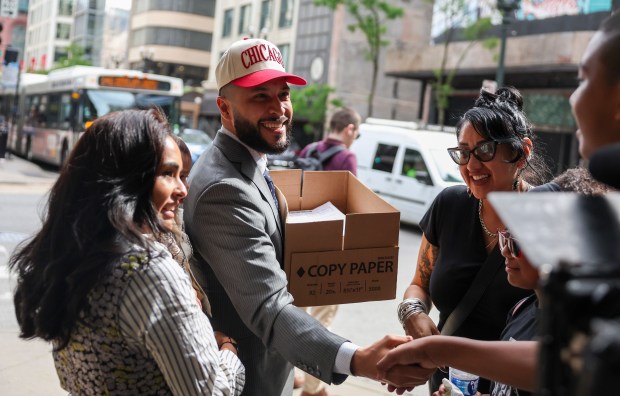
Claudia Peralta, running in District 1B on the Northwest Side, said her campaign aims to raise between $250,000 and $350,000. She said the funds will largely go toward getting out the vote in a lesser-known, down-ballot race, she said.
Peralta currently has about $18,000 in her candidate committee and is running against Michelle Pierre, a former chief of schools at LEARN Charter School network.
“The truth of the matter is that we are perceiving that this is going to be a pretty expensive race,” Peralta said.
Peralta works as the district director for Rep. Delia Ramirez (IL-03), and said she had tapped her professional network for support through the petition process. She’s planning a fundraiser Sunday at a brewery in Irving Park to watch the FIFA World Cup final.
“Asking people for money is never the most fun or easiest thing to do,” Peralta said. “If I’m 100% honest, I’d rather be at the door talking to neighbors.”