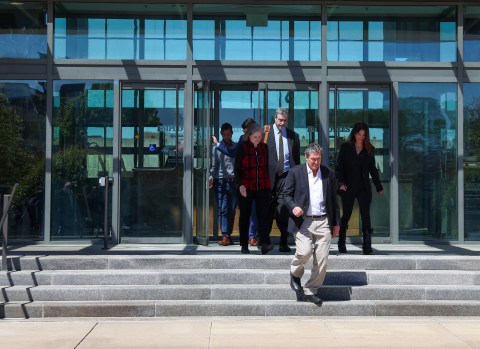
Indiana Attorney General Curtis Hill said Tuesday he would likely appeal the civil case against two ex-Munster administrators to the Indiana Supreme Court.
Former Superintendent William Pfister and Assistant Superintendent Richard Sopko were accused of siphoning around $840,000 from the School Town of Munster, mostly through snowballing annuity payments to their retirement funds not approved in their contracts, according to court documents.
On Monday, a state appeals judge upheld a lower Lake County court ruling which said too much time had passed by the time the Munster school board discovered it and Hill’s lawsuit was filed.
Hill’s office argued it should have had the flexibility to sue both men after a June 2016 State Board of Accounts report concluded the men were improperly paid between 1998 and 2013. New school board members are believed to have discovered the problem. The district’s lawyer alerted authorities in 2015.

Hill filed a lawsuit to recover the money in May 2017.
In March 2018, Lake County Circuit Judge Marissa McDermott set the five-year statute of limitations to start in May 2012 – near the end of their Munster tenure. That essentially threw out most of the case.
“It is now likely that the Indiana Supreme Court will eventually resolve this question because this memorandum decision breaks with a well-reasoned for-publication opinion by another panel of the Court in (a similar) case,” according to a statement from his office.
“There is little question that sound public policy — and the legislature’s intent — is for the State Board of Accounts to have the flexibility to fully investigate wrongdoing by public officials and for the Attorney General’s Office to have the ability to make the public whole after the full scope of corruption has been exposed. We remain confident that in due course the Supreme Court will affirm this sensible approach established by the General Assembly.”