
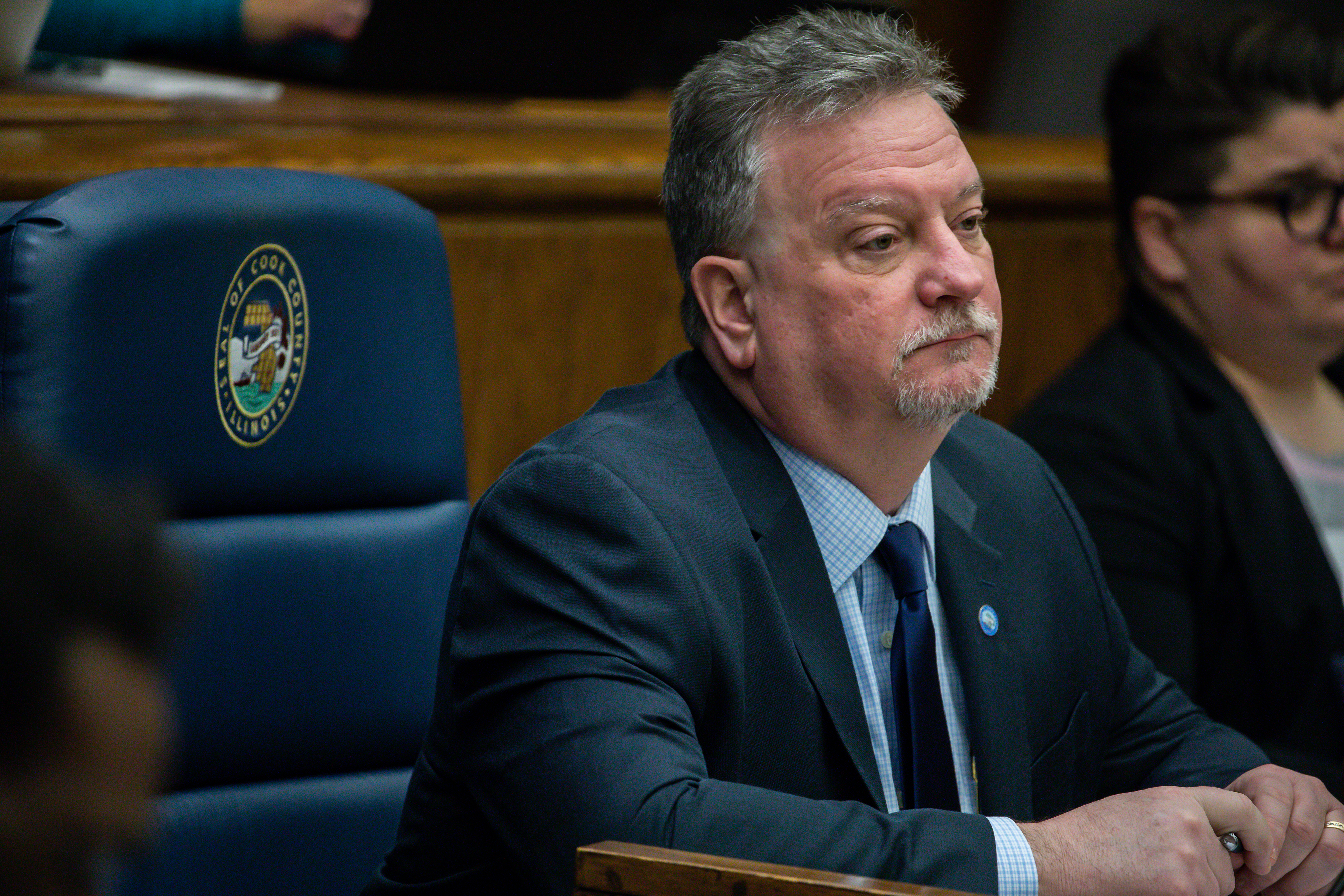

Jeffrey Tobolski traveled a well-worn path in Chicago-area politics, from following in the footsteps of his late father as mayor of the tiny west suburban town of McCook to double-dipping as a Cook County commissioner.
But his career also had another familiar — and darker — ring to it. For years, federal prosecutors say, he used his positions to create a fiefdom of graft, shaking down business owners who needed liquor licenses, forcing a developer to install air conditioning in his home for free, and even enlisting McCook’s police chief as his personal bagman.
After the FBI raided Tobolski’s offices in the fall of 2019, he became the poster boy in a burgeoning federal corruption probe that eventually brought down nearly a dozen suburban elected officials and political operatives, including Tobolski’s chief of staff and other close associates.
On Monday, nearly six years after Tobolski agreed to cooperate with the investigation, a federal judge sentenced him to four years in prison, calling him “a Jekyll and Hyde human being” who’d clearly become consumed by the power of his position.
“I think that the elixir for you was the power of that office, fueled by alcohol,” U.S. District Chief Judge Virginia Kendall said. “The side that was exhibited during those years was a very ugly, aggressive, arrogant individual, like the complete flip side of a human being.”
The judge also said she had to look up McCook and was surprised to see it has only 300 residents, a fact that makes the negative impact of Tobolski’s tenure loom even larger.
“This small community should never have been terrorized by one human being,” Kendall said.
Before he was sentenced, Tobolski stood at the lectern and read a nearly 15-minute statement to the court, apologizing for the people he hurt and saying he’s stopped abusing alcohol and changed his life for the better.
“What I did was wrong,” Tobolski said as about a dozen supporters, including his wife and daughter, looked on from the courtroom gallery. “I have added to the ever increasing distrust in elected officials.”
Tobolski said that after the FBI raids in 2019, he was in shock. “The lies and the deceit had come to an end,” he said. After taking a week to think about it, he made the decision to go all-in with his cooperation, admitting not only to his own litany of crimes but testifying before the grand jury and helping the government secure convictions of others.
Tobolski’s sentencing was one of the final acts in a case that unfolded like a cliched tale of midlevel Chicago corruption, with a wired-up executive entertaining politicos at his suburban cigar lounge, secret contracts siphoning funds from red-light cameras to a mob-connected businessman, and another mayor, Louis Presta, handing over an envelope of bribe money at a Crestwood pancake house called Stacked.
During the investigation, Tobolski was secretly recorded joking about how corrupt he was, according to prosecutors, at one point stating sarcastically, “You know I don’t take any money in McCook, ever. I’m as legitimate as they come.”
His then-chief of staff, Patrick Doherty, was caught on another wiretap talking with an associate about the prospect of doing business in Tobolski’s notoriously corrupt administration.
“It’s all contingent on what you can give,” Doherty told the associate, Omar Maani, about the obligatory campaign donations to Doherty’s boss, according to court records.
Maani, who was secretly recording the September 2019 conversation for the FBI, said, “It’s like you’re paying a little tax.”
“Right. Juice,” Doherty replied, according to court records. “Street juice. … I hope we can get it before (Tobolski) goes to jail. I hope we can retire.”
Tobolski, 60, pleaded guilty in September 2020 to conspiring with McCook’s then-police chief, Mario DePasquale, to extort a restaurant owner who needed permission to host events serving alcohol. At the time, Tobolski doubled as McCook’s liquor commissioner.
In all, Tobolski admitted to accepting more than a quarter of a million dollars in bribes or extortion payments over the years. He also was showered with a variety of other benefits, including cash, cigars, dinners, holiday gifts, sporting event tickets and those free air-conditioning units, which a developer installed at Tobolski’s home at a cost of $18,000.
Tobolski also pleaded guilty to filing a false tax return in 2018 where he underreported his income by at least $66,000, at least $10,000 of which was bribe money, according to his plea agreement. The document stated he also misreported his income in returns filed each year from 2012 to 2017.
In addition to the four-year prison term, Kendall ordered Tobolski to pay $85,000 in restitution to two of his extortion victims. He must report to prison by Nov. 3.
Prosecutors had asked Kendall for a 5½-year prison sentence for Tobolski, writing in a recent court filing that he “went on an aggressive and persistent cash grab to enrich himself” at his constituents’ expense, regularly demanding cash payments and other benefits from people seeking to do business in McCook and elsewhere in the Chicago area.
In court Monday, Assistant U.S. Attorney Tiffany Ardam said that for years, “corruption was a way of life” for Tobolski, and that he not only extorted money from people struggling to build businesses but also “unleashed his police chief to intimidate them.”
One victim, a Greek immigrant who was trying to live his American Dream by opening a restaurant in McCook, found himself instead forced to pay Tobolski $1,000 a month to keep his liquor license.
At DePasquale’s sentencing hearing last year, the victim, who asked to remain anonymous, testified how in July 2018, after he’d come up short with a payment, DePasquale warned him that the boss would not be happy. The man said his license was revoked by the city the next day, putting him out of business.
“That was one of the worst days I have in my life,” the victim testified in a thick accent.
Another victim told prosecutors he was “scared to death” that if he didn’t pay, he’d be shut down, Ardam said Monday.
“The defendant isn’t just a corrupt politician whose victims are society at large or taxpayers generally,” Ardam said. “His victims were real, everyday people who will forever remember his crimes.”
Tobolski’s lawyers, meanwhile, asked for leniency, pointing to his extensive cooperation in the case, which included reading a 61-page statement to the grand jury detailing his crimes and other corruption he’d witnessed as well as making secret recordings against unnamed associates — though that covert work did not result in any new charges.
“He didn’t hesitate, he didn’t hedge, he didn’t say ‘give me time to think about it,'” defense attorney David Sterba told the judge Monday. “That very day he said, ‘I’m all in.’”
The probe that ensnared Tobolski stretched from Chicago’s southwest suburbs to the Capitol building in Springfield, where federal agents raided the offices of then-state Sen. Martin Sandoval in September 2019, thrusting the case into the public spotlight.
Two days later, agents fanned out across the suburbs, executing search warrants at village halls and the homes of several elected officials, including Tobolski, where they found $51,000 in cash stored in a safe. Tobolski resigned from his elected positions the following March.
At the center of the case was Maani, an executive at the time for red-light camera company SafeSpeed LLC who worked undercover for the FBI for months and wore a wire on several defendants — including Sandoval, Tobolski, Doherty, and Presta — all of whom he hosted at his Countryside cigar lounge called Casa De Montechristo.
Maani, who was given a deferred prosecution agreement for his efforts, also recorded state Sen. Emil Jones III and testified for the first time at Jones’ bribery trial earlier this year.
Maani told the jury he started bribing elected officials when he was still in his 20s, making money hand over fist as a real estate developer and SafeSpeed co-founder. To him, it was the necessary way to do business in Illinois, he said.
“I gave them cigars, took them out to dinner, gave them campaign contributions,” Maani said of his corrupt ways. “They always asked me for money. I capitulated and gave it to them.”
Who asked him for money? a prosecutor asked.
“Virtually everyone, from what I recall,” Maani said.
The jury in Jones’ trial deadlocked on all counts, and a retrial is set for January.
Sandoval, the once-powerful head of the Senate Transportation Committee, pleaded guilty to taking tens of thousands of dollars in cash over a two-year period from Maani to serve as SafeSpeed’s protector in the Senate. He was cooperating with the government when he died suddenly of COVID-19 complications in December 2020.
Doherty and Presta also pleaded guilty and were sentenced to prison. Another target in the red-light camera aspect of the probe, former Oakbrook Terrace Mayor Tony Ragucci, has pleaded guilty and is awaiting sentencing.
SafeSpeed and its CEO, Nikki Zollar, have said they were not aware of Maani’s illegal activities and have not been accused of any wrongdoing.
As part of their sentencing submissions, Tobolski’s lawyers filed numerous awards and other accomplishments from his career. They also sent the judge two heartfelt letters from Tobolski’s wife and daughter, who talked at length about how he got into politics with seemingly the best intentions, but changed into someone they barely knew.
“I’d attend a political event with him and people would be so nauseatingly deferential to him that I had to actually concentrate to not make a face,” wrote his wife, Cathleen. “They’d laugh uproariously at a joke that wasn’t even funny.”
Tobolski’s daughter, who was a freshman in college at the time news of the investigation broke, wrote that she’d “loathed” her father for dragging her to funerals and introducing her to “a LOT of creepy drunk men” at political events.
“I resented him because I remember being told that any mistake I made in my own life would reflect poorly on him as a politician, that our lives were public and there would always be some political foe or reporter that would jump at the chance to use our family’s missteps as leverage against him,” Tobolski’s daughter wrote.
In asking for leniency, Tobolski’s wife and daughter both commended his decision early on to not fight the charges and cooperate, and said he’s since made amends and rededicated himself to his family.
“The heart of the matter is that we just got him back,” his daughter wrote.
In his statement to the court, Tobolski grew emotional as he talked about the gut punch of realizing how his actions had affected his family and those who supported his political career.
“I had become smug, arrogant, impatient and criminal. … I failed them,” he said.
Kendall told Tobolski it’s ironic, but in a way the FBI swooping in “saved your life” and gave him a second chance with his family.
“You could have easily lost both of them,” she said as Tobolski nodded in agreement. “And they’re here.”

