
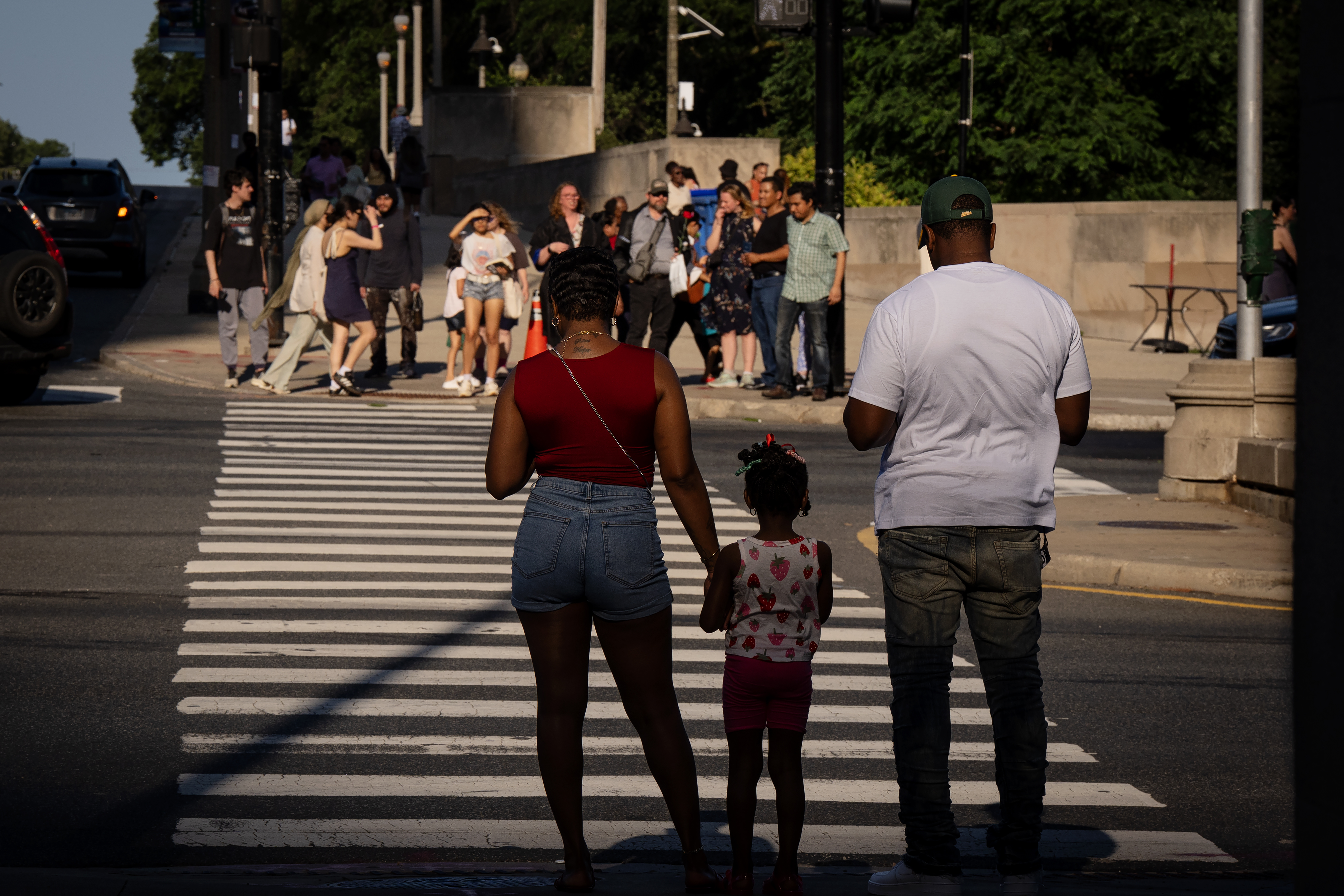

“Come and show me another city with lifted head singing so proud to be alive and coarse and strong and cunning.” — From the poem “Chicago” by Carl Sandburg
“Chicago is a hellhole right now.” — Donald Trump
It was an awkwardly charming moment.
I had met my friends, Carol and Mickey, at a legendary breakfast place on Chicago’s South Side.
A frequent customer at the Steak and Egger, Mickey exchanged hugs with the owner. When he introduced me as his friend back visiting Chicago after having moved to Florida, she hugged me as well.
I felt my face redden. The woman — full of bubbly energy and mischief in her smile — was either good at acting or genuinely warm hearted. Mick later affirmed the latter.
I had been overdue for a road trip. I missed my friends, my brothers and my hometown of Chicago, which has been under attack and in the national news.
And I like driving. There is something soothing and clarifying about the open road. Your daily routine’s placed on hold and you’re able to get outside your head and gaze upon life from a physical and psychological distance. You might experience the same thing vicariously in great American novels about journeys, like Jack Kerouac’s “On the Road,” Mark Harris’ “Bang the Drum Slowly” and Jim Harrison’s “A Good Day to Die,” but you feel it viscerally when you take to the highway alone.
The distance from Port Charlotte, Florida, to Chicago is 1,258 miles. I left on a Saturday, when there are fewer trucks on the highway, and was soon lulled by the farms, forest land and hills rolling by, my SUV crossing rivers and gobbling miles.
I routed around Atlanta and Nashville to avoid congestion and reminders of the everyday, but nagging claws clutch at you along the way, like the outsized Confederate flags waving over Interstate 75 in Florida and Interstate 65 in Alabama or the 180-ton steel cross towering above Interstate 57 in southern Illinois. When you’re going 75 mph, they quickly disappear.

The best antidote was my first stop at a Waffle House. Not only because of my weakness for ham and cheese omelets, raisin toast and hash browns with onions and jalapeno peppers, but also because you are festively welcomed when entering the diner, where the cooks, servers, bussers and travelers are all in the same room, like grandma’s crowded kitchen at Thanksgiving.
Then came the more familiar welcome from my daughter, Jackie, and her husband, Gene, when I finally hit town. Gene, a Marine and a cop, and Jackie, a teacher, both love dogs and the woods and kayaking. Though busy as public servants, they set aside an evening for dinner and catching up and gave me a pair of deer repelling whistles to attach to my car.
The next day, I met Tom and Franz, with whom I became friends while teaching English at College of DuPage.
Tom filled me in on the prayer marches led by religious leaders in Broadview in which he has regularly participated, describing the brutality he witnessed against peaceful protesters by ICE agents who have been lying about being provoked. Franz would later tempt me with a hike around Hidden Lake for some birding on gorgeous fall day in Chicagoland.
I had miles to go from there for a meetup with my pal Ron, a former Chicago cabbie who became a guidance counselor (go figure!) at College of DuPage, from where he is now retired. He spends three days a week volunteering at a food pantry.
Midweek, I headed over to the South Side and took a break from all the driving. Maurice, my Uber driver for a reunion with friends in the Beverly neighborhood, grew up near Chicago Vocational High School, where I taught in the 1970s and ’80s. He seemed stunned to learn that comedian Bernie Mac, former Chicago Bear Chris Zorich and one-time NBA star Juwan Howard were among my students, but it’s possible he might be might have been appalled by my age.
My reunion classmates from Chicago State University, well aware of Florida’s abysmal ranking on the pizza scale, ordered some of the city’s finest and thinnest from Fox’s on 99th and Western. No National Guard sightings yet, they said, and zero need given that violent crime was down across the city (it decreased by 23% in 2025, and homicides dropped by 37%).
Towards week’s end, close friends Tom and Joan hosted a cookout with Chicago red-hots and fresh Polish sausage. A dozen others from the Evergreen Park neighborhood where I grew up and from our Hale Park softball team traveled from opposite ends of the city to attend.
Tom handed me a can of “Trump Beer” bearing the president’s picture, which he had been saving for me. We laughed and it reminded me of the time when people favoring opposing political parties could rib each other without vitriol.
My last morning, over breakfast with my brothers, Kevin showed photos of the smooth new pavement on his block, which he persuaded the Cook County’s street department to fix by writing letters and emails to officials.
I had to leave the next morning, but I was conflicted. I needed to get back to my wife, but feeling the love from my family, friends and even strangers and the warmth I derive from Chicago is so essential to my identity.
I might add, as evidence for the ugly word the president used to describe my former home town, the White House showed videos of chaotic scenes and criminal activity. They were later revealed to have been shot in Florida, Texas, South Carolina and Nebraska — not Chicago.
The fabrication was apparently necessary since a truthful rendering would be closer to my homecoming to a city of earnest, friendly, industrious, altruistic and loving people proud to live in one of the best places in the world.
David McGrath is an emeritus English professor at the College of DuPage and author of “Far Enough Away,” a collection of Chicagoland stories. Email him at mcgrathd@dupage.edu.


