We have gotten to a point where it seems that money is the only factor in many corporate decisions. I just read that the Bears organization is worth more than $8 billion. How about letting the Bears do a joint project with the people of Illinois and let the stadium be owned by the people? The Green Bay Packers are publicly owned.
People in Illinois want the Bears to stay in Illinois. So why not offer a compromise that the Bears can certainly afford? I’m sure a lot of Illinoisans would put up their hard-earned money to make that happen.
I think Virginia McCaskey would be happy.
— Christine Hanslik, Warrenville
Transparency needed
For almost two decades, Chicagoans have been paying for the disastrous parking meter deal to the “private” company Chicago Parking Meters LLC. Apparently, that payment will continue for decades to come. Who are the owners/shareholders of CPM? How can public property be sold without the public knowing who bought it?
Who are the individuals who are profiting from the sale of Chicago’s parking meters? Are they living among us or have they moved to warmer locations? Don’t Chicagoans have the right to know whose retirement they’re paying for?
— Marilyn Kelly, Chicago
Mayor showed character
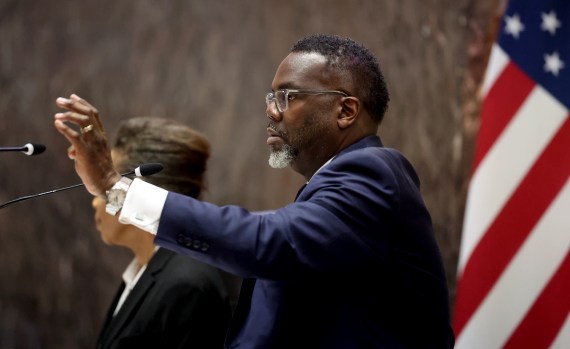
Chicagoans and others may disagree on many issues with Mayor Brandon Johnson, but he saved Chicago in one regard. Instead of saying no to the budget he did not like, he allowed it to pass. He would rather have a budget he does not like than have no budget for the city, thereby letting the city be the victim of some sort of paralysis.
— Michael M. Kazanjian, Chicago
Give patients a break
Isn’t it enough that families have to pay high tolls, parking fees and food costs when their loved ones are cared for in the Illinois Medical District in Chicago? Now there’s talk of adding another 1.5% tax to downtown hotel bills.
Regardless of the other arguments for and against this extra tax overall, give the already-challenged patients and families a break.
— Lori Miller Reszel, Libertyville
License plate readers
As a police district councilor and executive director of a youth-focused nonprofit in Englewood, I spend a lot of time thinking about what contributes to safe communities.
My nonprofit, Mr. Dad’s Father’s Club, works to engage fathers in their children’s lives through literacy and mentorship. We’ve witnessed the power of early intervention — catching kids early, building trust and helping them chart a positive course. Our work starts with prevention, not punishment.
That same principle should guide how we think about public safety technology such as license plate readers, or LPRs.
There has been a lot of noise about LPRs in recent months. From my perspective, LPRs are an essential public safety tool, similar to a security camera in a corner store. They capture still images of vehicles that pass by, the same as what anyone could see from the side of the road. They don’t follow people or monitor continuous movement.
But what they absolutely do is help solve crimes faster. The images captured by LPRs are put into a database for officers to access, often as their first point of reference in an investigation. Through this data, officers in Chicago have confiscated weapons, brought drug traffickers to justice, captured violent criminals, solved hit-and-run cases and more. LPRs are effective in solving crime, which in turn makes them effective in deterring and preventing future crime.
Concerns about privacy and security are understandable, and strong guardrails are essential. Most agencies have stringent data protection and retention policies, and Illinois law prohibits the sharing of LPR data with federal agencies. Continued accountability and transparency from local agencies in how their LPR data is used, stored and retained will be key in building more support.
It’s a challenging time right now, both for law enforcement and the communities they serve. Distrust is at record levels. But we cannot afford to waiver in our support for tools that are making our streets safer. Violent crime was down double digits last year in Chicago. What we’re doing is working, and we must stay the course.
License plate readers are a practical, commonsense tool that helps law enforcement respond faster and, ultimately, frees up officers to focus on community engagement and prevention. If we want safer neighborhoods, we should invest in both people and the tools that help protect them.
— Joseph Williams, police district councilor, Chicago
Protect worshippers
As a Chicago resident and member of our local Jewish community, I urge the passage of the bipartisan Pray Safe Act so all faith-based communities can be secure and stay safe before another tragedy strikes.
Keeping our faith-based institutions and houses of worship secure is more important now than ever before. In 2024, the Anti-Defamation League documented more than 9,350 hate-related incidents; 335 were aimed at our Jewish community right here in Illinois. As the city reported, anti-Jewish hate crimes increased by 58% over 2023.
No matter how or to whom you pray, all Americans have a right to do so safely, and our congressional leaders have an obligation to make our houses of worship as safe as possible so we don’t have to worry about when and where the next attack will come.
I call upon U.S. Sens. Tammy Duckworth and Dick Durbin to support the bipartisan Pray Safe Act so we can all gather in our communities and pray without fear.
— Greg Stewart, Chicago
Officers’ mental health
As we enter 2026, I want to speak directly to police officers, supervisors and leaders from lived experience, not theory.
Law enforcement has normalized exhaustion, emotional suppression and suffering in silence. That mindset is costing careers, families and lives. This year calls for honest resolutions that actually keep officers alive and well.
To police officers: Needing care is not weakness. I killed someone in the line of duty, and after years of pushing through trauma, stress and critical incidents, I learned the cost of waiting too long. Make your mental and physical health a priority. Check in after critical incidents, talk to someone you trust and use professional resources without shame. Mental health care preserves careers and lives.
To supervisors: You shape the culture every day. Pay attention to changes in your officers and intervene early. Normalize mental health conversations and model healthy leadership by taking time off, setting boundaries and seeking help when needed. What you tolerate becomes culture.
To police leaders: Wellness is not optional; i’s operational. Healthy officers make better decisions and build stronger community trust. Departments must stop abandoning officers when they struggle and start supporting recovery and accommodation. Leadership is measured by action, not policy.
My resolution for 2026: End the silence, end the stigma and change the culture. Taking care of the officer strengthens the badge and saves lives.
Let 2026 be the year we stop equating toughness with suffering alone and start protecting our own with the same urgency we protect the public.
— Capt. Adam A. Meyers,Hartford Township Police Department, Hartford, Wisconsin
Pace paratransit trips
Three years ago, I stopped driving. I am a senior using a cane, and I applied for and was approved by Pace. This service has allowed me to be independent as I can shop, see doctors, eat out and visit friends as I did when I drove. The Pace drivers on both the buses and taxis are very patient, courteous and helpful. One driver helped me bring my shopping cart into the house. I was able to meet many of the drivers, and they remembered me.
This is a wonderful service that Illinois offers and should be continued and given more money since some of the ride options were curtailed recently.
— Judy Arkes, Chicago
Submit a letter, of no more than 400 words, to the editor here or email letters@chicagotribune.com.