
Even the savviest of Chicagoans can be excused for not recognizing Desplaines Street. Situated just east of the Kennedy Expressway, it runs roughly between Ohio Street, to the north, and 21st Street, to the south.
In the context of Chicago’s arterial streets, wide boulevards and broad parkways, Desplaines doesn’t make much of a dent. But in the context of Chicago’s heritage, it has the impact of an interstate expressway.
On the night of May 4, 1886, on North Desplaines between Lake and Randolph streets, a violent labor disturbance erupted. Angry workers and responding police clashed. A bomb exploded, bullets flew and eight people were killed, including seven police officers. And the busy produce district known as Haymarket Square became forever embedded in Chicago history and its complicated relationship with freedom of assembly, organized labor and public safety.
Chicago in 1886 had recovered from the Great Fire and was embracing the Second Industrial Revolution. In particular, it was reestablishing itself as a transportation and manufacturing hub, while rapidly evolving into the “stormy, husky, brawling” melting pot that Carl Sandburg would later describe in his classic poem “Chicago.” And as part of that evolution, it was confronting the forces of corruption, income inequality and worker exploitation that Upton Sinclair and Theodore Dreiser would subsequently chronicle.
These forces would collide on the Near West Side on a spring evening, against the backdrop of labor unrest, union activity and a hint of influence from a sinister anarchist movement. Precipitating factors included the ongoing movement for an eight-hour workday, a massive May 1 pro-labor march and the previous day’s shooting by police of several workers involved in a strike at the McCormick Reaper Works.
News of the McCormick shooting circulated during the day. Matters culminated in a large crowd gathering at Haymarket Square, where several labor activists rose to make pro-labor speeches and pillory the McCormick conflict. Chicago Mayor Carter Harrison was said to be in attendance.
As tensions heightened, police moved to disperse the crowd. Then an unidentified person threw a bomb toward the police; it exploded, followed by confusion and gunfire. Once the fog of chaos lifted, the police and the protesters both gathered their dead.
The authorities moved swiftly to arrest multiple suspects, all from the activist labor movement. They were quickly tried, and seven were sentenced to death, despite inconclusive evidence. Of the convicted men, four were executed, and one died by suicide before his execution. The others ultimately received pardons in 1893 by Illinois Gov. John Altgeld as public concern grew over the fairness of the trials and the related sentences.
The events at Haymarket Square contributed significantly to the elevation of labor grievances to national prominence. But in the intervening 140 years, the memories of what happened, where it happened and the competing passions that caused it to happen have faded from civic memory.
Yet the constituencies and their causes, loyalties and duties remain as relevant as today’s headlines.
Immigrants still flock to Chicago for jobs and their share of opportunity the city offers. But now, they’re more likely to come from Central America than Eastern Europe. Employees continue to fear misplacement by technology. But now, the fear’s more likely to come from artificial intelligence than mechanized assembly lines.
Working conditions continue to be a labor concern. But now the concern’s more likely to come from masked immigration agents than dangerous forges and furnaces. Police officers continue to confront death on a regular basis. But now the confrontation’s more likely to come from a traffic stop than a labor demonstration.
And we continue to struggle with the fair labeling of controversial political events that some interpret as free speech and lawful assembly and others consider objectively unlawful violence and rioting. To this day the Haymarket event is variously referred to as a “riot,” an “incident,” a “bombing” and an “affair.”
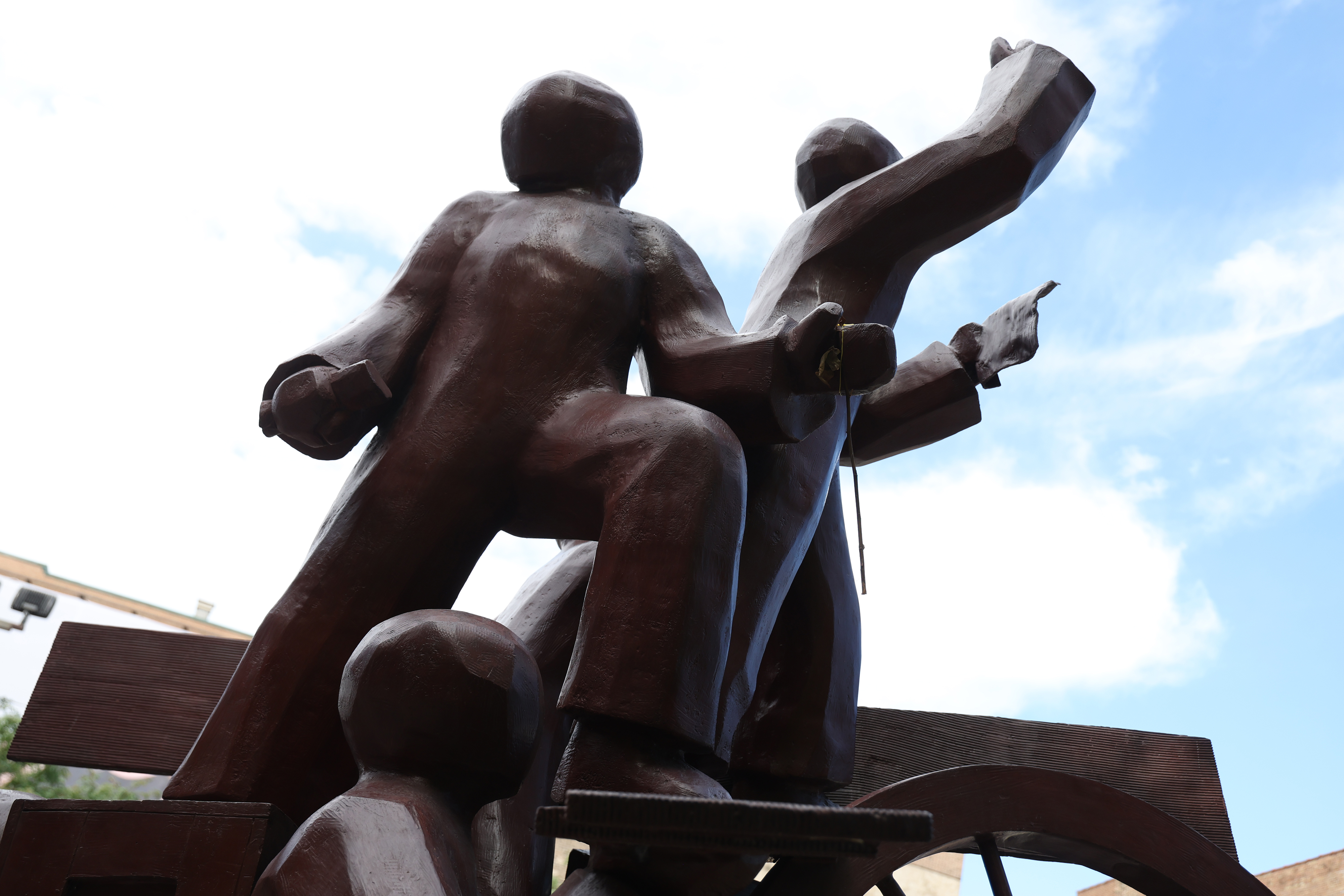
So the next time you’re headed down Randolph toward the Kennedy, slow down after you duck under the Metra tracks. Start tapping the brakes past Jefferson Street. Look to the right, toward the “L” tracks, when you hit Desplaines. There you’ll see the Haymarket Memorial, a moving sculpture modeled on the wagon that served as the protest leaders’ platform that evening.
And the truly curious will seek out the three other monuments honoring the incident and its victims. At Chicago Police Department headquarters at 35th Street and Michigan Avenue stands the Haymarket Riot Monument/Police Memorial. It’s a haunting statue of a lone police officer extending a hand as if to stop an advancing crowd of rioters. A statue of Altgeld is located in Lincoln Park, south of Diversey and east of North Cannon Drive.
Your tour ends west in Forest Park, where a tall monument in Forest Home Cemetery memorializes the fallen workers. The cemetery’s easy to find, right off the Eisenhower, in the 800 block of — you guessed it: Des Plaines Avenue.
Michael Peregrine is a Chicago lawyer. He grew up in River Forest, a short distance north of the Forest Home Cemetery.
Submit a letter, of no more than 400 words, to the editor here or email letters@chicagotribune.com.