
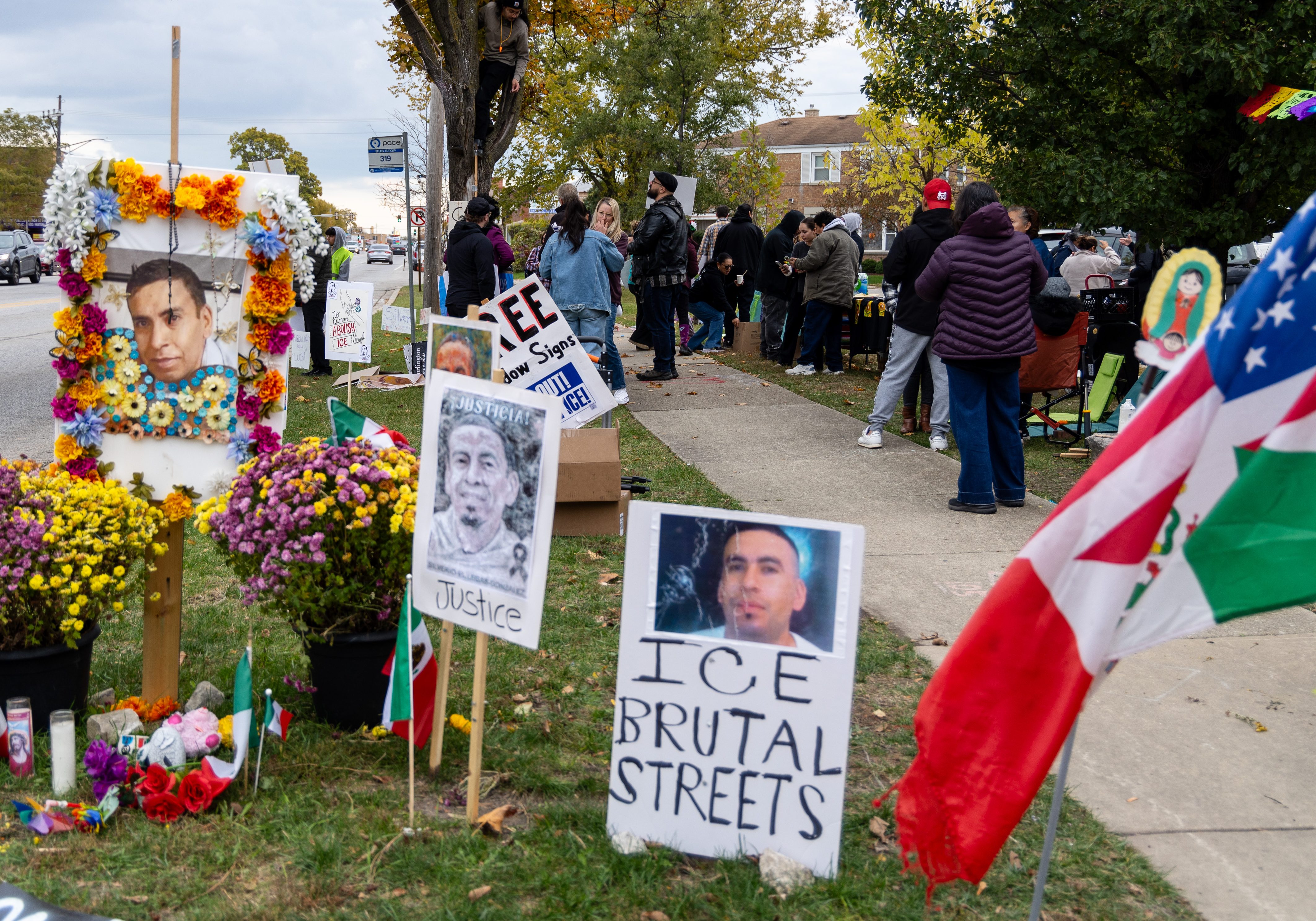


SPRINGFIELD — The Illinois State Police is investigating last year’s controversial fatal shooting of a father of two by an immigration enforcement agent in Franklin Park during the early days of the Trump administration’s Operation Midway Blitz immigration-enforcement raids.
The state police investigation is the first independent probe of federal agents’ actions during the intense immigration and deportation sweep that lasted more than two months.
Silverio Villegas González, 38, had just dropped off his children at daycare on Sept. 12 and was on his way to work when agents with U.S. Immigration and Customs Enforcement pulled him over near the intersection of Grand Avenue and Elder Lane in the near west suburb.
During the confrontation, Villegas González was shot in the neck before crashing his car into a semi truck, officials have said.
“The Franklin Park Police Department requested the (state police’s) Public Integrity Task Force to investigate the shooting of Silverio Villegas Gonzalez,” state police spokeswoman Melaney Arnold said in a prepared statement Tuesday night. “PITF has begun the initial investigation. When complete, the case will be turned over to the Cook County State’s Attorney’s Office.”
The controversial shooting spurred calls for a vigorous and transparent investigation by figures, including Gov. JB Pritzker and Mexican President Claudia Sheinbaum. Last year, after the shooting, Illinois Democrats led by U.S. Sen. Dick Durbin wrote to then-U.S. Secretary of Homeland Security Kristi Noem asking for transparency and urging her to end what they called “dangerous operations” in the Chicago area.
The calls for more transparency occurred because of questions surrounding the events of the shooting.
In a statement released shortly afterwards, U.S. Department of Homeland Security officials said Villegas González “refused to follow law enforcement commands and drove his car” at the agents, striking one and dragging him “a significant distance,” and that the officer who shot him was “fearing for his life.” In addition, DHS officials originally said the agent who was dragged was in critical condition, but body-worn camera footage released by Franklin Park police two weeks later showed the agent told police at the scene his injuries were “nothing major.”
Both the agent and Villegas González were taken to nearby Loyola University Medical Center in Maywood, where Villegas González was pronounced dead.
Neither of the ICE agents involved in the shooting was wearing a body camera, and no surveillance footage showing the agent allegedly being dragged or opening fire has publicly surfaced.
Autopsy results from the Cook County medical examiner’s office, meanwhile, showed Villegas González was struck in the left side of his neck by a bullet that wound up lodged in his lower-right chest, suggesting the gunfire came from someone above him on the driver’s side of the car.
He also suffered graze wounds to the pinky and ring fingers on his left hand, the report showed.
Toxicology tests showed Villegas Gonzalez had relatively low amounts of cocaine and benzoylecgonine — a byproduct of the body breaking down the narcotic — in his blood at the time of his death.
A relative of Villegas González previously told the Tribune he did not use drugs and worried the information could be used to cast him in a misleading or negative light as the investigation into the shooting continued.
The state police involvement comes after a state commission scrutinizing the Chicago-area immigration crackdown this past fall sent its findings to law enforcement last week, with some members and Pritzker pushing for investigations they said could lead to criminal charges against federal agents involved in violent episodes during Operation Midway Blitz raids.
Pritzker last fall tasked the Illinois Accountability Commission with fact-finding about the sweeping Chicago-area raids for posterity, the public eye and potential future law enforcement actions, but the panel itself had no direct law enforcement power.
One of the police departments that received the commission report was Franklin Park, along with Chicago, Elgin and Evanston police and the Cook County and Kane County state’s attorneys.
Since the 64-day crackdown, some advocates have been disappointed at what they see as a lack of accountability for ICE and Border Patrol agents who repeatedly used force against immigrants, U.S. citizens, protesters, journalists and neighborhood residents, including in the killing of Villegas González and the shooting of Marimar Martínez in October in Chicago.
Some of that criticism has been pointed at Cook County State’s Attorney Eileen O’Neil Burke, who hasn’t prosecuted any cases tied to federal agents’ actions during Operation Midway Blitz. The state’s attorney’s office has said it can bring charges only after receiving a completed investigation from a law enforcement agency.
On Tuesday night, state’s attorney spokeswoman Elyssa Cherney said the office has “been in contact with (the state police) and will play a supportive role in their investigation, in accordance with our Federal Immigration Enforcement Action Response Protocol.”
Olander reported from Chicago.


