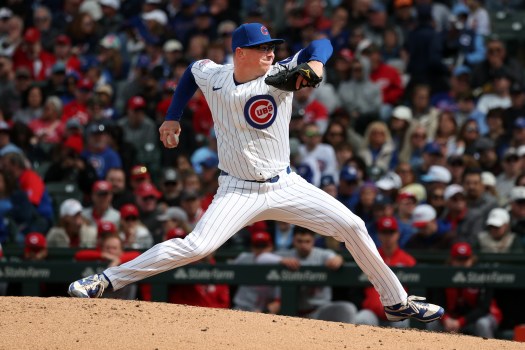
The Chicago Cubs saw something in Edward Cabrera.
The organization had coveted the right-hander long before they acquired him in a trade with the Miami Marlins in January. Cabrera’s first season with the Cubs hasn’t seen the 28-year-old fully tap into the version they believe he can be. Cabrera brought a 4.06 ERA and 94 ERA+ into Wednesday’s start against the Milwaukee Brewers.
After tossing 11 2/3 scoreless innings through his first two starts, Cabrera owns a 5.26 ERA in his last seven outings, allowing at least three earned runs in each.
A few underlying red flags have emerged nearly two months into the season, something pitching coach Tommy Hottovy said the Cubs are keeping an eye on. Most notably, Cabrera isn’t getting as much extension in his delivery’s release point — his changeup, for example, went from 6.6 feet last year to 6.4 feet — which isn’t a huge gap but enough to take note while his velocity has been down, including on his four-seam fastball (97 mph in 2025 to 95.7 mph this year), changeup (94.2 mph to 92.6 mph) and sinker (96.9 mph to 95.9 mph).
“My take with Edward is he’s a guy who has had injury flare-ups in the past — I’m not saying that he’s backing off, but he’s in a kind of cruise-control type of delivery right now, which I know he feels he recovers from,” Hottovy told the Tribune. “It might not be his max output, but as we’re building confidence and as he’s building that confidence into the season, I do think you’ll see that kind of trend up. He’s not purposely trying to throw slower.
“He knows there’s a lot of season left. He knows you want to pitch deep into the season, so he’s trying to navigate that a little bit. It’s like, OK, how much can I step on it to go deep for the team now, but also pitch deep into the season? What we’re hoping for is the most innings he’s had in a season.”
Cabrera’s changeup has been a vital pitch to his success, and it’s continued to be a key component to navigating opposing lineups. The Cubs are still trying to unlock the fastball within his repertoire, though there are some small improvements. It’s not producing as much hard contact, down 21.5% from 2025, with an increase in Whiff%, a measure of swings that don’t make contact, to 25.5%.

“You don’t ever want to say a guy who throws 96, 97 (mph) and his fastball gets hit so don’t throw it, like, I want to find out why,” Hottovy said. “I want to find out, is it because of how he’s thinking about using it or is it an execution thing or something like that? For me, though, it’s simplifying things for him and what a good quality recipe is for him to have success because I think in the past he can do a lot of different things, so go do all that and throw it all for strikes and you’ll be really good, and that works a lot of times.”
Hottovy wants Cabrera to think about how his pitches play off each other. If he throws a breaking ball early in the count for a strike, Hottovy explained, it can help protect Cabrera’s elite changeup by not having to show that pitch too many times during a start or even within an at-bat. Teams with good veteran hitters might be able to eliminate looking for Cabrera’s curveball or slider and instead sit on his fastball and changeup.
“It’s just talking him through that,” Hottovy said. “When we see teams make adjustments, when we see teams try to hunt certain areas, how do we adjust and how do we attack?”
As the Cubs continue to navigate the injuries to the rotation, Cabrera still possesses the type of upside that in-season improvements could make him one of their best starters by the end of the year. Clearly, though, there are still adjustments to be made.
“I thought there’s a lot of quality for four innings, and then it kind of fell off a little bit in that fifth inning on the South Side, but I think he would expect better, and I think he has better in him,” manager Craig Counsell said. “And it’s really just about getting those outs and making pitches every single pitch and moving on to the next pitch and keep executing.”