Driving down Interstate 94 and looking out at Six Flags Great America today, it is hard to imagine what the landscape looked like a half-century ago, before the park forever transformed the then-small community of Gurnee.
Great America, riding a wave of similar developments across the country, has lived to see the beginning and end of several eras of theme parks since opening its gates in Lake County 50 years ago.
The first mention of a new park in Illinois was in an exclusive Chicago Tribune report on Aug. 23, 1972, revealing that a “giant amusement park” was planned in Lake County, west of Gurnee, in the vein of Six Flags Over Mid-America in St. Louis. Disney World, in Florida, had opened the prior year.
More news would come out in the following years. The park, to be called Great America, was an endeavor by the hospitality company Marriott. But developers had a grander vision than just a single theme park. They planned to open three parks consecutively across the country for the United States bicentennial in 1976: one in Santa Clara, California, the second in the Chicago area, and a third in their home market of Washington, D.C.
In spite of fog and light rain, people showed up for opening day at Marriott’s Great America on May 29, 1976. The carousel greeted the crowds. (Michael Budrys/Chicago Tribune)
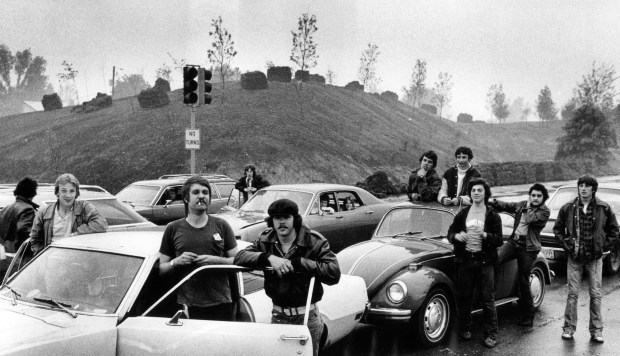
In spite of the fog and light rain, several cars were waiting at the parking lot gate at Great America on May 29, 1976, in Gurnee. Three Chicago kids, Richard Bee, 18, Jim Gengler, 19, and Michael Quinn, 21, had been the first to arrive at 1a.m., the opening day for Marriott's Great America. (Michael Budrys/Chicago Tribune)
Great America's newest ride, the Tidal Wave, was inaugurated at the Gurnee amusement park, May 6, 1978. Hailed as the world's largest roller coaster, the 76-foot high vertical loop catapults riders at 55 miles an hour into a 142-foot incline that is banked at 70 degrees. (Walter Kale/Chicago Tribune)
The final touches are being put on Marriott’s Great America on April 15, 1976, before opening day on May 29, 1976. (Quentin C. Dodt/Chicago Tribune)
Visitors to Marriott's Great America Theme Park in Gurnee had the chance to scout all the rides at once from the Sky Trek Tower in 1977. The ride, which is taller than the Statue of Liberty and took four months to build, made its first 300-foot ascent over the 200-acre park. On clear days, riders in the revolving cabin can see Lake Michigan and portions of Chicago's skyline. (William Yates/Chicago Tribune)
Thelma Dietmyer, shown with her son, Steve, and daughter, Cheryl, on Sept. 3, 1976, live right across from Great America's south entrance had this to say about the new amusement park: "I can picture a lot worse things there, like a bunch of high rise condominiums or apartments." Editors note: this historic print shows a crop mark midway through the print. (Mary Perlstein/Chicago Tribune)
A three-wheeled Ferris wheel is almost ready for opening day at Marriott’s Great America on April 15, 1976, in Gurnee. The park was putting on the finishing touches before opening later on May 29, 1976. (Quentin C. Dodt/Chicago Tribune)
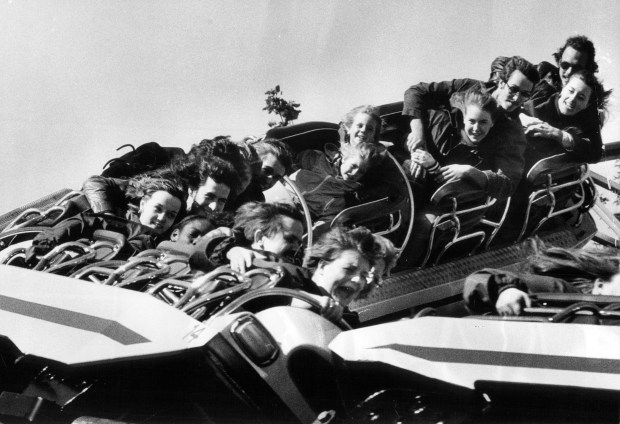
Crowds ride on roller coasters during opening day for year two of Marriott’s Great America on May 7, 1977, in Gurnee. (Quentin C. Dodt/Chicago Tribune)
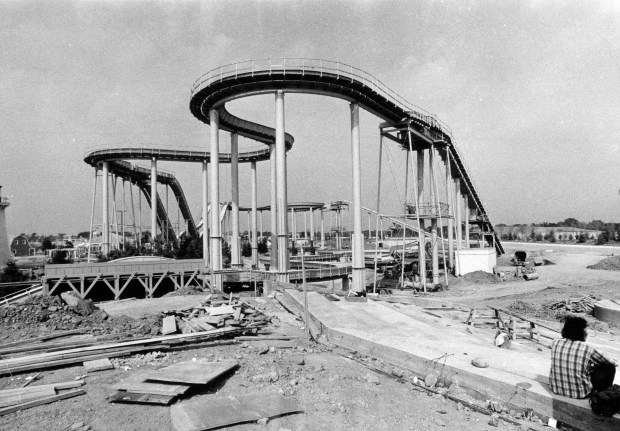
Functioning like a huge roller coaster ride but on water, Great America's Loggers Run is under construction and stands six stories tall in October 1975. (James O'Leary/Chicago Tribune)
Work continues on a double tiered carousel at Marriott's Great America amusement park in Gurnee on April 15, 1976, in preparation for next months opening. (Quentin C. Dodt/Chicago Tribune)
Construction continues on the New England Village and the log flume at Marriott’s Great America amusement park on Oct. 9, 1975. The park opened in May 1976. (James O’Leary/Chicago Tribune)
Gov. Dan Walker and his wife, center, along with U.S. Rep. Robert McClory, left, Mr. and Mrs. J. Willard, the Marriott Sr. Chairman of the Board, second and third from left, and Mr. and Mrs. Bill Marriott, president of the Marriott Corp., right, pose with cartoon characters at the opening ceremony for Marriott’s Great America on May 28, 1976, in Gurnee.
An aerial view shows Marriott’s Great America amusement park on May 6, 1978, in Gurnee. (Walter Kale/Chicago Tribune)
Two young park workers wearing hard hats pass the Yukon Territory area at Marriott’s Great America on April 15, 1976, a month before the amusement park was set to open in Gurnee. (Quentin C. Dodt/Chicago Tribune)
Electricians at Marriott’s Great America amusement park in Gurnee return to the ground in a work car on Jan. 13, 1976, after checking the electrical system of the 1852-foot cable-car ride. Officials of the $50 million family-theme park had scheduled a topping-out ceremony for the complex, but bad weather forced its cancelation. The park eventually opened on May 29, 1976. (Carl Hugare/Chicago Tribune)
Employees plant evergreens beneath Great America's two high-drop flume rides, the "Loggers Run" and "Yankee Clipper,” on April 15, 1976. The park would open a month later on May 29, 1976. (Quentin C. Dodt/Chicago Tribune)
The Centennial Circus show performs on June 25, 1976, which included trapeze flyers, acrobats, jugglers, clowns and tight rope walkers. (Carl Hugare/Chicago Tribune)
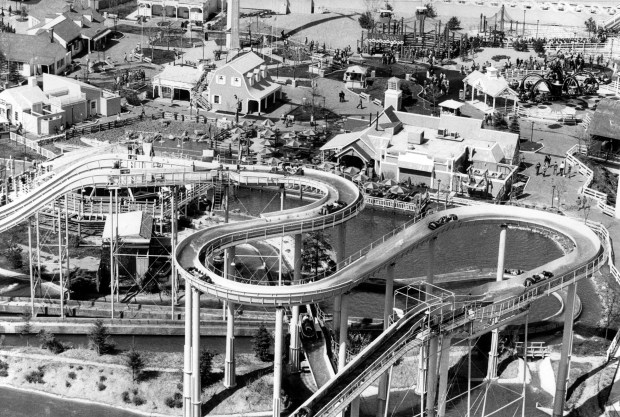
An aerial view shows Logger’s Run at Marriott’s Great America amusement park in Gurnee on May 6, 1978. (Walter Kale/Chicago Tribune)
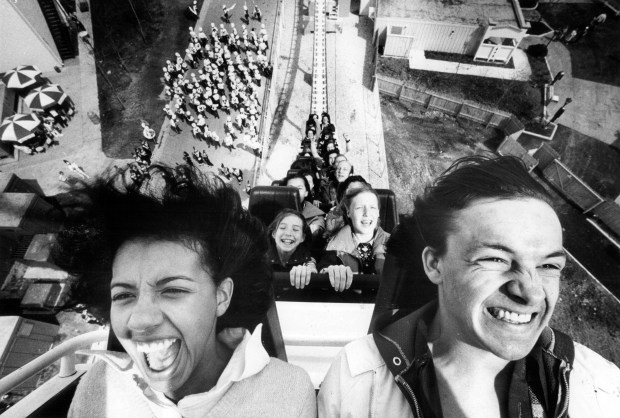
People leave a ride with smiles on their faces at Marriott’s Great America on Aug. 15, 1980, in Gurnee. (James Mayo/Chicago Tribune)
The Centennial Circus show performs on June 25, 1976, which included trapeze flyers, acrobats, jugglers, clowns and tight rope walkers. (Carl Hugare/Chicago Tribune)
With the roar of the Tidal Wave cars and the frightened screams of their riders, Great America's newest thrill was inaugurated on May 6, 1978, at the Gurnee park. Hailed as the world's largest roller coaster, the 76-foot high vertical loop catapults riders at 55 miles an hour into a 142-foot incline that is banked at 70 degrees.
(Walter Kale/Chicago Tribune)
Fort Fun at Marriott’s Great America opened in 1978 with the Midwest’s largest children’s play area, June 23, 1978. (Karen Engstrom/Chicago Tribune)
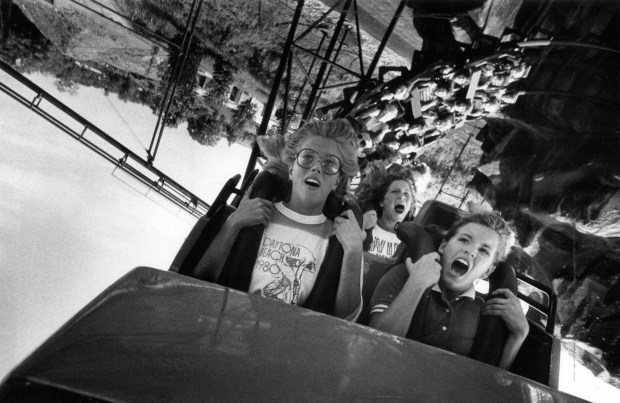
A young person reacts while strapped into a roller coaster at Great America in Gurnee on Aug. 15, 1980. (James Mayo/Chicago Tribune)
The Demon at Great America in Gurnee in August 1980. (James Mayo/Chicago Tribune)
An aerial view of Marriot's Great American amusement park on May 6, 1978. Logger's Run can be seen in the photo. (Walter Kale/Chicago Tribune)
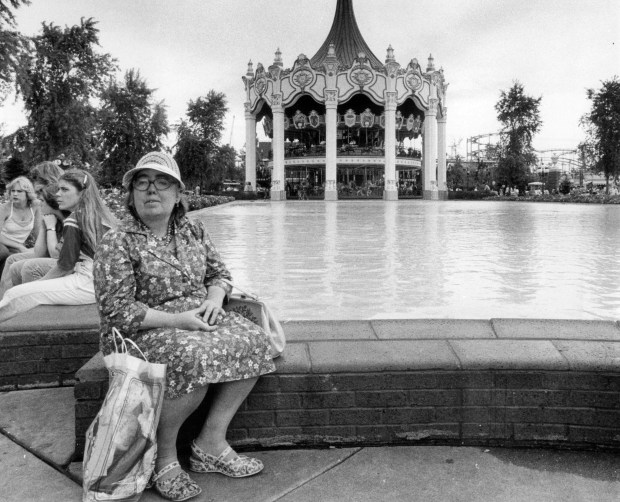
A woman rests near the carousel at Marriott’s Great America on Aug. 15, 1980, in Gurnee. (James Mayo/Chicago Tribune)
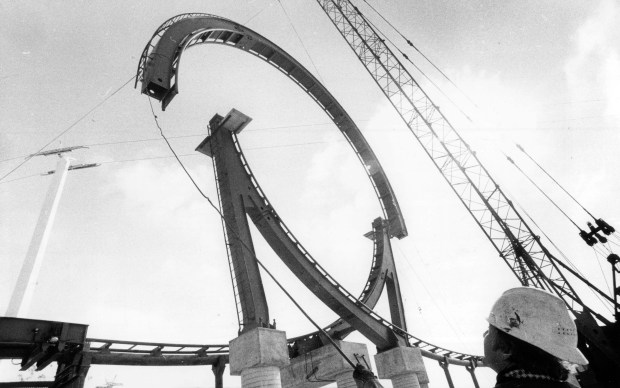
A crane maneuvers the last section of the giant loop into place on Feb. 16, 1978, at Marriott’s Great America amusement park in Gurnee. The 76-foot-high vertical loop will whisk riders upside down and up a 142-foot incline where the car will pause, then descend and go through the loop backward. (Luigi Mendicino/Chicago Tribune)
Fort Fun at Marriott’s Great America opened in 1978 with the Midwest’s largest children’s play area, June 23, 1978. (Karen Engstrom/Chicago Tribune)
Kids ride the Demon roller coaster at Great America in Gurnee on Aug. 15, 1980. (James Mayo/Chicago Tribune)
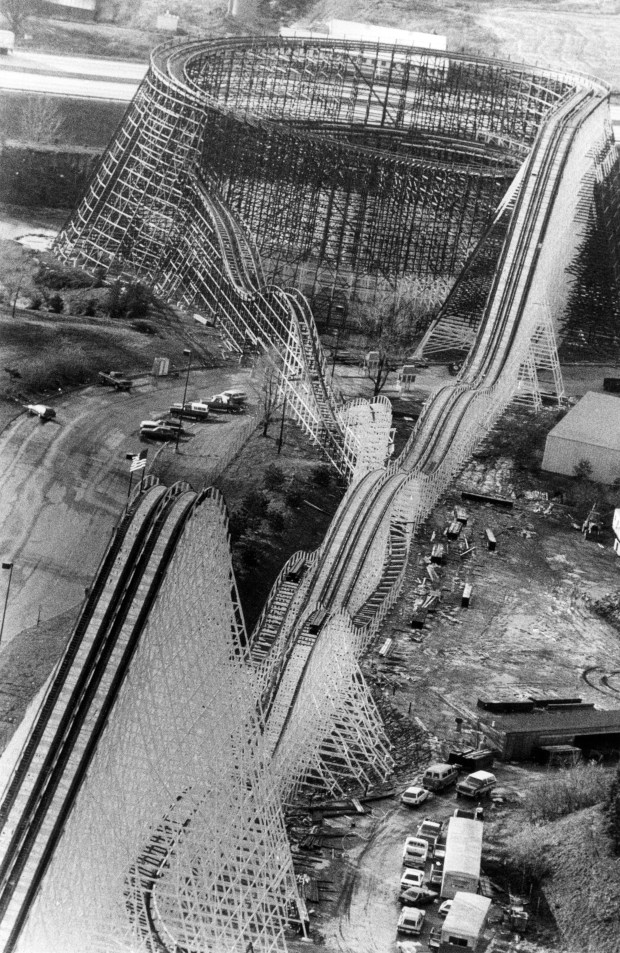
The 100-foot high American Eagle roller coaster stretches the entire length of the grounds at Marriott’s Great America on Dec. 9, 1980, the largest wooden roller coaster in the world.
A woman watches as riders twist upside down on the Demon at Marriott’s Great America on Aug. 15, 1980, in Gurnee. (James Mayo/Chicago Tribune)
High above Marriott's Great America in Gurnee, Jerry Stockdale takes a break from painting the American Eagle roller coaster in April 1981, which is scheduled to roar to life in May. At least 9,000 gallons of white paint were needed to spruce up the 127-foot tall ride, which took more than 20,000 hours to construct. (Walter Kale/Chicago Tribune)
Bill Baareman, of Michigan, gets his height checked by Marcy Pauley, left, so he can ride the Roaring Rapids at Great America on July 6, 1990. (Mario Petitti/Chicago Tribune)
The building of the American Eagle roller coaster on Dec. 9, 1980. The Eagle debuted in 1981 and is one of the largest wooden roller coasters. (Karen Engstrom/Chicago Tribune)
Steelworkers assemble a new ride called the Edge at Marriott's Great America amusement park in Gurnee April 21, 1983. The ride, no cheap thrill at $2.5 million construction cost, will lift the willing in a container to the top of a 131 foot tower before they are dropped in a 60 foot free fall, which speeds up to 55 miles an hour. The Edge premiered in May 1983, when the park opened for its eighth season. (James Mayo/Chicago Tribune)
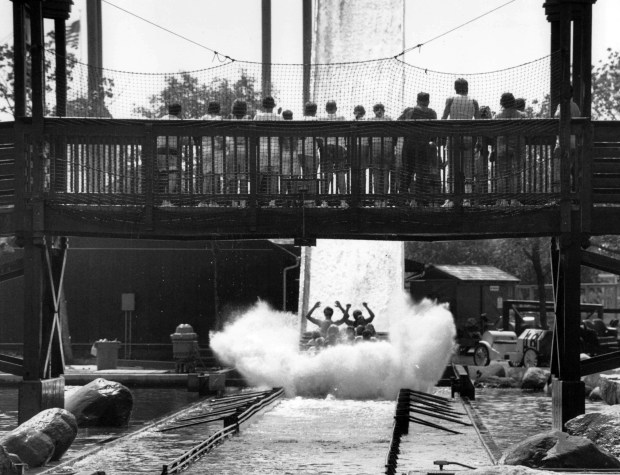
Splashwater Falls, shown here in July 1989, opened in 1987. The ride closed in 2007 and was replaced by X Flight. (Mario Petitti/Chicago Tribune)
Physics students from Glenbrook North High School are plastered against the wall of the Cajun Cliffhanger by centrifugal force as they take a field trip to Six Flags Great America in Gurnee in May 1989. (Ernie Cox Jr./Chicago Tribune)
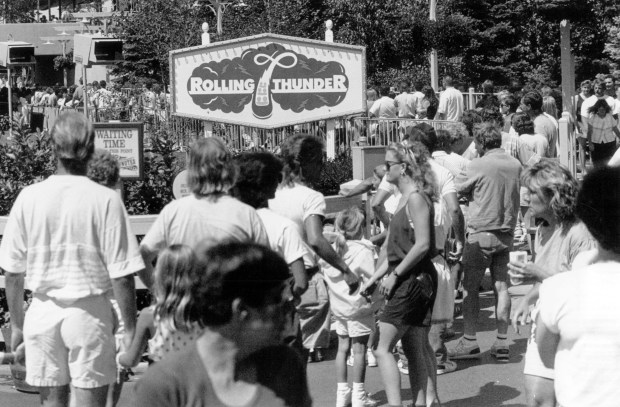
People wait in line to ride the Rolling Thunder, a bobsled-style trackless roller coaster, on July 6, 1990, at Great America in Gurnee. (Mario Petitti/Chicago Tribune)
Robert Evans, of Chicago, looks over a park map while Tricia Evans tries to get water out of her ears after riding the Roaring Rapids ride at Great America in Gurnee on July 6, 1990. (Mario Petitti/Chicago Tribune)
People line up for Whizzer at Great America on July 6, 1990. (Mario Petitti/Chicago Tribune)
A group of ice skaters show off a little fancy foot and leg work during an ice show at Great America in Gurnee on June 27, 1990. The international Ice Shows, Inc. put on the performance. (Mario Petitti/Chicago Tribune)
Deejays Mark Czerniek, left, and Alex Michaels of Great America Radio at the amusement park on Aug. 17, 1989. (Mario Petitti/Chicago Tribune)
1 of 42
In spite of fog and light rain, people showed up for opening day at Marriott’s Great America on May 29, 1976. The carousel greeted the crowds. (Michael Budrys/Chicago Tribune)
The parks’ development was driven by David L. Brown, then vice president of Marriott’s Theme Park Group, and designed by architect Randell Duell, also known for designing the Magic Mountain theme park and the original Universal Studio Tours in California, Six Flags over Texas and Opryland in Nashville.
Marriott’s plans for a D.C.-area park would ultimately hit local resistance and collapse, but Steven Wilson, who researched and wrote the visual history book “Six Flags Great America,” said opening two major theme parks just months apart was an “unprecedented” effort.
Jim Futrell, historian for the National Amusement Park Historical Association, also noted the sheer scale of Marriott’s ambition. Their foray into the industry was part of a wave of theme park construction across the country, and in some ways also marked the end of that boom era, he said.
Chicago theme park history
Theme parks as we know them today started — in many ways — with Disneyland in 1955, according to Futrell. Walt Disney kickstarted a “gold rush” of companies trying to duplicate his success, but for many years, “they just couldn’t capture that magic.”
But that would change with the 1961 opening of Six Flags over Texas, which “perfected” the concept of a regional theme park: a pay-one-price admission, live entertainment, family-oriented rides, and a staff of well-groomed college students.
These parks are not the international destinations that the Disney parks are today, instead drawing from more regional visitors and repeat guests.
The 1960s saw a rush of large corporations trying to claim a chunk of the market across the country. Marriott wasn’t the only one with big plans for the Chicago region; it was in a race against Taft Broadcasting — which already had park building experience — to try and seize the area’s market.
Chicago was actually an early hub of the amusement and theme park industry, Futrell said. The 1893 World’s Columbian Exposition had the mile-long Midway Plaisance, a collection of amusement park-esque displays, rides, food and performances, planting the seed of inspiration for amusement park designs for decades to come.
The crowds who were already dazzled by the White City of the World's Fair were absolutely dumbstruck by the engineering marvel created for the 1893 World's Columbian Exposition by George W. Ferris. (Chicago Tribune historical archive)
The city saw numerous parks following the World’s Fair, among them Paul Boynton’s Water Chutes, opened in 1894, then the White City in 1903 and Luna Park in 1907. The beloved Kiddieland opened in 1929.
But the biggest name was Riverview, Futrell said, which opened in 1904 and dominated the region’s market for decades. In the years since, all those parks closed for various reasons. Riverview’s closing in 1967 was “devastating,” Futrell said, leaving a hole in the market that would take nearly a decade to refill.
Taft had plans for a massive park in Huntley, between Chicago and Rockford, but ran into difficulties in Illinois, and Marriott would ultimately “beat Taft to the punch,” Futrell said.
But even at the time, he said there was chatter that Marriott’s parks would be the last of their kind. The theme park boom was ending, as America simply ran out of markets large enough to sustain such massive parks. The sentiment has since proven largely accurate, he said.
Marriott to Six Flags
Great America has been owned since 1984 by Six Flags, which Futrell said has evolved into a thrill-ride-focused company, matching a shift in demographics seen over the decades.
The first amusement park boom was fed by baby-boomer families and their children, he said, which necessitated a wider variety of entertainment. Early on, parks actually tended to avoid roller coasters and thrill rides, he said, not wanting to draw associations with carnival-style parks.
But the 1970s would see a roller coaster “arms race” among theme parks, as Futrell described it, as they tried to build the longest, fastest, tallest or “loopiest” rides possible. The roller coaster race was — temporarily — ended with the opening of Great America’s American Eagle in 1981, according to Futrell, which at the time had the longest drop and fastest speeds of any wooden roller coaster.
While the American Eagle is a well-loved icon of the park, its construction pushed the limits of both the era’s roller coaster design and Marriott’s wallet. According to a 1981 Chicago Tribune article, it cost $8 million to build, and Futrell recalled the numerous technical issues it initially faced due to its size and speed.
The building of the American Eagle roller coaster on Dec. 9, 1980. The Eagle debuted in 1981 and is one of the largest wooden roller coasters. (Karen Engstrom/Chicago Tribune)
The 1982 season saw ticket prices rise $2 — which Futrell said personally left him an “unhappy customer” — to try and help pay for the massive coaster. That season saw a “huge loss” in attendance, although that can’t be fully attributed to ticket prices, he said. The year was bad for Chicago’s economy in general.
Along with the failure to build a park in their home market, Futrell said the financial struggles “got Marriott thinking, ‘Maybe this is not the business for us.’”
Six Flags bought the Gurnee park in 1984, and while the company has had “struggles” of its own on the corporate level, Great America has remained one of the company’s flagship parks, Futrell said.
After merging with Cedar Fair Entertainment Co. in 2024, Six Flags has been cleaning up shop, closing Six Flags America in Maryland, and announcing that Great America’s sister location in Santa Clara, California, will be closing at the end of the 2027 season.
Despite the changes, Gurnee’s park will likely remain open, according to industry experts, who view the closings as the company reorganizing after being “mismanaged for the last two regimes,” according to previous statements from Dennis Speigel, founder of International Theme Park Services.
Six Flags representatives say Great America’s “core” has remained through the decades. Years of innovation, both in ride technology and overall guest experience, have “stayed true to the idea that the park offers something for everyone.”
Visitors ride Sky Striker at Six Flags Great America, May 16, 2026, in Gurnee. (John J. Kim/Chicago Tribune)
Visitors ride Wrath of Rakshasa at Six Flags Great America on May 16, 2026, in Gurnee. (John J. Kim/Chicago Tribune)
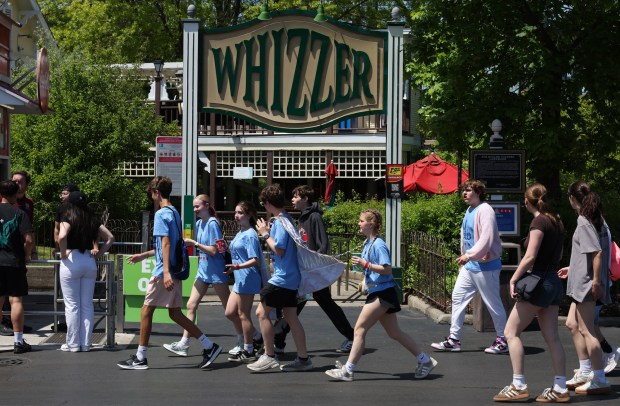
Visitors walk past the entrance to Whizzer at Six Flags Great America, May 16, 2026, in Gurnee. (John J. Kim/Chicago Tribune)
Visitors ride Viper at Six Flags Great America, May 16, 2026, in Gurnee. (John J. Kim/Chicago Tribune)
Visitors ride THE FLASH: Vertical Velocity at Six Flags Great America on May 16, 2026, in Gurnee. (John J. Kim/Chicago Tribune)
Visitors ride Sky Striker at Six Flags Great America, May 16, 2026, in Gurnee. (John J. Kim/Chicago Tribune)
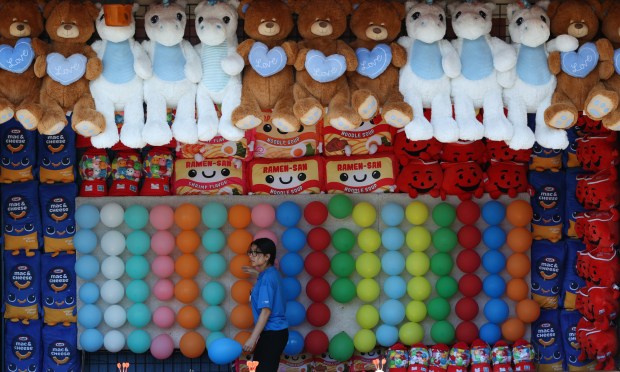
A worker aligns balloons for a carnival game at Six Flags Great America on May 16, 2026, in Gurnee. (John J. Kim/Chicago Tribune)
Visitors ride BATMAN: The Ride at Six Flags Great America, May 16, 2026, in Gurnee. (John J. Kim/Chicago Tribune)
Visitors ride SUPERMAN: Ultimate Flight at Six Flags Great America, May 16, 2026, in Gurnee. (John J. Kim/Chicago Tribune)
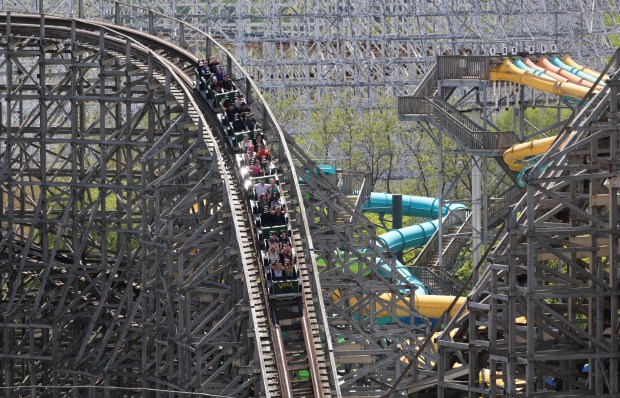
Visitors ride American Eagle at Six Flags Great America, May 16, 2026, in Gurnee. (John J. Kim/Chicago Tribune)
1 of 10
Visitors ride Sky Striker at Six Flags Great America, May 16, 2026, in Gurnee. (John J. Kim/Chicago Tribune)
“As attractions have grown more immersive and thrilling, that sense of inclusivity has never been lost,” a statement said. “The through-line is our commitment to being a place where guests of all ages can create memories together. We’re proud to be not only a beloved theme park in the region, but also a meaningful part of the community we’ve served for generations.”
But the future of theme parks is once again shifting, Futrell said. America’s population is aging, and large roller coasters are massive financial investments. Instead, he’s seen a rise in more immersive experiences that can appeal to families. While there will “always be room for thrill rides,” the types of attractions have begun to broaden.
It’s a shift that Six Flags referenced in its statement. The industry is evolving, new technologies and creative concepts are being developed, and park officials plan to look for ways to make visits “more immersive and memorable.”
“While specific plans are always under development, guests can continue to expect us to push boundaries, introduce new experiences, and find thoughtful ways to enhance how guests enjoy the park year after year,” the statement said.
On the international stage, the new industry focus is on China, India and the Middle East, Futrell said, which are seen as the next great theme park markets.
Today, he said it’s “hard to believe” that regional theme parks like Great America, still considered a relatively new phenomenon in the industry, are marking 50 years. They “changed the nature of the industry.”
“You wonder if, when Bill Marriott cut the ribbon on it 50 years ago, he thought it would still be there in 50 years,” Futrell said.