Like the hero in Bruce Springsteen’s song, I was born in the USA. But my patriotic fever did not heat up until I was 23 years old.
It happened on a Tuesday night in Blue Island, a working-class suburb on the South Side that still has neighborhood taverns, mom-and-pop restaurants and buildings dating to the Civil War.
But Blue Island’s sweetest location, and a source of pride for residents, is Hart Park, a public baseball stadium built to emulate big league venues such as Wrigley Field or Fenway Park on a smaller scale.
There is nothing small, however, about the care and affection lavished on Hart Park by city workers. Every suburban town has public spaces with ball diamonds, but few match Hart for its classic stadium-style bleachers, concession stand and press box; its lushly sodded outfields ringed by light towers; and its meticulously chalked infields featuring reddish-brown sand and clay that invite headfirst slides into home.
At 23, I was not a starter on our 16-inch softball team. But for an early summer game scheduled at Hart Park, the regular shortstop, Kenny, was out of town on account of his job. So there I was, fielding ground balls tossed by the first baseman during pregame warmups, my nervousness exacerbated by the sight of all those fans filling the seats. More accustomed to playing the outfield, I felt way too close to the hitters, fearing the velocity of the batted balls.
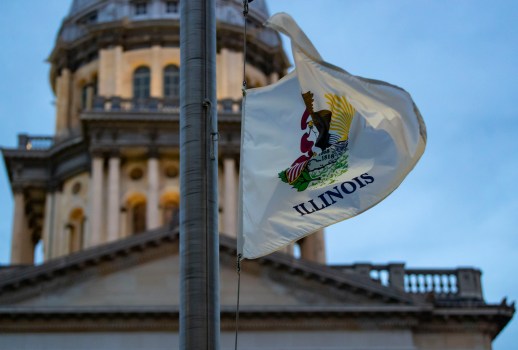
When the announcer in the press box asked over the loudspeaker that everyone remove their hats and stand for the national anthem, I looked to see if my teammates were smiling — if we were overdoing this masquerade of the big leaguers. But Rich, our burly first baseman and a Vietnam veteran, faced the flag with his hand over his heart and an expression of solemnity.
A recording of “The Star-Spangled Banner” began playing over the speaker, as men, women and children rose to their feet. The umpire held his hat in his left hand and with his right saluted the flag rising above the fence in center field.
Though I had watched this ritual a hundred times on TV, I was, for the first time, smack-dab in the middle of the ceremony, the trumpeted strains taking me by surprise, with tears welling up in my eyes.
I thought of my father who had served in the Army during World War II. Of him and Mom raising eight children in the Evergreen Park home he purchased with one of the earliest loans for veterans.
Of the state of Illinois educator scholarship I received to finish college and get a teaching job, along with the one-bedroom Blue Island apartment Marianne and I were living in, and our maroon Chevrolet Impala, the first new car I owned.
I envisioned all the life ahead of us with the freedom to travel where we’d never been, to live wherever we chose and to be whoever I wanted to be.

Of being so free it was almost scary, how someone who was just a kid a few years ago could map out his life, own a house, raise a family and harbor lofty dreams, such as planning to build a wilderness cabin on a quiet lakeshore and some day writing a novel.
I was still holding my baseball cap, my head bowed, when I realized the music had stopped and the catcher was whipping the ball around the horn.
Their first man up was a lefty who ripped a line drive at my head. I got my arms up in time, but the brand-new, and hard, softball bounced off my hands and into the air behind me. It could have been a disastrous start, except that I was able to spin around and catch the tipped ball for the first out.
I didn’t commit any errors the rest of the game, though I did make a mental mistake in failing to flip the ball to second when we could have had a double play.
We won anyway. And during the celebration at Shacks and Lou’s tavern, the team’s sponsor, Rich, explained where I needed to position myself with runners on base if I was ever needed to play shortstop again.
Later, I thought I’d fall instantly asleep as soon as my head hit the pillow. Instead, I kept replaying the moment before the game, trying to re-experience the fervid emotions (and goosebumps) I felt during the anthem.

Today, I remain just as proud of our country for using its riches and resources to feed the poor at home and overseas, all those sacks of grains with the stamp of USA. For its history of sacrifice in battling tyrants to secure freedom and justice around the globe. For leading the world in science and medicine to raise the standard of living for all humankind.
America may not be perfect. But we deserve to feel proud of its goodness and integrity, as long as we also decry what’s shameful, such as slavery, or McCarthyism, or our treatment of Native Americans. Or the packs of masked federal immigration agents hunting down and brutalizing people of color. The Jan. 6 mob beating police and desecrating the Capitol in an attempt to overturn a democratic election. And 25 million without healthcare in the richest nation in the world.
We must acknowledge the failures in order to resolve them so America might rise to greater heights in the next 250 years. For our most valuable and envied asset around the globe is our freedom to criticize the wrongs of our own country in order to right them.
David McGrath is an emeritus English professor at the College of DuPage and the author of “Far Enough Away,” a collection of Chicagoland stories. Email him at mcgrathd@dupage.edu.
Submit a letter, of no more than 400 words, to the editor here or email letters@chicagotribune.com.