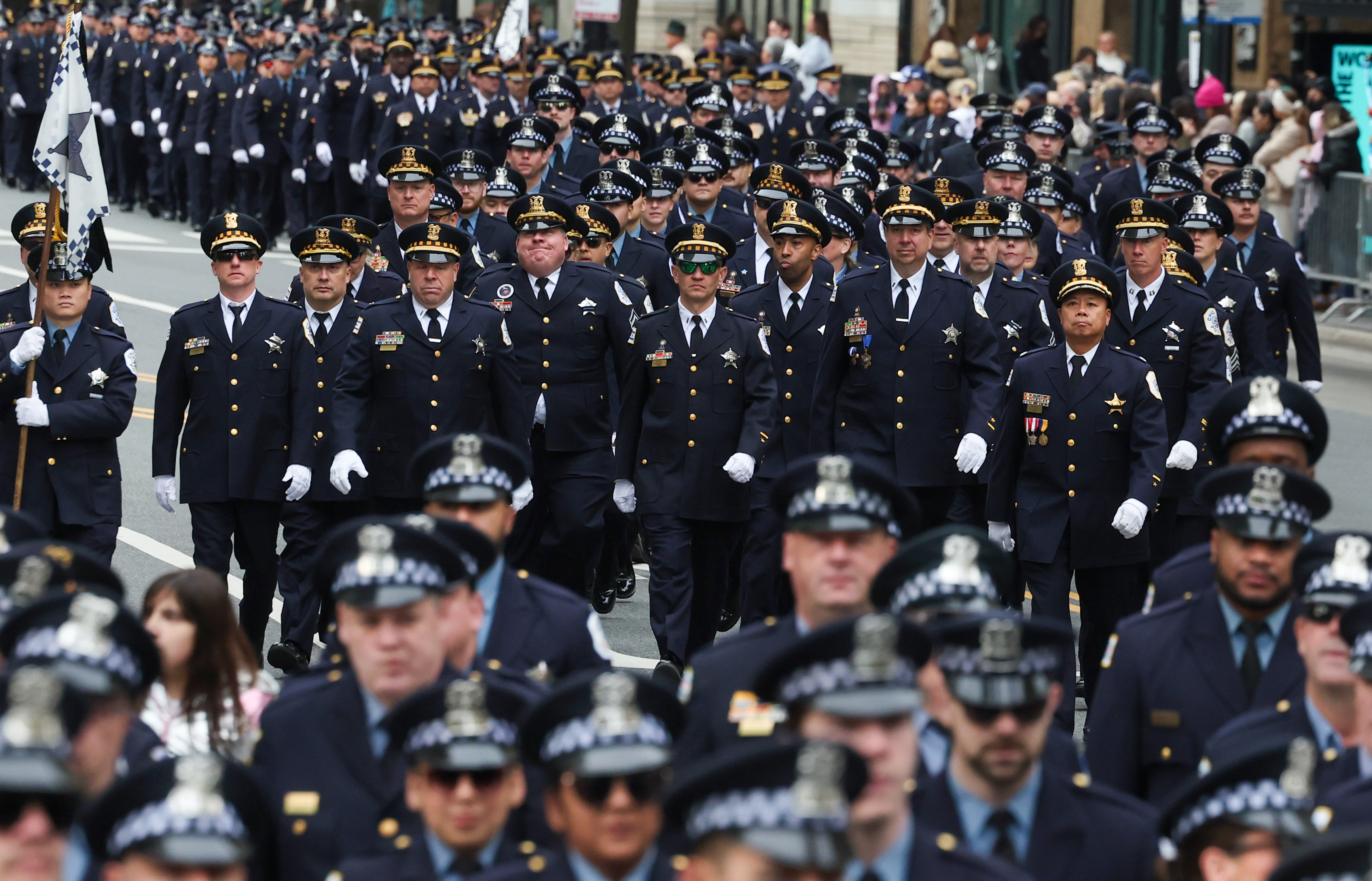

In the examination of candidates to succeed Larry Snelling as Chicago’s next superintendent of police, a successful candidate must be able to answer two important questions truthfully.
First, the candidate must acknowledge that there is a code of silence within the Chicago Police Department, and he or she must promise to create the hiring, training and culture changes that will eliminate this practice. The code of silence prevents the establishment of an honest, effective and efficient police force that is welcomed and trusted by all communities. Until honest officers are given the necessary backing to identify those among them who are a discredit to the department and the city, Chicago will never have the police department it deserves.
Second, the candidate must be committed to removing from the department officers who have been found to lie on reports, in court or under investigative questioning. An officer who lies can never effectively testify in court, a requirement of their job, because they will always be subject to a cross examination regarding their credibility. Officers must understand that lying to protect themselves or their co-workers will result in removal from the department.
I was an FBI agent who investigated public corruption, a chief investigator for the Chicago Police Department Office of Professional Standards and a director of investigations for the city of Chicago Office of Inspector General. I regularly investigated Chicago police officers who lied during investigations. I found this to be the greatest impediment to having a fair, honest, trustworthy and effective police force.
Make no mistake. Instituting the necessary changes to a deeply embedded police culture will be the most difficult part of a new superintendent’s job, with pushback from those who will contend that no such culture presently exists within the department. But unless a candidate can promise to work to change the culture of the Chicago Police Department in these two areas, it should be suggested to them that they seek another line of work.
We have missed too many opportunities to demand this change. We must seize the opportunity now.
— David Grossman, Chicago
Snelling’s exit is our loss
Here is another reason to make sure this is Brandon Johnson’s only term as mayor. I so admire police Superintendent Larry Snelling, and it is a great loss to Chicago for him to retire.
I once chatted with two police officers while watching the Pride Parade, and they were so complimentary of him and said he is admired throughout the police force.
I wish he would have stayed through Johnson’s term because hopefully it’s the mayor’s last.
— Susan Bernstein, Chicago
The kind of mayor I want
Regarding the editorial “Johnson says Chicagoans want a ‘revolution.’ How about competence, Mr. Mayor?” (July 9): I am a born-and-bred Chicagoan, and I certainly do not want a “full-out” progressive political revolution in this city. I am a “full-out” lover of this city, and what I do want is a mayor who understands that the business community is vital for the growth and development of the city by providing job opportunities and it wants to collaborate and invest in the city’s future and safety. It is not the enemy but can be a positive force for Chicago.
I want a mayor who will take a stand against the Chicago Teachers Union and who recognizes how detrimental to taxpayers and students the union is in fighting the closure of underused schools. I want a mayor who works with our elected aldermen and recognizes that they represent all of the city and should be listened to and respected. I want a mayor who understands the need for competency in his appointments. The retirement of police Superintendent Larry Snelling is a huge loss, and I want a mayor who will follow a careful, collaborative, transparent search for a new police superintendent.
When I voted for mayor, I did not want a representative of a type of party — progressive, conservative or any other label. I wanted a mayor who understood the compromises, collaborations and skills necessary to running a complex and beautiful Chicago.
— Joy Daskal, Chicago
A real revolution for Chicago
I disagree with the editorial that Chicagoans don’t want “a full-out revolution,” such as envisioned by Mayor Brandon Johnson. My idea of a “full-out revolution” for Chicago would involve:
Rising up against an incompetent mayor. Fixing the tax burden. Resolving the untenable pension deficit. Addressing financial mismanagement. Addressing affordable housing. Addressing gun violence. Investing in jobs. Prioritizing investment in neighborhoods. Growing our economy. Attracting business. Prioritizing our kids. Fixing the lead pipe crisis. Having a multidiscipline approach to combating “teen takeovers.” Supporting Chicago Public Schools students. Eliminating obvious waste. Making school safer for learning. Having the Chicago Teachers Union focus on children and their education, not politics.
Maybe a revolution is brewing as we look toward deep reforms for Chicago to continue to be a world-class city.
— Elizabeth Butler Marren, Chicago
DuSable and Obama center
A recent editorial (“The DuSable, the other South Side museum celebrating civil rights, needs some help,” July 1) recognizes what we have long believed: The opening of the Obama Presidential Center (OPC) represents a transformative moment for Chicago’s South Side and for our city as a whole. We appreciate the editorial’s encouragement that visitors extend their journey beyond a single destination to experience the remarkable cultural institutions that have served this community for generations.
The DuSable Black History Museum and Education Center welcomes the OPC to our neighborhood. We look forward to being not only neighbors, but also partners in inspiring curiosity, fostering dialogue and sharing stories that have shaped our nation.
Long before this historic moment, generations of Chicagoans, educators, artists, scholars and visitors found the DuSable to be a place to learn, reflect, and discover the people and events that are central to the American story.
Millions of visitors will visit the OPC. We invite them to continue their exploration just steps away at the DuSable where the broader story of Black history provides essential context for understanding the past, present and future of our country.
This moment is about more than tourism. It’s about community stewardship.
We invite everyone to spend an evening with us at DuSummer Music Series. Join us on July 24 for a screening of the award-winning film “Montmartre” as part of our Black Imagination Abroad series. From July 24 to 26, experience the powerful production of “Anne & Emmett,” which reflects on the shared injustices suffered by Anne Frank and Emmett Till. Explore our exhibitions and permanent collections where stories of innovation, resilience, artistry and leadership come to life.
Chicago’s cultural landscape is strongest when its institutions lift one another up. The arrival of the OPC is not a replacement for the work already happening in this community — it is an opportunity to amplify it.
— Perri L. Irmer, president and CEO, DuSable Black History Museum and Education Center, Chicago
Submit a letter, of no more than 400 words, to the editor here or email letters@chicagotribune.com.