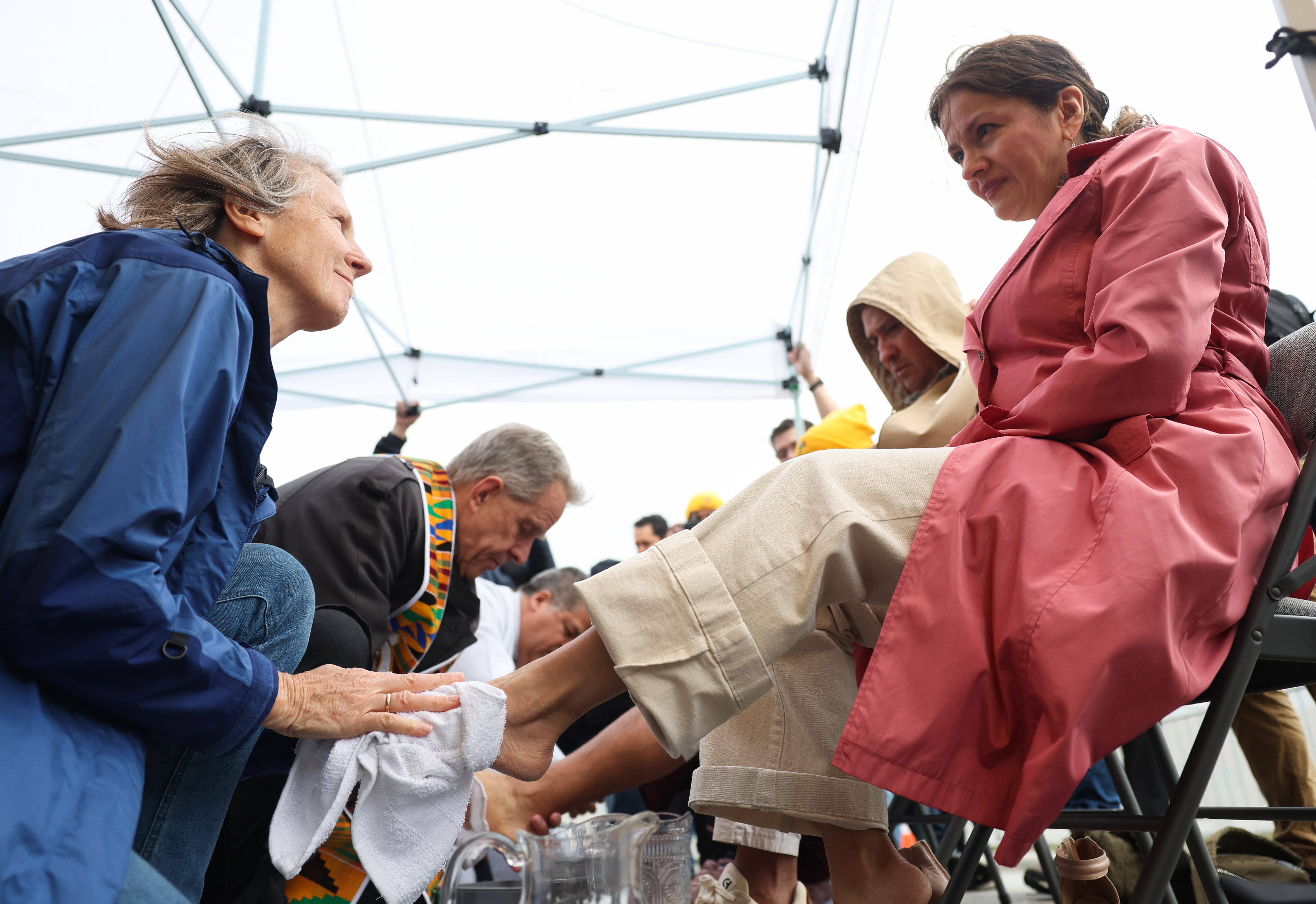




With the wind whipping by over the hum of Lenten hymns, community members sat outside Broadview’s U.S. Immigration and Customs Enforcement facility on Thursday and had their feet washed.
Inside the building, more than a dozen detainees did the same.
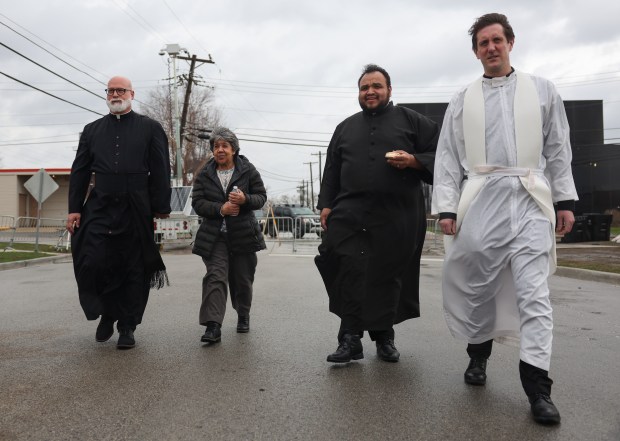
Amid an ongoing court battle over clergy access to the west suburban ICE facility, Catholic ministers entered the building and, in the traditional Holy Thursday ritual, washed the feet of 14 detainees. The access comes after a federal judge earlier this week allowed clergy members from the Chicago area to minister to migrants in the facility during Holy Week and Easter.
“This was a moment of light in a time of so much darkness,” the Rev. David Inczauskis, a priest with the Society of Jesus at Loyola University Chicago and one of the four ministers who provided pastoral care to detainees on Thursday, said to reporters after entering the facility.
Since last year, religious leaders have been trying to provide regular pastoral care at the facility, something they say they’d been granted access to do for years, but in the months leading up to and since Operation Midway Blitz — the Trump administration’s immigration crackdown in Chicago last fall and early winter — they have been denied. In November, the Coalition for Spiritual and Public Leadership, a Chicago-based Catholic advocacy group, filed a lawsuit against the federal government seeking resumed access.
The complaint came shortly after a class-action lawsuit alleged broader human rights violations in the processing center, arguing that the Trump administration turned the facility into a “black box” with immigration attorneys unable to visit clients amid overcrowding and other substandard conditions.
Three months into faith leaders’ legal battle, they were allowed back inside the facility in February for Ash Wednesday after a court order granted limited access. Similarly, U.S. District Judge Robert Gettleman on Tuesday ordered the Trump administration to again allow clergy members inside — over the federal government’s objection — but limited the mandate to Thursday through Sunday.
Gettleman urged the government to find ways to reach a settlement that would enable ongoing access, consistent with what has historically been the regular practice.
Ministers on Thursday spent more than an hour inside the facility as they prayed, offered Holy Communion and washed feet. Meanwhile, just outside, worship continued, as faith leaders and community members took part in a Holy Thursday service of their own.
The Holy Thursday foot-washing ceremony is a hallmark of every Holy Week, a period of worship in Christianity leading up to Easter Sunday. Thursday’s liturgy recalls the foot-washing Jesus performed on his 12 apostles at the Last Supper together before he was crucified.
In Broadview, a few dozen gathered to commemorate the ritual outside alongside detainees. Though afternoon storms made for a blustery service, worshippers huddled underneath pop-up canopies, where they sang hymns, read Scripture and saw the ceremony through on metal folding chairs.
Riverside resident Kate Williams and her 9-year-old daughter commemorate Holy Thursday together every year, whether it’s at a church or at home. It was an honor to continue the tradition this year in solidarity with detainees, Williams said.
“It is more important now than ever that we literally come to the streets,” she said, “and we celebrate with not only those who are free but those who are still imprisoned.”
Williams had also flocked to Broadview on Ash Wednesday. She said she admires that faith leaders are staying attentive to detainees’ needs, despite pushback.
Priscilla Pena was one of the first people who stepped up to have her feet washed outside the facility on Thursday. As the daughter of an immigrant, the 23-year-old said it meant a lot to her to be a part of the ceremony.
“I know the sacrifice that they have to make to come here to find a better life,” she said. “It really hits close to home.”
The Associated Press contributed.