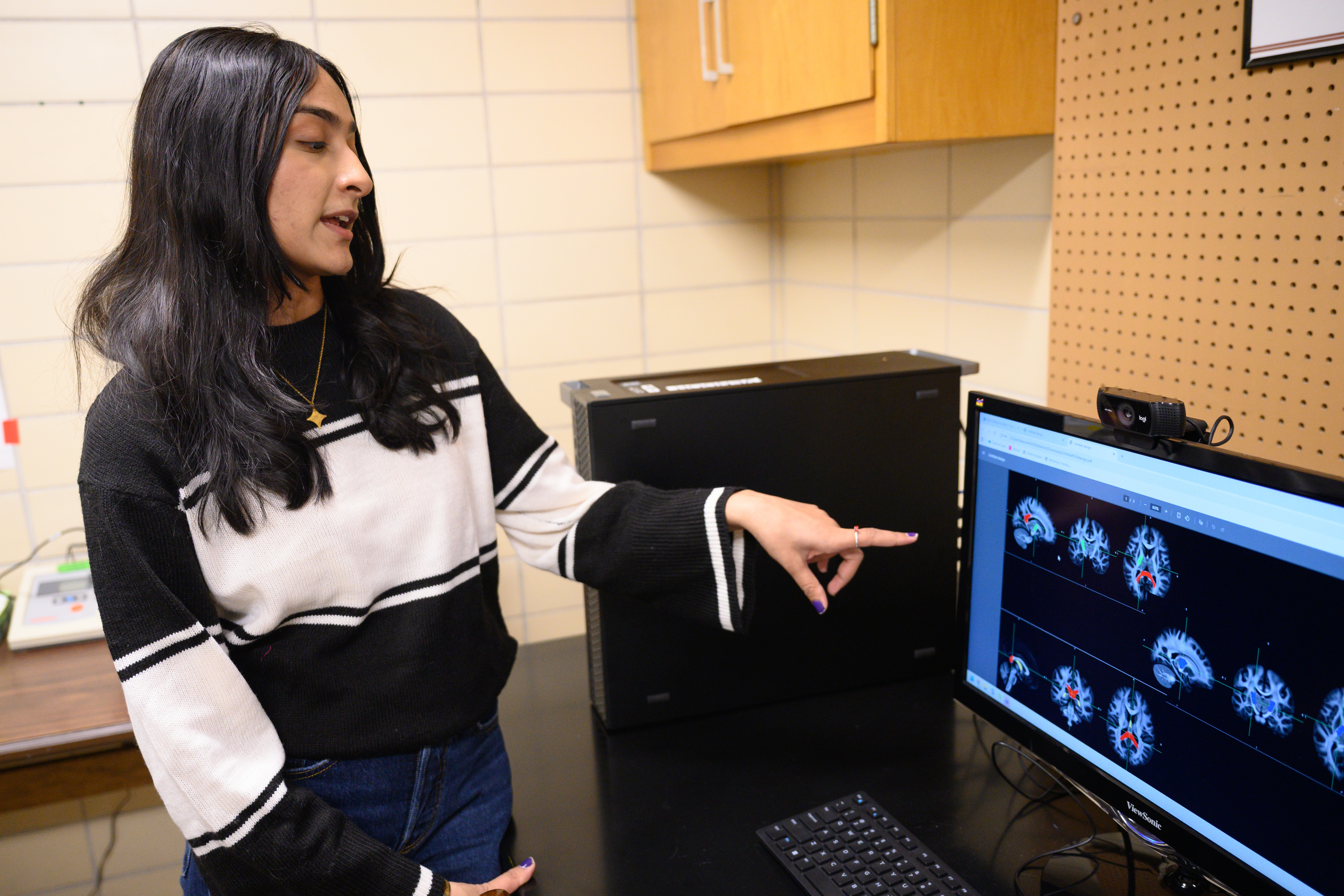

When it was time for her to go to college, Mina Mahmood was always interested in neuroscience.
“The biggest reason is because of my dad,” said Mahmood, a junior neuroscience major at Indiana University Northwest. “My dad has a cognitive disorder that has, unfortunately, made him disabled for the past 15 or so years of my life.”

Mahmood grew up going to doctors’ appointments with her dad, and she watched his memory decline as she grew up.
“It’s always been really interesting to me,” Mahmood said. “It’s made me want to learn more about how I can help him.”
Mahmood’s interest in neuroscience led her to Indianapolis in summer 2025, where she helped with student research into early detection of Alzheimer’s disease. She was part of a Datawiz-IN, a student research project that promotes health data science and artificial intelligence.
According to the Alzheimer’s Association website, Alzheimer’s disease is a type of dementia that affects memory, thinking and behavior, and when severe, symptoms can interfere with daily tasks.

Mahmood discovered the program through her involvement in IUN’s student government, she said. Initially, she was told that only students in the Indianapolis region participate, but she got in contact with someone in the program and got approval to join.
“Basically, what it aims to do is give students the opportunity to have different concentrations of biomedical research there,” Mahmood said. “I applied, and I explained some of my interests, and the program matched me with the Alzheimer’s research opportunity there.”
Maureen Rutherford, IUN associate professor of psychology, gave a support letter for Mahmood and checked in with her before presenting findings at Regionals at the Rotunda, an IU event that highlights research from IU regional campuses.
“I’m kind of more of her on-campus support,” Rutherford said. “All of the work, all the research itself, that was in (Indianapolis).”
Mahmood researched a less invasive way to diagnose and detect Alzheimer’s disease. She pulled data from a Korean dataset, which included statistics on blood tests from patients in South Korean hospitals over a 10-year period.

“Our job was to see if the genes that are in those blood samples are associated with Alzheimer’s disease risk,” Mahmood said. “After doing all of that data analysis, we found that there was a statistical significance with the transcriptional risk score.”
Mahmood also worked with PhD fellows on the study, but she was the only undergraduate student involved, she said. She would research statistics and complete analysis Monday through Wednesday each week, and on Fridays, they would get together and present findings during the two-month program.
“Because I was the only undergraduate student, I expected that they were going to make things easy for me,” Mahmood said. “They basically gave me the same course load as the other people there, and they expected me to figure it out. It was rough at first, but I did it, and it was good.”
Rutherford is proud to see how successful Mahmood was throughout the summer program. She likes to see students on regional campuses succeed, even if they might not have the same resources as other schools in the IU system.
“I think that’s one of the really great benefits of the system,” Rutherford said. “We can access those resources and also show the caliber of our students and that they can thrive in these high-intensity research programs because of the foundations that they’ve gotten here.”
mwilkins@chicagotribune.com