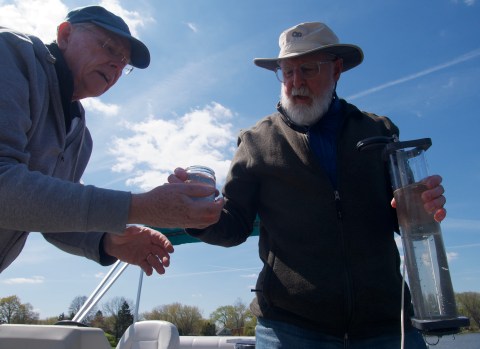

A pontoon boat quietly hums across the 75-acre Loch Lomond in Mundelein on a sunny but chilly day, coming to rest along a bobbing yellow buoy.
Doug Johnson and Gerry Munley take out an unusual piece of equipment — a clear plastic tube with cap mechanisms on each end — and lower it into the water by a line.
The caps are snapped shut, and Munley reels it back up, then pours the water into a sample jar. It will be used to measure phosphate levels in the water, which can cause damaging algae blooms.
“This looks pretty clear,” Munley says. “Almost drinkable.”
“I don’t know if I’d go that far,” Johnson responds, laughing.
The pair are just two of a quickly growing army of volunteers helping monitor lakes across the county, as Lake County Lake Lovers, a working group of nonprofit Global Water Works, expands its efforts.
Lake Lovers launched its lake health monitoring program in 2025 with a dozen lakes, aiming to help residents take better care of the county’s many “orphan lakes,” as co-chair Becky Sawle described them.

“They need someone to adopt them and start to rally people around their local lakes, to say ‘Hey we care about our lake,’” Sawle said.
With about 70% of Lake County’s more than 170 lakes considered impaired by the Environmental Protection Agency, Lake Lovers considers data collection critical to addressing the water health issues.
The group’s efforts have proven popular. This year saw all 12 lakes return, with an additional nine joining for 2026. Last year, the group boasted about 160 members. This year, that’s risen to nearly 500.
Illinois manufacturer Xylem, which donated the group’s monitoring equipment last year, agreed to donate a second set to allow Lake Lovers to expand their efforts. All told, Xylem has provided about $25,000 in free equipment, according to a Lake Lovers news release.
Sawle said they learned a lot from last year’s pilot program, which garnered “a lot of positive feedback” from the group’s scientific panel.
Between mid-April and mid-October, the equipment is on rotation between volunteers trained on how to take measurements. They receive the wagon of equipment, go out and collect data, then deliver it to the next volunteer group the following day.

“Imagine a relay race, but instead of handing off a baton between runners, in this case they are the lake teams, and what we’re handing off is a wagon full of expensive professional water quality monitoring equipment,” Sawle said.
There’s a “palpable excitement” from volunteers during training, she said. Most lakes don’t have well-funded groups measuring water quality, meaning they are running blind without data. While the data Lake Lovers is collecting “wouldn’t hold up in a court of law,” it’s high-caliber enough to start making treatment decisions, Sawle said.
Paul Spiewak, the group’s water quality lead, said they’ve seen “explosive growth” built off the “tremendous success” of the pilot program. Volunteers are “drawn to the work,” he said.
With Lake County’s long farming history, there’s a century of phosphorus buildup in sediments at many lakes, which can be released in the summer and cause toxic algae blooms.
There are various techniques for reducing phosphorus and restoring lakes, and the group’s data is concrete evidence that advocates can point to when talking with residents and lake stakeholders about what the issues are, or provide a better idea of what methods to utilize.
It can also give a greater understanding of the lake’s health over several years, and compare before and after treatment. Lake Lovers makes its data public.
“It’s education to action,” Spiewak said.
While some of the group’s volunteers include people with science backgrounds, such as Munley, “everyone has a place,” Sawle said. She’s learned a lot since joining, and said it was more about taking responsibility for the health of their lakes.
“The magic lake fairy isn’t coming; our government agencies probably don’t have the resources to fix things. It’s our volunteers, it’s our local communities, and by coming together, we can start to influence change,” Sawle said.