
On any given day of the week, Nadia Ali will see her relatives posting their drinks from Arwa Yemeni Coffee on social media.
Although Ali, 30, does not understand the appeal of posting a midday coffee photo online, she does understand the appeal of places like Arwa, located off Route 59 in Naperville. Warm atmosphere. Enticing scents. Coffee that she described as “soft tasting yet very refreshing.”
“Everything is made fresh and right in front of the eyes,” she said on a recent Wednesday morning.
It’s a welcome addition to her hometown, which she noted has changed drastically over time.
“In a time span of the past five years, my god, (Route 59) has become a hub of coffee shops, big restaurants, franchises — it’s always about getting into something new,” she said. “It has just become a hub for teenagers, all kinds of ages.”

Part of that changing Route 59 is a cluster of Yemeni and Arab coffee shops all located within a few miles of each other, serving everything from freshly brewed pistachio lattes and Adeni chai — sweet Yemeni milk tea infused with spices like cardamom and cinnamon — to baklava and Biscoff milk cakes.
But the boom isn’t limited to the Naperville area.
Cities across the U.S., from New York to Dallas, are seeing a rise in Yemeni, Arab and Muslim-owned coffee shops. Unlike typical American cafes, many of these stay open late into the evening. On weekdays, that’s usually until 10 or 11 p.m. On weekends, it can be as late as 1 a.m.
“Friday night, Saturdays, Sundays … people are looking to party, go to clubs, go to bars, hang out. We Muslims don’t do that because it’s against our religion to drink,” said Aqib Shazzad, managing partner and owner of the Naperville and Lombard locations for coffee shop Muslims of the World. “These coffee shops are a nice, healthy way for the community to come (and) enjoy time with friends and family.”
And their appeal extends beyond the Muslim community, shop owners and experts say.

“I think that all Americans are looking for a third space like this,” said Sally Howell, a professor of history at the University of Michigan-Dearborn. “They’re different from some of the national coffee chains, which have really come to emphasize speed of service and not necessarily to provide a comfortable place for people to sit and hang out anymore.”
Howell, who studies Arab American history, pointed to Qahwah House in Dearborn, Michigan, as being responsible for kickstarting the rise of these types of coffee shops. When Ibrahim Alhasbani, who comes from a long line of Yemeni coffee makers, opened the first Qahwah House location in 2017, it was the first coffee shop of its kind.
“They serve coffee in a number of distinctive ways, like they season it with a lot of spices. And one of the ways they prepare it is they cook the hull of the coffee instead of the bean,” Howell said.
The initial intent of Qahwah House, she said, was to elevate and celebrate Yemeni culture within Dearborn, which is home to one of the largest Arab American enclaves in the U.S. A second Qahwah House opened in suburban Lombard in 2021, setting off a wave of new Yemeni coffee shops across the Chicago area.
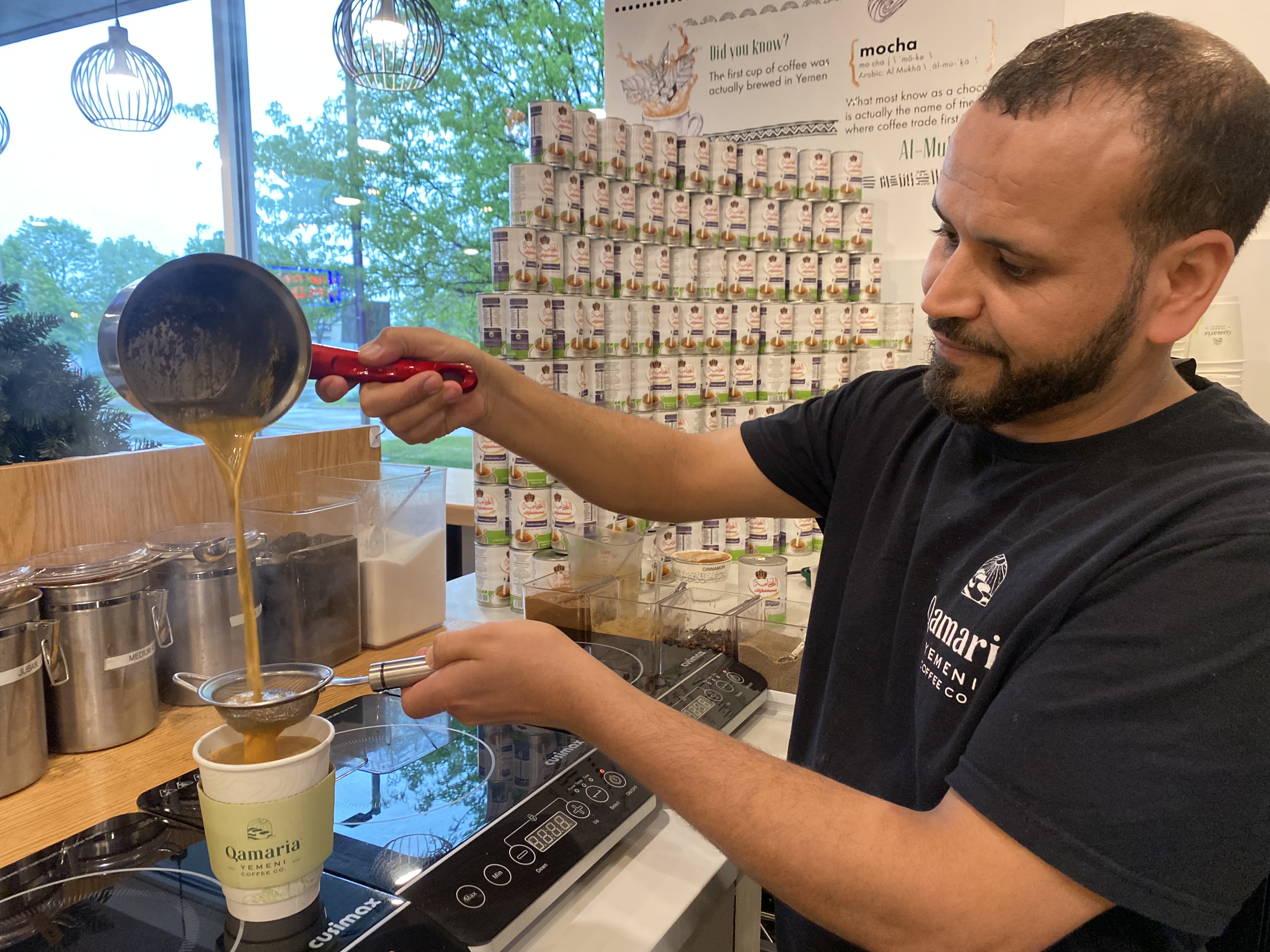
In the past three years, more of these coffee shops have started to open along the Route 59 corridor, many of them chains that originated in other cities. When Taha Monasar opened a Qamaria Yemeni Coffee location in 2023 on the border of Aurora and Naperville, he said there were no other coffee shops like his in the area.

“It was a good fit for the community because it was something different,” said Monasar, a convenience store owner from Bridgeview who owns other Qamaria locations.
He believes part of what helped him stand out was the quality of the drinks. All of Qamaria’s coffee is single origin, sourced from the Haraz mountains in Yemen. Many of his customers, he said, not only rave about how good the coffee is but are surprised to learn that the first cup of coffee was brewed in Yemen.
Monasar wasn’t alone in seeing potential in the Yemeni coffee business. Multiple shops similar to Qamaria — including Haraz Coffee House, Delah Coffee, Muslims of the World and Arwa Yemeni Coffee — have opened along the corridor in the past two years. A new shop, Shibam Coffee, is set to open in the area at the end of May.
Aziz Khan, who owns multiple Arwa Yemeni Coffee locations in the Chicago area, opened one in Naperville last year. He had never run a coffee business before but knew he had to bring the brand to Illinois after he was blown away by the Adeni chai he tried from Arwa in Dallas in 2022.
Now, he has come to appreciate the coffee shop as much more than just a business.

“In Yemen, coffee isn’t just a morning ritual. It acts as a kind of social glue. It brings the community together,” he said. “We are open late at night to serve people. It becomes like a hub.”
And it’s not just the drinks and late night hours that give it that community feel. Everything in Arwa is designed with intention.
Cushiony Middle Eastern communal seating encourages conversation among guests. Lights hanging from the ceiling mimic the hats worn by coffee farmers in Yemen. At the center of the shop is an abstract rendering of a Dragon’s Blood Tree, a plant native to Yemen’s Socotra Island known for its mushroom-like canopy and dark red, blood-like sap.
“We want people to feel welcomed and to feel at home,” said Faris Almatrahi, co-founder of Arwa Yemeni Coffee. “We as a society, here in the U.S., have become so individualistic that we no longer have that communal, tribal family structure anymore. … We want to create that safe space where they can come and meet new people, even if it’s just over a cup of coffee.”
That sense of openness many of these shops embrace is also introducing people to cultures they may not have known much about otherwise.

“I’ve had people say they were afraid to come in at first … and now they’re bringing their friends,” Shazzad said.
For him, that visibility is what matters most.
“We live in the same area … maybe you didn’t know I was Muslim or didn’t know about my heritage, and now you do,” he said. “I feel like even the local impact has been great.”
cstein@chicagotribune.com