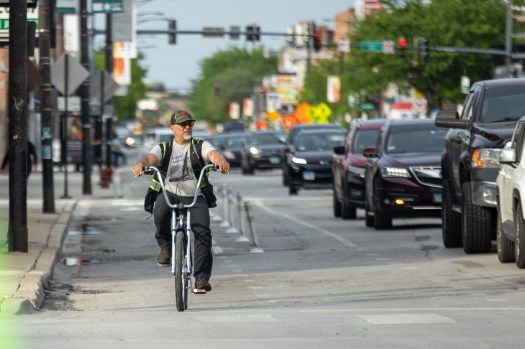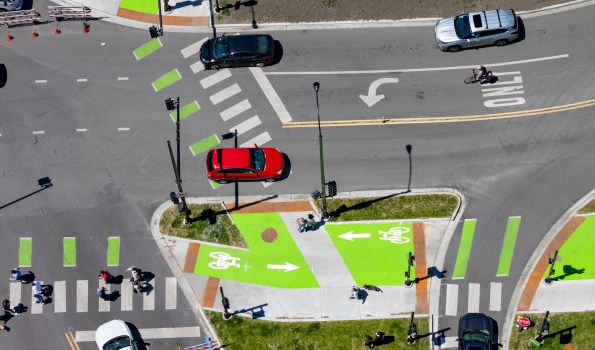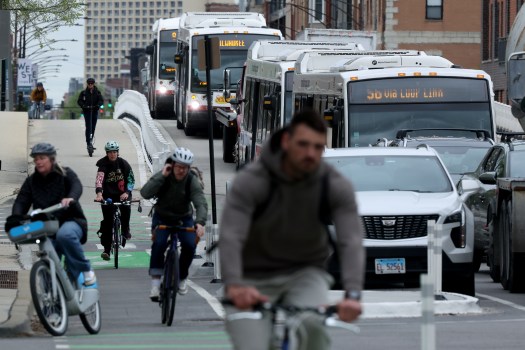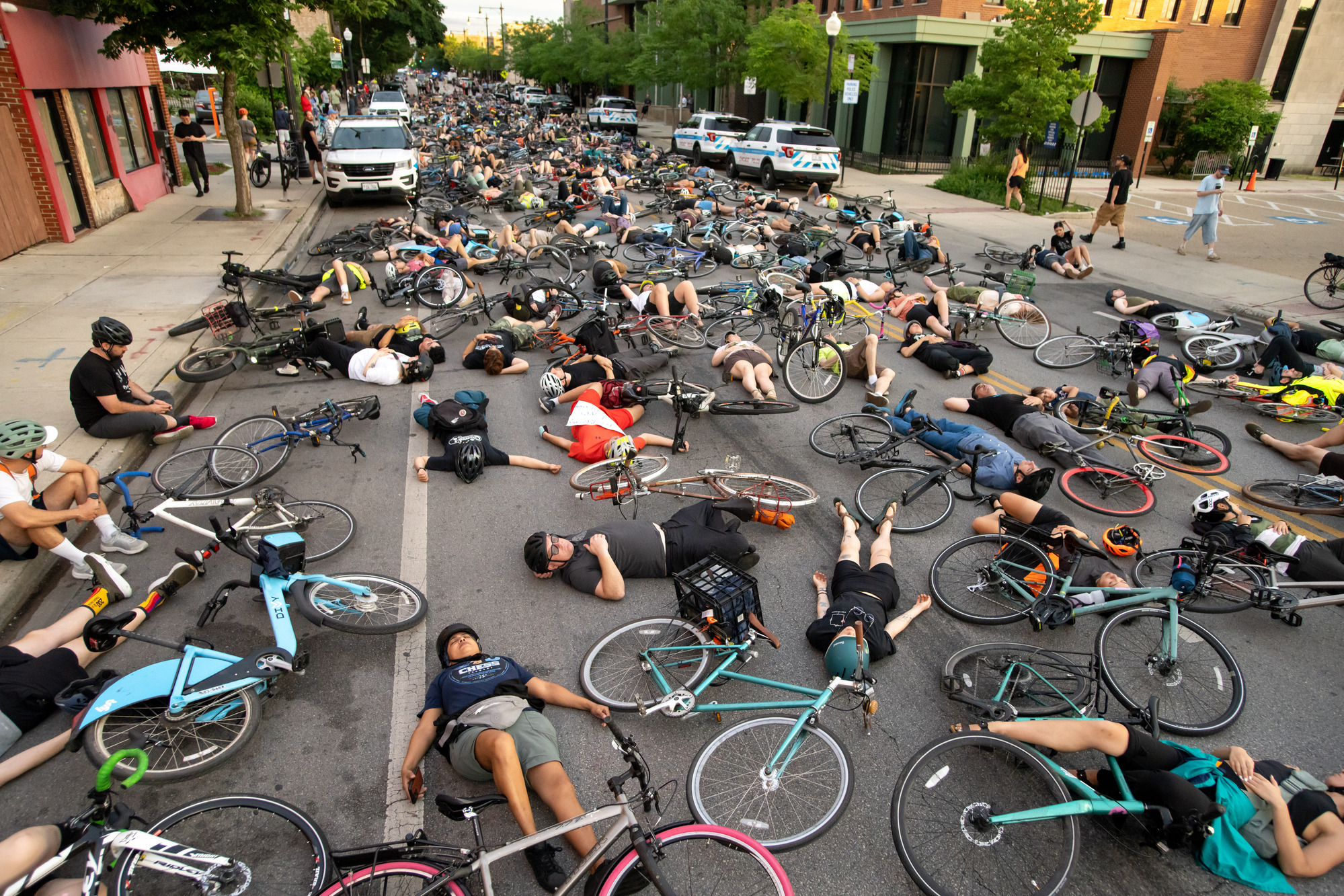

As one of the hundreds of people who attended the vigil last Monday night for cyclist and beloved city planner Riley O’Neil, I was deeply saddened by how familiar it felt (“Riley O’Neil, bicyclist killed in Bridgeport crash, remembered at vigil,” June 10)
Nearly every person who gathered at Palmisano Park to honor Riley could share a story of somebody close to them who had been injured or killed in a crash. And nearly every person understood that the unlicensed, uninsured, illegally parked driver who “doored” Riley into traffic could have easily done the same to any of us.
Another reason last week’s vigil felt familiar is because, earlier this spring, a similarly large group of loved ones rallied at the corner of 63rd and Kedzie to demand justice for 18-year-old Damian Gomez, who was killed by a reckless driver while delivering food on his bike on Easter weekend.
Several weeks after that, Chicago cyclists gathered for their annual Ride of Silence to honor people killed on our roadways — an event that has taken place for 24 years, and that has never had a shortage of riders to remember or families to console.
And now we have yet another vigil to attend, and yet another loss to mourn.
Because of our unique vulnerability on the roads, traffic safety is an issue that many cyclists feel strongly about. But make no mistake: This is an issue that affects everybody.
Across Chicago’s Southwest Side — which is dominated by heavy truck traffic and wide roads that practically invite speeding — vehicle crashes amount to an urgent crisis. During the five-year stretch from 2020 to 2024 (the latest data available from the city), we experienced crashes that killed or seriously injured somebody that were comparable in number to the shootings that killed or seriously injured somebody. In my neighborhood of Archer Heights, we experienced many more fatal crashes than homicides.
Riley made it his life’s work to address this crisis by creating safer streets for everybody: drivers, pedestrians, public transit users and his own joyful community of cyclists. We should continue that work in his honor, so maybe the next vigil won’t feel quite so familiar.
— Dixon Galvez-Searle, founding member and transit advocacy steward, The Southwest Collective
CPS decision hurts my students
It should come as no surprise that teaching in Chicago Public Schools is hard. Teachers work well beyond our contracted hours — planning, grading and contending with truly gut-wrenching circumstances — all for the love of our students and the core belief that every single child deserves a fair shot.
This is why I am distraught by CPS’ sudden announcement that all eighth graders must now complete the 2.5-hour, English-only PreACT 9 to compete for limited spots in our city’s top-performing high schools. I teach eighth-grade newcomer English learners (ELs) who are working through the immense changes and challenges of immigration, including armed and unrestrained federal agents patrolling our school area, profiling and taking people at will. At times this school year, my Albany Park school even had to cancel recess due to federal agents flying helicopters so close to the building that my classroom windows would shake.
Even under these terrifying circumstances, what my eighth graders dreamed of most was attending the high school of their choice. I would remind them that what counted most was largely under their control: good grades and decent scores on the high school admissions exam. For the last couple of years, the test has been provided in six languages, allowing vital linguistic access to our more than 70,000 students learning English as a second language. Now CPS is closing the door to my students.
The joy and pride of any eighth grade teacher is to see their kids beaming at the news of getting into their top-choice school. But now, through a unilateral and callous action on behalf of CPS to change back to an English-only admissions exam, I know I’ll have far fewer kids accomplishing that dream — not because of low academics but solely because of their language. Where we open doors to welcome kids in, CPS seems to shut them again and again. With this regression, selective-enrollment high schools may as well have an “immigrants not welcome” sign posted across their front doors.
To make matters even worse, Chief Education Officer Dr. Karime Asaf wrote that students who completed the test in an alternate language performed lower than ELs who took it in English with accommodations. Without citing evidence, the district is arguing that offering additional languages actually hurt our students’ performance.
Again, educators and students suffer under another top-down, one-size-fits-all model that only serves to further disenfranchise and marginalize our kids.
This teacher says: Enough!
— Gabriel Paez, bilingual middle school teacher, Chicago Public Schools
Spending discipline is needed
Glad to hear the Tribune Editorial Board prefers that the state stop tacking on new taxes (“So is Illinois’ social media tax going to take on Tinder? Nextdoor? Yelp? Yahoo?” June 12). The clear implication is that Illinois needs to get serious about managing spending, cutting waste and doing better with the billions it already collects.
I’m not optimistic that will happen with our leadership in Springfield or Chicago.
— Tom Nicholson, Hoffman Estates
Possibilities in redistricting
The June 9 editorial “Is the US redistricting war slowing down? Or is it an arms race with no foreseeable end?” got me thinking of the unintended consequences of redistricting battles. The editorial mentions that 10 states have followed through with the mid-decade remapping. It occurs to me that the scrambled maps in Texas, California, Missouri, Tennessee, Florida and others mean there are opportunities for both parties. There are incumbent representatives who are running in districts with new boundaries. Voters may not even know which district they live in anymore and who their representative are. This is the opposite of representative democracy.
These races could break either way, with potential surprises for both parties. Not sure that Texas Gov. Greg Abbott and California Gov. Gavin Newsom thought about the possibilities.
— Raymond Peterman, Glen Ellyn
Investigative journalism matters
Kudos to the Tribune on its article “Plastic surgeon case to be audited” in the June 8 edition. This is an example of the press doing its job in a thorough and fair manner. As a result of this reporting, some positive changes “to help accelerate the disciplinary process in similar cases” have happened.
Our press corps currently excels in pursuing and finding the truth in many difficult situations. It is my hope it will continue to do so.
However, there are forces afoot in our country that would try to control what our freedom of the press is all about. Please don’t let this happen. Our democracy depends on it.
Don’t let production moguls, powerful lobbies or even presidents dictate what can and cannot be printed or spoken. This Tribune article proves that when situations are honestly investigated and facts come to light, no matter who is the subject, change can happen for the good of all.
Keep up the good work, Tribune investigative reporters.
— Mary Herrick, Gilberts
A costly 13 minutes of parking
Chicago, thanks for a lovely visit. My wife and I had a great time visiting my former hometown a little more than a week ago. Except, we decided to drive downtown to visit the Art Institute on a Tuesday, not realizing it was closed that day. We parked in the Grant Park garage. We walked to the museum and returned to the garage.
Total elapsed time: 13 minutes. Total charge: $46. Thanks, Chicago!
— Mark Litwin, Larkspur, California
Submit a letter, of no more than 400 words, to the editor here or email letters@chicagotribune.com.